

52
H. Oka
The difference from Fig. 3.5a is that intermediate adiabatic potential is not modified
and the central energy k 0 of incident photons is resonant to those of the intermediate
vibronic states |m ν , and hence the intermediate vibrational modes are really excited.
The sum of the central energy, 2k 0 ≈ 4.0024 eV, is resonant to the excited state with
the vibrational mode of ν
= 18 as is the case for the two-photon absorption. The
Franck–Condon factors of F ν and F ν,ν are shown in Fig. 3.7b, c. We use entangled
and uncorrelated photons with pulse width of σ = 10 THz and σ s characterizing the
quantum correlation is set to σ s = 500 GHz. The dipole relaxation rates γ m = γ e = 6
MHz are chosen, for simplicity.
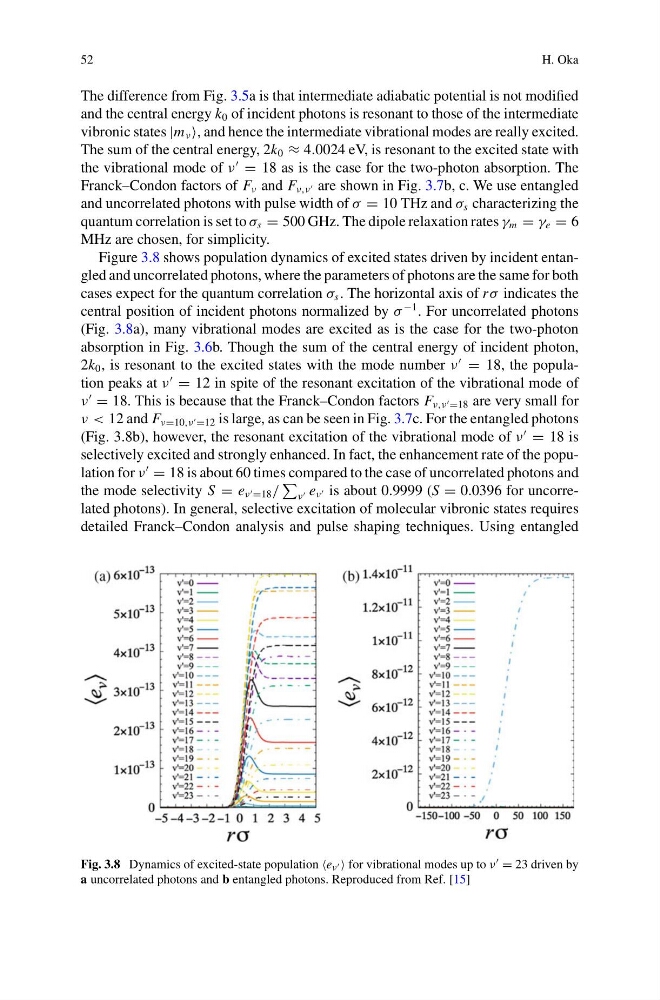
Figure 3.8 shows population dynamics of excited states driven by incident entangled and uncorrelated photons, where the parameters of photons are the same for both
cases expect for the quantum correlation σ s . The horizontal axis of r σ indicates the
central position of incident photons normalized by σ
−1 . For uncorrelated photons
(Fig. 3.8a), many vibrational modes are excited as is the case for the two-photon
absorption in Fig. 3.6b. Though the sum of the central energy of incident photon,
2k 0 , is resonant to the excited states with the mode number ν
= 18, the population peaks at ν
= 12 in spite of the resonant excitation of the vibrational mode of
ν
= 18. This is because that the Franck–Condon factors F ν,ν =18 are very small for
ν < 12 and F ν=10,ν =12 is large, as can be seen in Fig. 3.7c. For the entangled photons
(Fig. 3.8b), however, the resonant excitation of the vibrational mode of ν
= 18 is
selectively excited and strongly enhanced. In fact, the enhancement rate of the population for ν
= 18 is about 60 times compared to the case of uncorrelated photons and
the mode selectivity S = e ν =18 /
ν e ν is about 0.9999 (S = 0.0396 for uncorrelated photons). In general, selective excitation of molecular vibronic states requires
detailed Franck–Condon analysis and pulse shaping techniques. Using entangled
Fig. 3.8 Dynamics of excited-state population e ν for vibrational modes up to ν = 23 driven by
a uncorrelated photons and b entangled photons. Reproduced from Ref. [15]
H. Oka
The difference from Fig. 3.5a is that intermediate adiabatic potential is not modified
and the central energy k 0 of incident photons is resonant to those of the intermediate
vibronic states |m ν , and hence the intermediate vibrational modes are really excited.
The sum of the central energy, 2k 0 ≈ 4.0024 eV, is resonant to the excited state with
the vibrational mode of ν
= 18 as is the case for the two-photon absorption. The
Franck–Condon factors of F ν and F ν,ν are shown in Fig. 3.7b, c. We use entangled
and uncorrelated photons with pulse width of σ = 10 THz and σ s characterizing the
quantum correlation is set to σ s = 500 GHz. The dipole relaxation rates γ m = γ e = 6
MHz are chosen, for simplicity.
Figure 3.8 shows population dynamics of excited states driven by incident entangled and uncorrelated photons, where the parameters of photons are the same for both
cases expect for the quantum correlation σ s . The horizontal axis of r σ indicates the
central position of incident photons normalized by σ
−1 . For uncorrelated photons
(Fig. 3.8a), many vibrational modes are excited as is the case for the two-photon
absorption in Fig. 3.6b. Though the sum of the central energy of incident photon,
2k 0 , is resonant to the excited states with the mode number ν
= 18, the population peaks at ν
= 12 in spite of the resonant excitation of the vibrational mode of
ν
= 18. This is because that the Franck–Condon factors F ν,ν =18 are very small for
ν < 12 and F ν=10,ν =12 is large, as can be seen in Fig. 3.7c. For the entangled photons
(Fig. 3.8b), however, the resonant excitation of the vibrational mode of ν
= 18 is
selectively excited and strongly enhanced. In fact, the enhancement rate of the population for ν
= 18 is about 60 times compared to the case of uncorrelated photons and
the mode selectivity S = e ν =18 /
ν e ν is about 0.9999 (S = 0.0396 for uncorrelated photons). In general, selective excitation of molecular vibronic states requires
detailed Franck–Condon analysis and pulse shaping techniques. Using entangled
Fig. 3.8 Dynamics of excited-state population e ν for vibrational modes up to ν = 23 driven by
a uncorrelated photons and b entangled photons. Reproduced from Ref. [15]