

3 Enhanced and Selective Two-Photon Excitation of Molecular …
51
excitation of molecular vibration. Though the sum of the central energy of incident
photon, 2k 0 , is resonant to the excited states with mode number ν = 18, population peaks at ν = 16. This is because that incident pulse is spectrally broad and
the value of Franck–Condon factor for ν = 16 is larger than that for ν = 18. For
untangled photons (Fig. 3.6b), however, the vibration mode resonant to k 0 is efficiently and selectively excited, and the excitations of other vibrational modes are
strongly suppressed. The enhancement rate of the population for ν = 18 is about
15 times compared to the case of uncorrelated photons and the mode selectivity
S = e ν=18 /
ν e ν is about 0.97. Thus, entangled photons can concurrently achieve
high selectivity and enhancement of excitation population.
By using entangled photons with broader pulse width σ and stronger quantum
correlation σ s → 0, we can further increase the enhancement rate and mode
selectivity. In fact, more than thousandfold enhancement and mode selectivity of
S ≈ 0.9999 have been theoretically predicted for atoms and molecules [17, 18] when
ultrabroadband frequency-entangled photons are used. In addition, further enhancement of population excitation by utilizing plasmonic nanoantenna is also theoretically predicted [19]. Since an ultrabroadband frequency-entangled photon source is
already realized [20], experimental demonstration of huge two-photon absorption of
molecules might be reported in the near future.
3.4 Enhanced and Selective Two-Step Excitation Utilizing
Entangled Photons
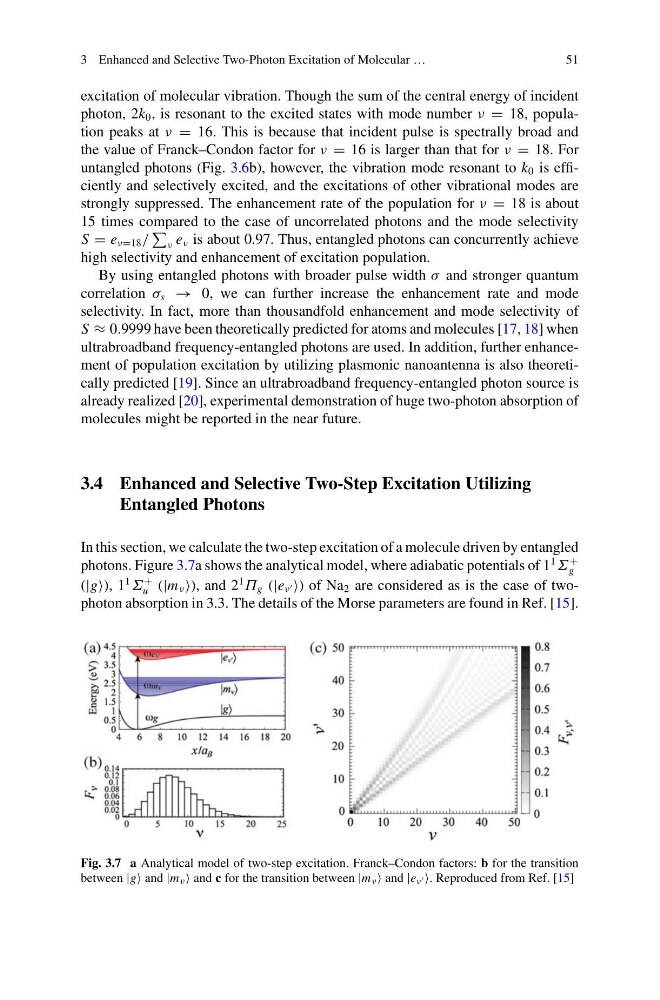
In this section, we calculate the two-step excitation of a molecule driven by entangled
photons. Figure 3.7a shows the analytical model, where adiabatic potentials of 1
1
Σ
+
g
(|g), 1
1
Σ
+
u (|m ν ), and 2
1
Π g (|e ν ) of Na 2 are considered as is the case of twophoton absorption in 3.3. The details of the Morse parameters are found in Ref. [15].
Fig. 3.7 a Analytical model of two-step excitation. Franck–Condon factors: b for the transition
between |g and |m ν and c for the transition between |m ν and |e ν . Reproduced from Ref. [15]
51
excitation of molecular vibration. Though the sum of the central energy of incident
photon, 2k 0 , is resonant to the excited states with mode number ν = 18, population peaks at ν = 16. This is because that incident pulse is spectrally broad and
the value of Franck–Condon factor for ν = 16 is larger than that for ν = 18. For
untangled photons (Fig. 3.6b), however, the vibration mode resonant to k 0 is efficiently and selectively excited, and the excitations of other vibrational modes are
strongly suppressed. The enhancement rate of the population for ν = 18 is about
15 times compared to the case of uncorrelated photons and the mode selectivity
S = e ν=18 /
ν e ν is about 0.97. Thus, entangled photons can concurrently achieve
high selectivity and enhancement of excitation population.
By using entangled photons with broader pulse width σ and stronger quantum
correlation σ s → 0, we can further increase the enhancement rate and mode
selectivity. In fact, more than thousandfold enhancement and mode selectivity of
S ≈ 0.9999 have been theoretically predicted for atoms and molecules [17, 18] when
ultrabroadband frequency-entangled photons are used. In addition, further enhancement of population excitation by utilizing plasmonic nanoantenna is also theoretically predicted [19]. Since an ultrabroadband frequency-entangled photon source is
already realized [20], experimental demonstration of huge two-photon absorption of
molecules might be reported in the near future.
3.4 Enhanced and Selective Two-Step Excitation Utilizing
Entangled Photons
In this section, we calculate the two-step excitation of a molecule driven by entangled
photons. Figure 3.7a shows the analytical model, where adiabatic potentials of 1
1
Σ
+
g
(|g), 1
1
Σ
+
u (|m ν ), and 2
1
Π g (|e ν ) of Na 2 are considered as is the case of twophoton absorption in 3.3. The details of the Morse parameters are found in Ref. [15].
Fig. 3.7 a Analytical model of two-step excitation. Franck–Condon factors: b for the transition
between |g and |m ν and c for the transition between |m ν and |e ν . Reproduced from Ref. [15]