

3 Enhanced and Selective Two-Photon Excitation of Molecular …
53
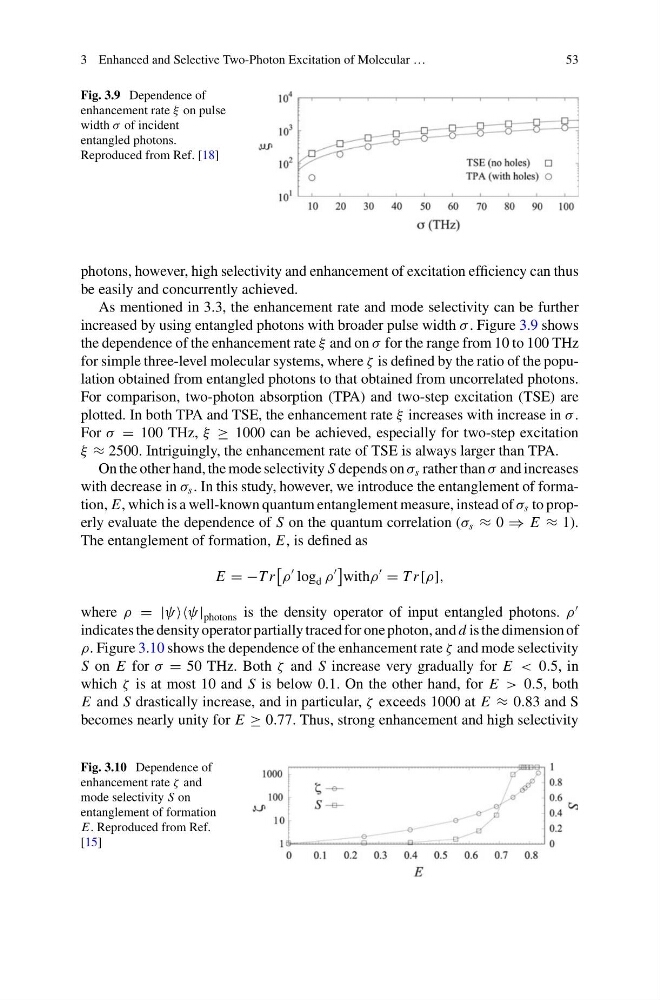
Fig. 3.9 Dependence of
enhancement rate ξ on pulse
width σ of incident
entangled photons.
Reproduced from Ref. [18]
photons, however, high selectivity and enhancement of excitation efficiency can thus
be easily and concurrently achieved.
As mentioned in 3.3, the enhancement rate and mode selectivity can be further
increased by using entangled photons with broader pulse width σ . Figure 3.9 shows
the dependence of the enhancement rate ξ and on σ for the range from 10 to 100 THz
for simple three-level molecular systems, where ζ is defined by the ratio of the population obtained from entangled photons to that obtained from uncorrelated photons.
For comparison, two-photon absorption (TPA) and two-step excitation (TSE) are
plotted. In both TPA and TSE, the enhancement rate ξ increases with increase in σ .
For σ = 100 THz, ξ ≥ 1000 can be achieved, especially for two-step excitation
ξ ≈ 2500. Intriguingly, the enhancement rate of TSE is always larger than TPA.
On the other hand, the mode selectivity S depends on σ s rather than σ and increases
with decrease in σ s . In this study, however, we introduce the entanglement of formation, E, which is a well-known quantum entanglement measure, instead of σ s to properly evaluate the dependence of S on the quantum correlation (σ s ≈ 0 ⇒ E ≈ 1).
The entanglement of formation, E, is defined as
E = −T r
ρ
log d ρ
withρ
= T r[ρ],
where ρ = |ψψ| photons is the density operator of input entangled photons. ρ
indicates the density operator partially traced for one photon, and d is the dimension of
ρ. Figure 3.10 shows the dependence of the enhancement rate ζ and mode selectivity
S on E for σ = 50 THz. Both ζ and S increase very gradually for E < 0.5, in
which ζ is at most 10 and S is below 0.1. On the other hand, for E > 0.5, both
E and S drastically increase, and in particular, ζ exceeds 1000 at E ≈ 0.83 and S
becomes nearly unity for E ≥ 0.77. Thus, strong enhancement and high selectivity
Fig. 3.10 Dependence of
enhancement rate ζ and
mode selectivity S on
entanglement of formation
E. Reproduced from Ref.
[15]
53
Fig. 3.9 Dependence of
enhancement rate ξ on pulse
width σ of incident
entangled photons.
Reproduced from Ref. [18]
photons, however, high selectivity and enhancement of excitation efficiency can thus
be easily and concurrently achieved.
As mentioned in 3.3, the enhancement rate and mode selectivity can be further
increased by using entangled photons with broader pulse width σ . Figure 3.9 shows
the dependence of the enhancement rate ξ and on σ for the range from 10 to 100 THz
for simple three-level molecular systems, where ζ is defined by the ratio of the population obtained from entangled photons to that obtained from uncorrelated photons.
For comparison, two-photon absorption (TPA) and two-step excitation (TSE) are
plotted. In both TPA and TSE, the enhancement rate ξ increases with increase in σ .
For σ = 100 THz, ξ ≥ 1000 can be achieved, especially for two-step excitation
ξ ≈ 2500. Intriguingly, the enhancement rate of TSE is always larger than TPA.
On the other hand, the mode selectivity S depends on σ s rather than σ and increases
with decrease in σ s . In this study, however, we introduce the entanglement of formation, E, which is a well-known quantum entanglement measure, instead of σ s to properly evaluate the dependence of S on the quantum correlation (σ s ≈ 0 ⇒ E ≈ 1).
The entanglement of formation, E, is defined as
E = −T r
ρ
log d ρ
withρ
= T r[ρ],
where ρ = |ψψ| photons is the density operator of input entangled photons. ρ
indicates the density operator partially traced for one photon, and d is the dimension of
ρ. Figure 3.10 shows the dependence of the enhancement rate ζ and mode selectivity
S on E for σ = 50 THz. Both ζ and S increase very gradually for E < 0.5, in
which ζ is at most 10 and S is below 0.1. On the other hand, for E > 0.5, both
E and S drastically increase, and in particular, ζ exceeds 1000 at E ≈ 0.83 and S
becomes nearly unity for E ≥ 0.77. Thus, strong enhancement and high selectivity
Fig. 3.10 Dependence of
enhancement rate ζ and
mode selectivity S on
entanglement of formation
E. Reproduced from Ref.
[15]