

34 Crystallization Control of the Photoresponsible Diarylethene …
589
grating after 23 h later (Fig. 34.6e). This result was not consistent with the other
results.
Creation of crystal nucleus was found to depend on the conversion rate. A glass
transition temperature for 1c is known to be below a room temperature, and the
lowest melting point (T m ) is around a room temperature for 3:1-mixture of 1o and
1c [21]. 1c molecules are considered to align cooperatively at the lowest T m close to
a room temperature. Therefore, a creation of microcrystal nucleus may occur over
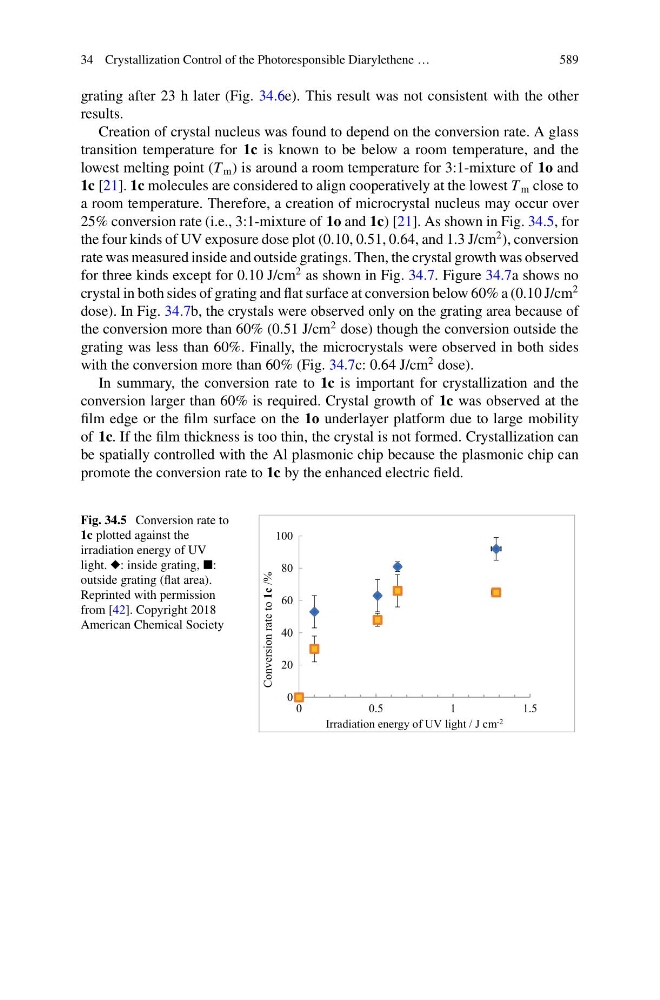
25% conversion rate (i.e., 3:1-mixture of 1o and 1c) [21]. As shown in Fig. 34.5, for
the four kinds of UV exposure dose plot (0.10, 0.51, 0.64, and 1.3 J/cm
2 ), conversion
rate was measured inside and outside gratings. Then, the crystal growth was observed
for three kinds except for 0.10 J/cm
2 as shown in Fig. 34.7. Figure 34.7a shows no
crystal in both sides of grating and flat surface at conversion below 60% a (0.10 J/cm
2
dose). In Fig. 34.7b, the crystals were observed only on the grating area because of
the conversion more than 60% (0.51 J/cm
2 dose) though the conversion outside the
grating was less than 60%. Finally, the microcrystals were observed in both sides
with the conversion more than 60% (Fig. 34.7c: 0.64 J/cm
2 dose).
In summary, the conversion rate to 1c is important for crystallization and the
conversion larger than 60% is required. Crystal growth of 1c was observed at the
film edge or the film surface on the 1o underlayer platform due to large mobility
of 1c. If the film thickness is too thin, the crystal is not formed. Crystallization can
be spatially controlled with the Al plasmonic chip because the plasmonic chip can
promote the conversion rate to 1c by the enhanced electric field.
Fig. 34.5 Conversion rate to
1c plotted against the
irradiation energy of UV
light. ◆: inside grating,
outside grating (flat area).
Reprinted with permission
from [42]. Copyright 2018
American Chemical Society
0
20
40
60
80
100
0
0.5
1
1.5
Conversion rate to 1c /%
Irradiation energy of UV light / J cm -2
589
grating after 23 h later (Fig. 34.6e). This result was not consistent with the other
results.
Creation of crystal nucleus was found to depend on the conversion rate. A glass
transition temperature for 1c is known to be below a room temperature, and the
lowest melting point (T m ) is around a room temperature for 3:1-mixture of 1o and
1c [21]. 1c molecules are considered to align cooperatively at the lowest T m close to
a room temperature. Therefore, a creation of microcrystal nucleus may occur over
25% conversion rate (i.e., 3:1-mixture of 1o and 1c) [21]. As shown in Fig. 34.5, for
the four kinds of UV exposure dose plot (0.10, 0.51, 0.64, and 1.3 J/cm
2 ), conversion
rate was measured inside and outside gratings. Then, the crystal growth was observed
for three kinds except for 0.10 J/cm
2 as shown in Fig. 34.7. Figure 34.7a shows no
crystal in both sides of grating and flat surface at conversion below 60% a (0.10 J/cm
2
dose). In Fig. 34.7b, the crystals were observed only on the grating area because of
the conversion more than 60% (0.51 J/cm
2 dose) though the conversion outside the
grating was less than 60%. Finally, the microcrystals were observed in both sides
with the conversion more than 60% (Fig. 34.7c: 0.64 J/cm
2 dose).
In summary, the conversion rate to 1c is important for crystallization and the
conversion larger than 60% is required. Crystal growth of 1c was observed at the
film edge or the film surface on the 1o underlayer platform due to large mobility
of 1c. If the film thickness is too thin, the crystal is not formed. Crystallization can
be spatially controlled with the Al plasmonic chip because the plasmonic chip can
promote the conversion rate to 1c by the enhanced electric field.
Fig. 34.5 Conversion rate to
1c plotted against the
irradiation energy of UV
light. ◆: inside grating,
outside grating (flat area).
Reprinted with permission
from [42]. Copyright 2018
American Chemical Society
0
20
40
60
80
100
0
0.5
1
1.5
Conversion rate to 1c /%
Irradiation energy of UV light / J cm -2