

588
K. Tawa et al.
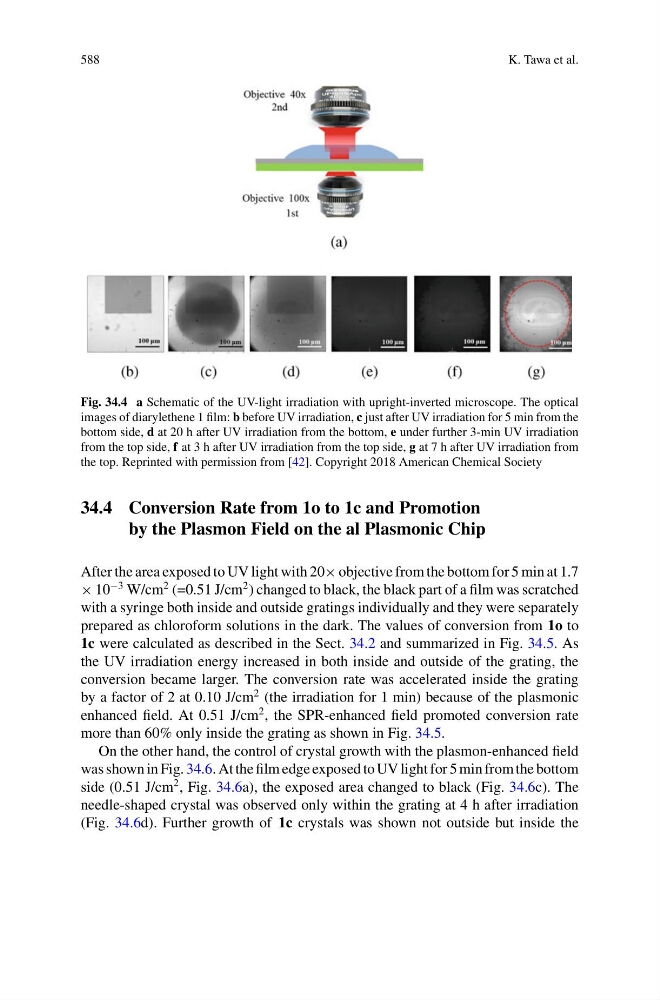
Fig. 34.4 a Schematic of the UV-light irradiation with upright-inverted microscope. The optical
images of diarylethene 1 film: b before UV irradiation, c just after UV irradiation for 5 min from the
bottom side, d at 20 h after UV irradiation from the bottom, e under further 3-min UV irradiation
from the top side, f at 3 h after UV irradiation from the top side, g at 7 h after UV irradiation from
the top. Reprinted with permission from [42]. Copyright 2018 American Chemical Society
34.4 Conversion Rate from 1o to 1c and Promotion
by the Plasmon Field on the al Plasmonic Chip
After the area exposed to UV light with 20× objective from the bottom for 5 min at 1.7
× 10
−3 W/cm
2 (=0.51 J/cm
2 ) changed to black, the black part of a film was scratched
with a syringe both inside and outside gratings individually and they were separately
prepared as chloroform solutions in the dark. The values of conversion from 1o to
1c were calculated as described in the Sect. 34.2 and summarized in Fig. 34.5. As
the UV irradiation energy increased in both inside and outside of the grating, the
conversion became larger. The conversion rate was accelerated inside the grating
by a factor of 2 at 0.10 J/cm
2 (the irradiation for 1 min) because of the plasmonic
enhanced field. At 0.51 J/cm
2 , the SPR-enhanced field promoted conversion rate
more than 60% only inside the grating as shown in Fig. 34.5.
On the other hand, the control of crystal growth with the plasmon-enhanced field
was shown in Fig. 34.6. At the film edge exposed to UV light for 5 min from the bottom
side (0.51 J/cm
2 , Fig. 34.6a), the exposed area changed to black (Fig. 34.6c). The
needle-shaped crystal was observed only within the grating at 4 h after irradiation
(Fig. 34.6d). Further growth of 1c crystals was shown not outside but inside the
K. Tawa et al.
Fig. 34.4 a Schematic of the UV-light irradiation with upright-inverted microscope. The optical
images of diarylethene 1 film: b before UV irradiation, c just after UV irradiation for 5 min from the
bottom side, d at 20 h after UV irradiation from the bottom, e under further 3-min UV irradiation
from the top side, f at 3 h after UV irradiation from the top side, g at 7 h after UV irradiation from
the top. Reprinted with permission from [42]. Copyright 2018 American Chemical Society
34.4 Conversion Rate from 1o to 1c and Promotion
by the Plasmon Field on the al Plasmonic Chip
After the area exposed to UV light with 20× objective from the bottom for 5 min at 1.7
× 10
−3 W/cm
2 (=0.51 J/cm
2 ) changed to black, the black part of a film was scratched
with a syringe both inside and outside gratings individually and they were separately
prepared as chloroform solutions in the dark. The values of conversion from 1o to
1c were calculated as described in the Sect. 34.2 and summarized in Fig. 34.5. As
the UV irradiation energy increased in both inside and outside of the grating, the
conversion became larger. The conversion rate was accelerated inside the grating
by a factor of 2 at 0.10 J/cm
2 (the irradiation for 1 min) because of the plasmonic
enhanced field. At 0.51 J/cm
2 , the SPR-enhanced field promoted conversion rate
more than 60% only inside the grating as shown in Fig. 34.5.
On the other hand, the control of crystal growth with the plasmon-enhanced field
was shown in Fig. 34.6. At the film edge exposed to UV light for 5 min from the bottom
side (0.51 J/cm
2 , Fig. 34.6a), the exposed area changed to black (Fig. 34.6c). The
needle-shaped crystal was observed only within the grating at 4 h after irradiation
(Fig. 34.6d). Further growth of 1c crystals was shown not outside but inside the