

576
M. Morimoto and M. Irie
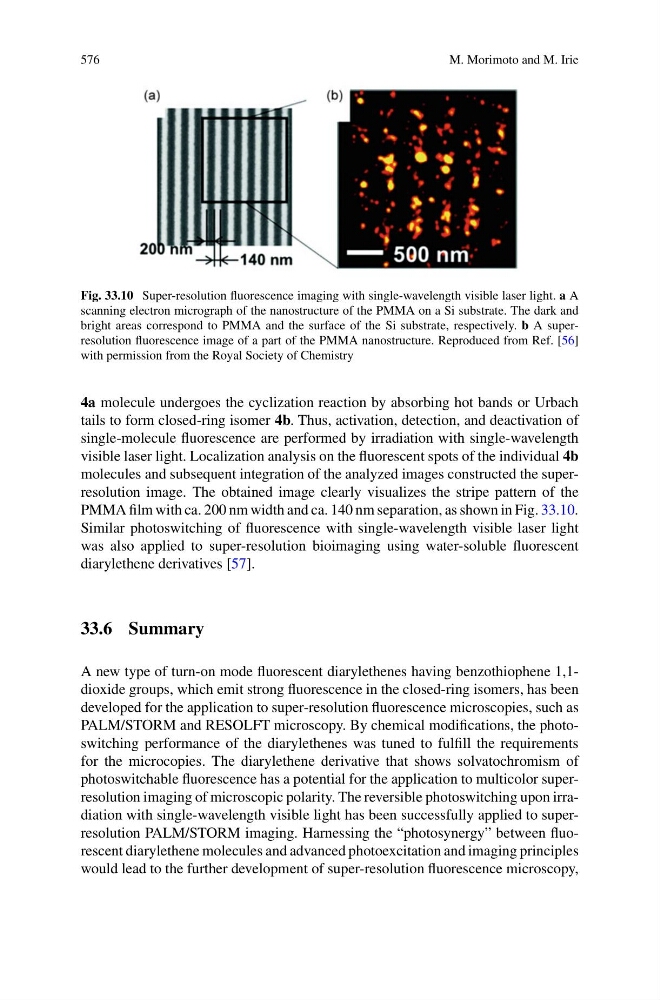
Fig. 33.10 Super-resolution fluorescence imaging with single-wavelength visible laser light. a A
scanning electron micrograph of the nanostructure of the PMMA on a Si substrate. The dark and
bright areas correspond to PMMA and the surface of the Si substrate, respectively. b A superresolution fluorescence image of a part of the PMMA nanostructure. Reproduced from Ref. [56]
with permission from the Royal Society of Chemistry
4a molecule undergoes the cyclization reaction by absorbing hot bands or Urbach
tails to form closed-ring isomer 4b. Thus, activation, detection, and deactivation of
single-molecule fluorescence are performed by irradiation with single-wavelength
visible laser light. Localization analysis on the fluorescent spots of the individual 4b
molecules and subsequent integration of the analyzed images constructed the superresolution image. The obtained image clearly visualizes the stripe pattern of the
PMMA film with ca. 200 nm width and ca. 140 nm separation, as shown in Fig. 33.10.
Similar photoswitching of fluorescence with single-wavelength visible laser light
was also applied to super-resolution bioimaging using water-soluble fluorescent
diarylethene derivatives [57].
33.6 Summary
A new type of turn-on mode fluorescent diarylethenes having benzothiophene 1,1dioxide groups, which emit strong fluorescence in the closed-ring isomers, has been
developed for the application to super-resolution fluorescence microscopies, such as
PALM/STORM and RESOLFT microscopy. By chemical modifications, the photoswitching performance of the diarylethenes was tuned to fulfill the requirements
for the microcopies. The diarylethene derivative that shows solvatochromism of
photoswitchable fluorescence has a potential for the application to multicolor superresolution imaging of microscopic polarity. The reversible photoswitching upon irradiation with single-wavelength visible light has been successfully applied to superresolution PALM/STORM imaging. Harnessing the “photosynergy” between fluorescent diarylethene molecules and advanced photoexcitation and imaging principles
would lead to the further development of super-resolution fluorescence microscopy,
M. Morimoto and M. Irie
Fig. 33.10 Super-resolution fluorescence imaging with single-wavelength visible laser light. a A
scanning electron micrograph of the nanostructure of the PMMA on a Si substrate. The dark and
bright areas correspond to PMMA and the surface of the Si substrate, respectively. b A superresolution fluorescence image of a part of the PMMA nanostructure. Reproduced from Ref. [56]
with permission from the Royal Society of Chemistry
4a molecule undergoes the cyclization reaction by absorbing hot bands or Urbach
tails to form closed-ring isomer 4b. Thus, activation, detection, and deactivation of
single-molecule fluorescence are performed by irradiation with single-wavelength
visible laser light. Localization analysis on the fluorescent spots of the individual 4b
molecules and subsequent integration of the analyzed images constructed the superresolution image. The obtained image clearly visualizes the stripe pattern of the
PMMA film with ca. 200 nm width and ca. 140 nm separation, as shown in Fig. 33.10.
Similar photoswitching of fluorescence with single-wavelength visible laser light
was also applied to super-resolution bioimaging using water-soluble fluorescent
diarylethene derivatives [57].
33.6 Summary
A new type of turn-on mode fluorescent diarylethenes having benzothiophene 1,1dioxide groups, which emit strong fluorescence in the closed-ring isomers, has been
developed for the application to super-resolution fluorescence microscopies, such as
PALM/STORM and RESOLFT microscopy. By chemical modifications, the photoswitching performance of the diarylethenes was tuned to fulfill the requirements
for the microcopies. The diarylethene derivative that shows solvatochromism of
photoswitchable fluorescence has a potential for the application to multicolor superresolution imaging of microscopic polarity. The reversible photoswitching upon irradiation with single-wavelength visible light has been successfully applied to superresolution PALM/STORM imaging. Harnessing the “photosynergy” between fluorescent diarylethene molecules and advanced photoexcitation and imaging principles
would lead to the further development of super-resolution fluorescence microscopy,