

33 Turn-on Mode Photoswitchable Fluorescent Diarylethenes …
575
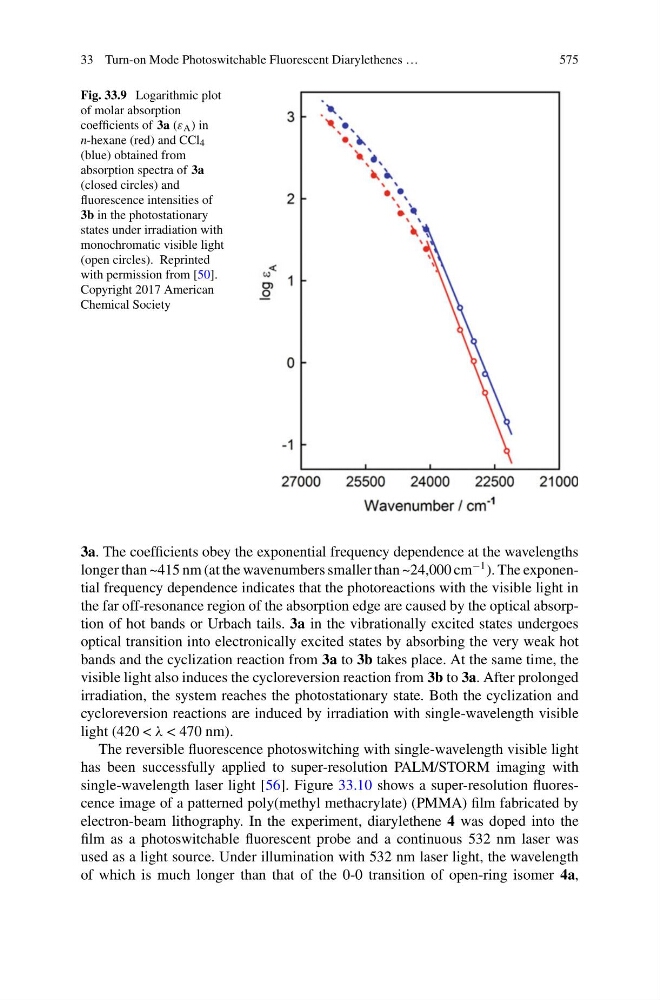
Fig. 33.9 Logarithmic plot
of molar absorption
coefficients of 3a (ε A ) in
n-hexane (red) and CCl 4
(blue) obtained from
absorption spectra of 3a
(closed circles) and
fluorescence intensities of
3b in the photostationary
states under irradiation with
monochromatic visible light
(open circles). Reprinted
with permission from [50].
Copyright 2017 American
Chemical Society
3a. The coefficients obey the exponential frequency dependence at the wavelengths
longer than ~415 nm (at the wavenumbers smaller than ~24,000 cm
−1 ). The exponential frequency dependence indicates that the photoreactions with the visible light in
the far off-resonance region of the absorption edge are caused by the optical absorption of hot bands or Urbach tails. 3a in the vibrationally excited states undergoes
optical transition into electronically excited states by absorbing the very weak hot
bands and the cyclization reaction from 3a to 3b takes place. At the same time, the
visible light also induces the cycloreversion reaction from 3b to 3a. After prolonged
irradiation, the system reaches the photostationary state. Both the cyclization and
cycloreversion reactions are induced by irradiation with single-wavelength visible
light (420 < λ < 470 nm).
The reversible fluorescence photoswitching with single-wavelength visible light
has been successfully applied to super-resolution PALM/STORM imaging with
single-wavelength laser light [56]. Figure 33.10 shows a super-resolution fluorescence image of a patterned poly(methyl methacrylate) (PMMA) film fabricated by
electron-beam lithography. In the experiment, diarylethene 4 was doped into the
film as a photoswitchable fluorescent probe and a continuous 532 nm laser was
used as a light source. Under illumination with 532 nm laser light, the wavelength
of which is much longer than that of the 0-0 transition of open-ring isomer 4a,
575
Fig. 33.9 Logarithmic plot
of molar absorption
coefficients of 3a (ε A ) in
n-hexane (red) and CCl 4
(blue) obtained from
absorption spectra of 3a
(closed circles) and
fluorescence intensities of
3b in the photostationary
states under irradiation with
monochromatic visible light
(open circles). Reprinted
with permission from [50].
Copyright 2017 American
Chemical Society
3a. The coefficients obey the exponential frequency dependence at the wavelengths
longer than ~415 nm (at the wavenumbers smaller than ~24,000 cm
−1 ). The exponential frequency dependence indicates that the photoreactions with the visible light in
the far off-resonance region of the absorption edge are caused by the optical absorption of hot bands or Urbach tails. 3a in the vibrationally excited states undergoes
optical transition into electronically excited states by absorbing the very weak hot
bands and the cyclization reaction from 3a to 3b takes place. At the same time, the
visible light also induces the cycloreversion reaction from 3b to 3a. After prolonged
irradiation, the system reaches the photostationary state. Both the cyclization and
cycloreversion reactions are induced by irradiation with single-wavelength visible
light (420 < λ < 470 nm).
The reversible fluorescence photoswitching with single-wavelength visible light
has been successfully applied to super-resolution PALM/STORM imaging with
single-wavelength laser light [56]. Figure 33.10 shows a super-resolution fluorescence image of a patterned poly(methyl methacrylate) (PMMA) film fabricated by
electron-beam lithography. In the experiment, diarylethene 4 was doped into the
film as a photoswitchable fluorescent probe and a continuous 532 nm laser was
used as a light source. Under illumination with 532 nm laser light, the wavelength
of which is much longer than that of the 0-0 transition of open-ring isomer 4a,