

33 Turn-on Mode Photoswitchable Fluorescent Diarylethenes …
573
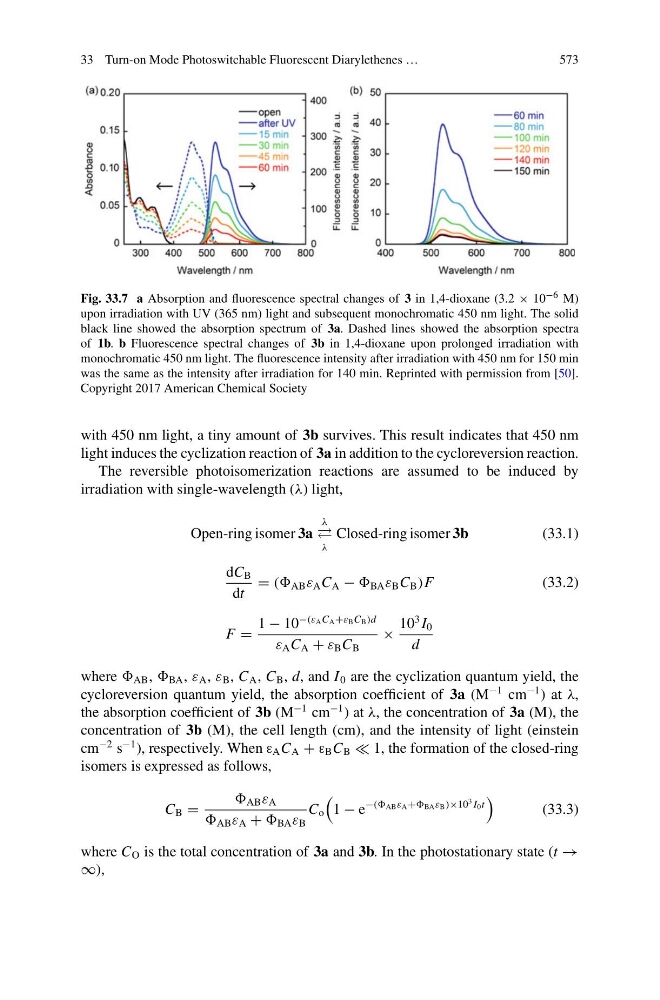
Fig. 33.7 a Absorption and fluorescence spectral changes of 3 in 1,4-dioxane (3.2 × 10 −6 M)
upon irradiation with UV (365 nm) light and subsequent monochromatic 450 nm light. The solid
black line showed the absorption spectrum of 3a. Dashed lines showed the absorption spectra
of 1b. b Fluorescence spectral changes of 3b in 1,4-dioxane upon prolonged irradiation with
monochromatic 450 nm light. The fluorescence intensity after irradiation with 450 nm for 150 min
was the same as the intensity after irradiation for 140 min. Reprinted with permission from [50].
Copyright 2017 American Chemical Society
with 450 nm light, a tiny amount of 3b survives. This result indicates that 450 nm
light induces the cyclization reaction of 3a in addition to the cycloreversion reaction.
The reversible photoisomerization reactions are assumed to be induced by
irradiation with single-wavelength (λ) light,
Open-ring isomer 3a
λ
λ
Closed-ring isomer 3b
(33.1)
dC B
dt
= ( AB ε A C A − BA ε B C B )F
(33.2)
F =
1 − 10
−(ε A C A +ε B C B )d
ε A C A + ε B C B
×
10
3 I 0
d
where AB , BA , ε A , ε B , C A , C B , d, and I 0 are the cyclization quantum yield, the
cycloreversion quantum yield, the absorption coefficient of 3a (M
−1 cm
−1 ) at λ,
the absorption coefficient of 3b (M
−1 cm
−1 ) at λ, the concentration of 3a (M), the
concentration of 3b (M), the cell length (cm), and the intensity of light (einstein
cm
−2 s
−1 ), respectively. When ε A C A + ε B C B 1, the formation of the closed-ring
isomers is expressed as follows,
C B =
AB ε A
AB ε A + BA ε B
C o
1 − e
−( AB ε A + BA ε B )×10
3 I 0 t
(33.3)
where C O is the total concentration of 3a and 3b. In the photostationary state (t →
∞),
573
Fig. 33.7 a Absorption and fluorescence spectral changes of 3 in 1,4-dioxane (3.2 × 10 −6 M)
upon irradiation with UV (365 nm) light and subsequent monochromatic 450 nm light. The solid
black line showed the absorption spectrum of 3a. Dashed lines showed the absorption spectra
of 1b. b Fluorescence spectral changes of 3b in 1,4-dioxane upon prolonged irradiation with
monochromatic 450 nm light. The fluorescence intensity after irradiation with 450 nm for 150 min
was the same as the intensity after irradiation for 140 min. Reprinted with permission from [50].
Copyright 2017 American Chemical Society
with 450 nm light, a tiny amount of 3b survives. This result indicates that 450 nm
light induces the cyclization reaction of 3a in addition to the cycloreversion reaction.
The reversible photoisomerization reactions are assumed to be induced by
irradiation with single-wavelength (λ) light,
Open-ring isomer 3a
λ
λ
Closed-ring isomer 3b
(33.1)
dC B
dt
= ( AB ε A C A − BA ε B C B )F
(33.2)
F =
1 − 10
−(ε A C A +ε B C B )d
ε A C A + ε B C B
×
10
3 I 0
d
where AB , BA , ε A , ε B , C A , C B , d, and I 0 are the cyclization quantum yield, the
cycloreversion quantum yield, the absorption coefficient of 3a (M
−1 cm
−1 ) at λ,
the absorption coefficient of 3b (M
−1 cm
−1 ) at λ, the concentration of 3a (M), the
concentration of 3b (M), the cell length (cm), and the intensity of light (einstein
cm
−2 s
−1 ), respectively. When ε A C A + ε B C B 1, the formation of the closed-ring
isomers is expressed as follows,
C B =
AB ε A
AB ε A + BA ε B
C o
1 − e
−( AB ε A + BA ε B )×10
3 I 0 t
(33.3)
where C O is the total concentration of 3a and 3b. In the photostationary state (t →
∞),