

572
M. Morimoto and M. Irie
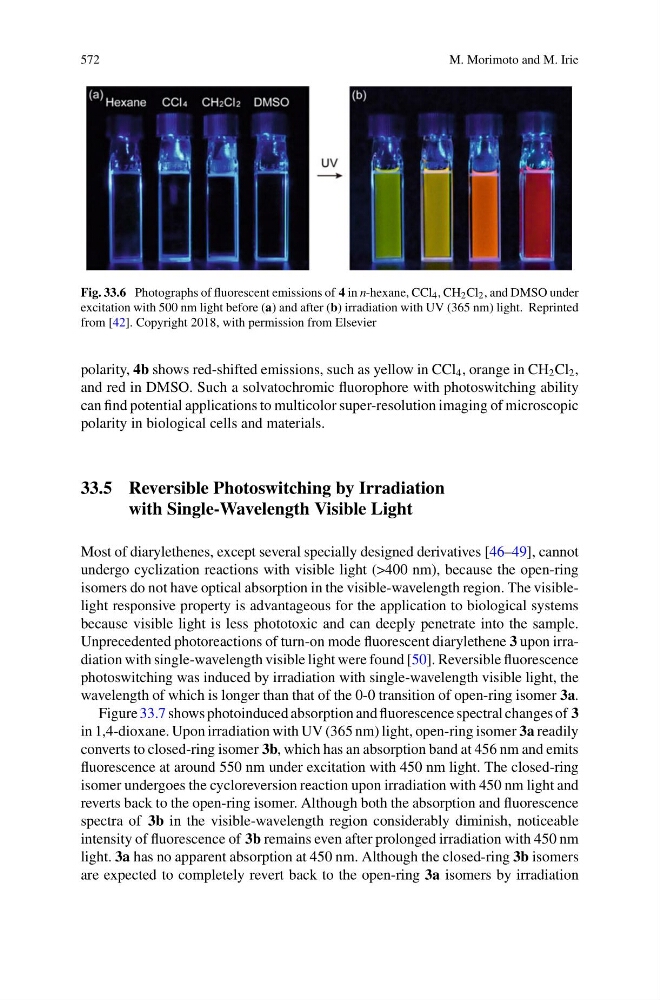
Fig. 33.6 Photographs of fluorescent emissions of 4 in n-hexane, CCl 4 , CH 2 Cl 2 , and DMSO under
excitation with 500 nm light before (a) and after (b) irradiation with UV (365 nm) light. Reprinted
from [42]. Copyright 2018, with permission from Elsevier
polarity, 4b shows red-shifted emissions, such as yellow in CCl 4 , orange in CH 2 Cl 2 ,
and red in DMSO. Such a solvatochromic fluorophore with photoswitching ability
can find potential applications to multicolor super-resolution imaging of microscopic
polarity in biological cells and materials.
33.5 Reversible Photoswitching by Irradiation
with Single-Wavelength Visible Light
Most of diarylethenes, except several specially designed derivatives [46–49], cannot
undergo cyclization reactions with visible light (>400 nm), because the open-ring
isomers do not have optical absorption in the visible-wavelength region. The visiblelight responsive property is advantageous for the application to biological systems
because visible light is less phototoxic and can deeply penetrate into the sample.
Unprecedented photoreactions of turn-on mode fluorescent diarylethene 3 upon irradiation with single-wavelength visible light were found [50]. Reversible fluorescence
photoswitching was induced by irradiation with single-wavelength visible light, the
wavelength of which is longer than that of the 0-0 transition of open-ring isomer 3a.
Figure 33.7 shows photoinduced absorption and fluorescence spectral changes of 3
in 1,4-dioxane. Upon irradiation with UV (365 nm) light, open-ring isomer 3a readily
converts to closed-ring isomer 3b, which has an absorption band at 456 nm and emits
fluorescence at around 550 nm under excitation with 450 nm light. The closed-ring
isomer undergoes the cycloreversion reaction upon irradiation with 450 nm light and
reverts back to the open-ring isomer. Although both the absorption and fluorescence
spectra of 3b in the visible-wavelength region considerably diminish, noticeable
intensity of fluorescence of 3b remains even after prolonged irradiation with 450 nm
light. 3a has no apparent absorption at 450 nm. Although the closed-ring 3b isomers
are expected to completely revert back to the open-ring 3a isomers by irradiation
M. Morimoto and M. Irie
Fig. 33.6 Photographs of fluorescent emissions of 4 in n-hexane, CCl 4 , CH 2 Cl 2 , and DMSO under
excitation with 500 nm light before (a) and after (b) irradiation with UV (365 nm) light. Reprinted
from [42]. Copyright 2018, with permission from Elsevier
polarity, 4b shows red-shifted emissions, such as yellow in CCl 4 , orange in CH 2 Cl 2 ,
and red in DMSO. Such a solvatochromic fluorophore with photoswitching ability
can find potential applications to multicolor super-resolution imaging of microscopic
polarity in biological cells and materials.
33.5 Reversible Photoswitching by Irradiation
with Single-Wavelength Visible Light
Most of diarylethenes, except several specially designed derivatives [46–49], cannot
undergo cyclization reactions with visible light (>400 nm), because the open-ring
isomers do not have optical absorption in the visible-wavelength region. The visiblelight responsive property is advantageous for the application to biological systems
because visible light is less phototoxic and can deeply penetrate into the sample.
Unprecedented photoreactions of turn-on mode fluorescent diarylethene 3 upon irradiation with single-wavelength visible light were found [50]. Reversible fluorescence
photoswitching was induced by irradiation with single-wavelength visible light, the
wavelength of which is longer than that of the 0-0 transition of open-ring isomer 3a.
Figure 33.7 shows photoinduced absorption and fluorescence spectral changes of 3
in 1,4-dioxane. Upon irradiation with UV (365 nm) light, open-ring isomer 3a readily
converts to closed-ring isomer 3b, which has an absorption band at 456 nm and emits
fluorescence at around 550 nm under excitation with 450 nm light. The closed-ring
isomer undergoes the cycloreversion reaction upon irradiation with 450 nm light and
reverts back to the open-ring isomer. Although both the absorption and fluorescence
spectra of 3b in the visible-wavelength region considerably diminish, noticeable
intensity of fluorescence of 3b remains even after prolonged irradiation with 450 nm
light. 3a has no apparent absorption at 450 nm. Although the closed-ring 3b isomers
are expected to completely revert back to the open-ring 3a isomers by irradiation