

33 Turn-on Mode Photoswitchable Fluorescent Diarylethenes …
571
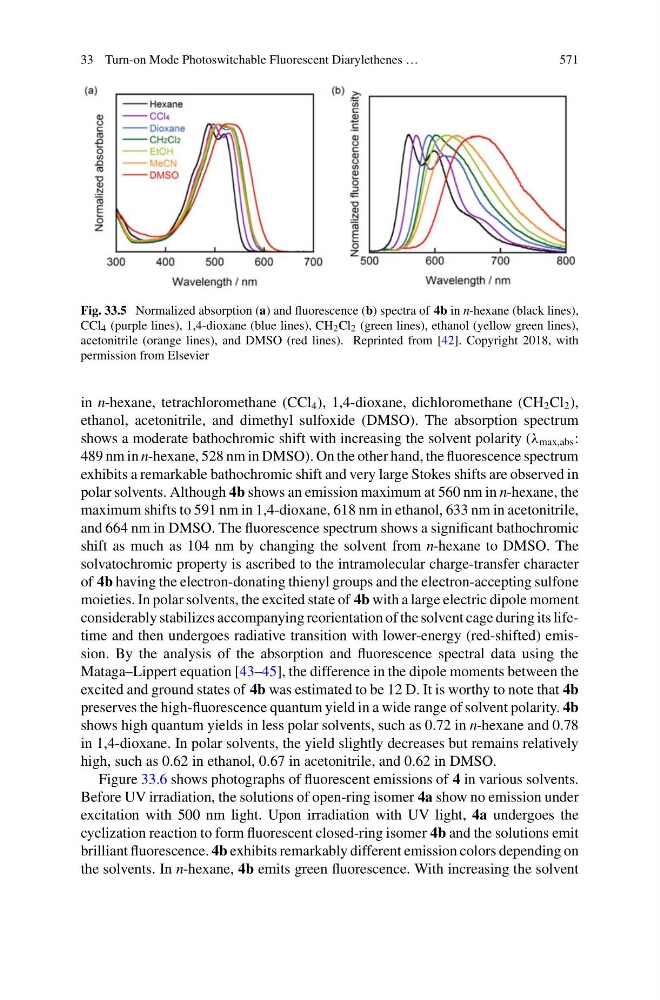
Fig. 33.5 Normalized absorption (a) and fluorescence (b) spectra of 4b in n-hexane (black lines),
CCl 4 (purple lines), 1,4-dioxane (blue lines), CH 2 Cl 2 (green lines), ethanol (yellow green lines),
acetonitrile (orange lines), and DMSO (red lines). Reprinted from [42]. Copyright 2018, with
permission from Elsevier
in n-hexane, tetrachloromethane (CCl 4 ), 1,4-dioxane, dichloromethane (CH 2 Cl 2 ),
ethanol, acetonitrile, and dimethyl sulfoxide (DMSO). The absorption spectrum
shows a moderate bathochromic shift with increasing the solvent polarity (λ max,abs :
489 nm in n-hexane, 528 nm in DMSO). On the other hand, the fluorescence spectrum
exhibits a remarkable bathochromic shift and very large Stokes shifts are observed in
polar solvents. Although 4b shows an emission maximum at 560 nm in n-hexane, the
maximum shifts to 591 nm in 1,4-dioxane, 618 nm in ethanol, 633 nm in acetonitrile,
and 664 nm in DMSO. The fluorescence spectrum shows a significant bathochromic
shift as much as 104 nm by changing the solvent from n-hexane to DMSO. The
solvatochromic property is ascribed to the intramolecular charge-transfer character
of 4b having the electron-donating thienyl groups and the electron-accepting sulfone
moieties. In polar solvents, the excited state of 4b with a large electric dipole moment
considerably stabilizes accompanying reorientation of the solvent cage during its lifetime and then undergoes radiative transition with lower-energy (red-shifted) emission. By the analysis of the absorption and fluorescence spectral data using the
Mataga–Lippert equation [43–45], the difference in the dipole moments between the
excited and ground states of 4b was estimated to be 12 D. It is worthy to note that 4b
preserves the high-fluorescence quantum yield in a wide range of solvent polarity. 4b
shows high quantum yields in less polar solvents, such as 0.72 in n-hexane and 0.78
in 1,4-dioxane. In polar solvents, the yield slightly decreases but remains relatively
high, such as 0.62 in ethanol, 0.67 in acetonitrile, and 0.62 in DMSO.
Figure 33.6 shows photographs of fluorescent emissions of 4 in various solvents.
Before UV irradiation, the solutions of open-ring isomer 4a show no emission under
excitation with 500 nm light. Upon irradiation with UV light, 4a undergoes the
cyclization reaction to form fluorescent closed-ring isomer 4b and the solutions emit
brilliant fluorescence. 4b exhibits remarkably different emission colors depending on
the solvents. In n-hexane, 4b emits green fluorescence. With increasing the solvent
571
Fig. 33.5 Normalized absorption (a) and fluorescence (b) spectra of 4b in n-hexane (black lines),
CCl 4 (purple lines), 1,4-dioxane (blue lines), CH 2 Cl 2 (green lines), ethanol (yellow green lines),
acetonitrile (orange lines), and DMSO (red lines). Reprinted from [42]. Copyright 2018, with
permission from Elsevier
in n-hexane, tetrachloromethane (CCl 4 ), 1,4-dioxane, dichloromethane (CH 2 Cl 2 ),
ethanol, acetonitrile, and dimethyl sulfoxide (DMSO). The absorption spectrum
shows a moderate bathochromic shift with increasing the solvent polarity (λ max,abs :
489 nm in n-hexane, 528 nm in DMSO). On the other hand, the fluorescence spectrum
exhibits a remarkable bathochromic shift and very large Stokes shifts are observed in
polar solvents. Although 4b shows an emission maximum at 560 nm in n-hexane, the
maximum shifts to 591 nm in 1,4-dioxane, 618 nm in ethanol, 633 nm in acetonitrile,
and 664 nm in DMSO. The fluorescence spectrum shows a significant bathochromic
shift as much as 104 nm by changing the solvent from n-hexane to DMSO. The
solvatochromic property is ascribed to the intramolecular charge-transfer character
of 4b having the electron-donating thienyl groups and the electron-accepting sulfone
moieties. In polar solvents, the excited state of 4b with a large electric dipole moment
considerably stabilizes accompanying reorientation of the solvent cage during its lifetime and then undergoes radiative transition with lower-energy (red-shifted) emission. By the analysis of the absorption and fluorescence spectral data using the
Mataga–Lippert equation [43–45], the difference in the dipole moments between the
excited and ground states of 4b was estimated to be 12 D. It is worthy to note that 4b
preserves the high-fluorescence quantum yield in a wide range of solvent polarity. 4b
shows high quantum yields in less polar solvents, such as 0.72 in n-hexane and 0.78
in 1,4-dioxane. In polar solvents, the yield slightly decreases but remains relatively
high, such as 0.62 in ethanol, 0.67 in acetonitrile, and 0.62 in DMSO.
Figure 33.6 shows photographs of fluorescent emissions of 4 in various solvents.
Before UV irradiation, the solutions of open-ring isomer 4a show no emission under
excitation with 500 nm light. Upon irradiation with UV light, 4a undergoes the
cyclization reaction to form fluorescent closed-ring isomer 4b and the solutions emit
brilliant fluorescence. 4b exhibits remarkably different emission colors depending on
the solvents. In n-hexane, 4b emits green fluorescence. With increasing the solvent