

570
M. Morimoto and M. Irie
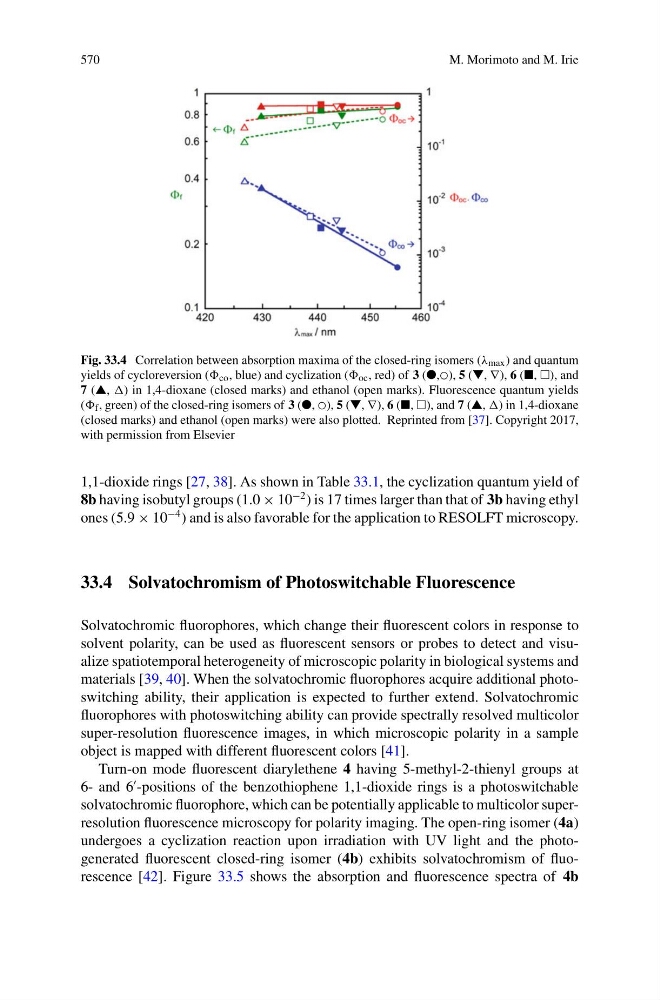
Fig. 33.4 Correlation between absorption maxima of the closed-ring isomers (λ max ) and quantum
yields of cycloreversion ( co , blue) and cyclization ( oc , red) of 3 (●,◯), 5 (▼, ∇), 6 (, ), and
7 (▲, ) in 1,4-dioxane (closed marks) and ethanol (open marks). Fluorescence quantum yields
( f , green) of the closed-ring isomers of 3 (●, ◯), 5 (▼, ∇), 6 (, ), and 7 (▲, ) in 1,4-dioxane
(closed marks) and ethanol (open marks) were also plotted. Reprinted from [37]. Copyright 2017,
with permission from Elsevier
1,1-dioxide rings [27, 38]. As shown in Table 33.1, the cyclization quantum yield of
8b having isobutyl groups (1.0 × 10
−2 ) is 17 times larger than that of 3b having ethyl
ones (5.9 × 10
−4 ) and is also favorable for the application to RESOLFT microscopy.
33.4 Solvatochromism of Photoswitchable Fluorescence
Solvatochromic fluorophores, which change their fluorescent colors in response to
solvent polarity, can be used as fluorescent sensors or probes to detect and visualize spatiotemporal heterogeneity of microscopic polarity in biological systems and
materials [39, 40]. When the solvatochromic fluorophores acquire additional photoswitching ability, their application is expected to further extend. Solvatochromic
fluorophores with photoswitching ability can provide spectrally resolved multicolor
super-resolution fluorescence images, in which microscopic polarity in a sample
object is mapped with different fluorescent colors [41].
Turn-on mode fluorescent diarylethene 4 having 5-methyl-2-thienyl groups at
6- and 6
-positions of the benzothiophene 1,1-dioxide rings is a photoswitchable
solvatochromic fluorophore, which can be potentially applicable to multicolor superresolution fluorescence microscopy for polarity imaging. The open-ring isomer (4a)
undergoes a cyclization reaction upon irradiation with UV light and the photogenerated fluorescent closed-ring isomer (4b) exhibits solvatochromism of fluorescence [42]. Figure 33.5 shows the absorption and fluorescence spectra of 4b
M. Morimoto and M. Irie
Fig. 33.4 Correlation between absorption maxima of the closed-ring isomers (λ max ) and quantum
yields of cycloreversion ( co , blue) and cyclization ( oc , red) of 3 (●,◯), 5 (▼, ∇), 6 (, ), and
7 (▲, ) in 1,4-dioxane (closed marks) and ethanol (open marks). Fluorescence quantum yields
( f , green) of the closed-ring isomers of 3 (●, ◯), 5 (▼, ∇), 6 (, ), and 7 (▲, ) in 1,4-dioxane
(closed marks) and ethanol (open marks) were also plotted. Reprinted from [37]. Copyright 2017,
with permission from Elsevier
1,1-dioxide rings [27, 38]. As shown in Table 33.1, the cyclization quantum yield of
8b having isobutyl groups (1.0 × 10
−2 ) is 17 times larger than that of 3b having ethyl
ones (5.9 × 10
−4 ) and is also favorable for the application to RESOLFT microscopy.
33.4 Solvatochromism of Photoswitchable Fluorescence
Solvatochromic fluorophores, which change their fluorescent colors in response to
solvent polarity, can be used as fluorescent sensors or probes to detect and visualize spatiotemporal heterogeneity of microscopic polarity in biological systems and
materials [39, 40]. When the solvatochromic fluorophores acquire additional photoswitching ability, their application is expected to further extend. Solvatochromic
fluorophores with photoswitching ability can provide spectrally resolved multicolor
super-resolution fluorescence images, in which microscopic polarity in a sample
object is mapped with different fluorescent colors [41].
Turn-on mode fluorescent diarylethene 4 having 5-methyl-2-thienyl groups at
6- and 6
-positions of the benzothiophene 1,1-dioxide rings is a photoswitchable
solvatochromic fluorophore, which can be potentially applicable to multicolor superresolution fluorescence microscopy for polarity imaging. The open-ring isomer (4a)
undergoes a cyclization reaction upon irradiation with UV light and the photogenerated fluorescent closed-ring isomer (4b) exhibits solvatochromism of fluorescence [42]. Figure 33.5 shows the absorption and fluorescence spectra of 4b