

33 Turn-on Mode Photoswitchable Fluorescent Diarylethenes …
567
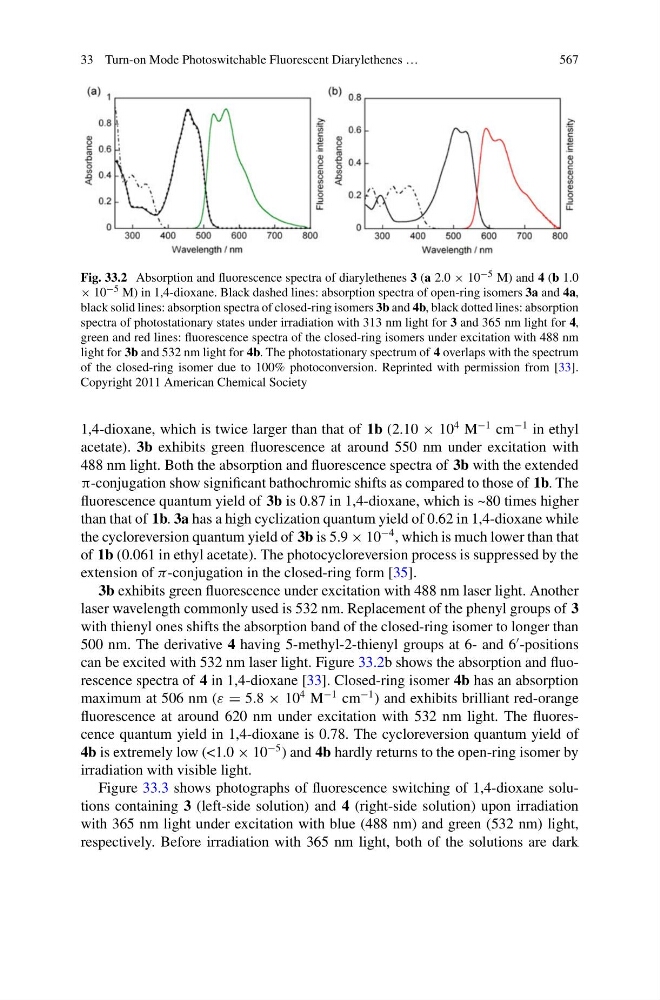
Fig. 33.2 Absorption and fluorescence spectra of diarylethenes 3 (a 2.0 × 10 −5 M) and 4 (b 1.0
× 10 −5 M) in 1,4-dioxane. Black dashed lines: absorption spectra of open-ring isomers 3a and 4a,
black solid lines: absorption spectra of closed-ring isomers 3b and 4b, black dotted lines: absorption
spectra of photostationary states under irradiation with 313 nm light for 3 and 365 nm light for 4,
green and red lines: fluorescence spectra of the closed-ring isomers under excitation with 488 nm
light for 3b and 532 nm light for 4b. The photostationary spectrum of 4 overlaps with the spectrum
of the closed-ring isomer due to 100% photoconversion. Reprinted with permission from [33].
Copyright 2011 American Chemical Society
1,4-dioxane, which is twice larger than that of 1b (2.10 × 10
4 M
−1 cm
−1 in ethyl
acetate). 3b exhibits green fluorescence at around 550 nm under excitation with
488 nm light. Both the absorption and fluorescence spectra of 3b with the extended
π-conjugation show significant bathochromic shifts as compared to those of 1b. The
fluorescence quantum yield of 3b is 0.87 in 1,4-dioxane, which is ~80 times higher
than that of 1b. 3a has a high cyclization quantum yield of 0.62 in 1,4-dioxane while
the cycloreversion quantum yield of 3b is 5.9 × 10
−4 , which is much lower than that
of 1b (0.061 in ethyl acetate). The photocycloreversion process is suppressed by the
extension of π-conjugation in the closed-ring form [35].
3b exhibits green fluorescence under excitation with 488 nm laser light. Another
laser wavelength commonly used is 532 nm. Replacement of the phenyl groups of 3
with thienyl ones shifts the absorption band of the closed-ring isomer to longer than
500 nm. The derivative 4 having 5-methyl-2-thienyl groups at 6- and 6
-positions
can be excited with 532 nm laser light. Figure 33.2b shows the absorption and fluorescence spectra of 4 in 1,4-dioxane [33]. Closed-ring isomer 4b has an absorption
maximum at 506 nm (ε = 5.8 × 10
4 M
−1 cm
−1 ) and exhibits brilliant red-orange
fluorescence at around 620 nm under excitation with 532 nm light. The fluorescence quantum yield in 1,4-dioxane is 0.78. The cycloreversion quantum yield of
4b is extremely low (<1.0 × 10
−5 ) and 4b hardly returns to the open-ring isomer by
irradiation with visible light.
Figure 33.3 shows photographs of fluorescence switching of 1,4-dioxane solutions containing 3 (left-side solution) and 4 (right-side solution) upon irradiation
with 365 nm light under excitation with blue (488 nm) and green (532 nm) light,
respectively. Before irradiation with 365 nm light, both of the solutions are dark
567
Fig. 33.2 Absorption and fluorescence spectra of diarylethenes 3 (a 2.0 × 10 −5 M) and 4 (b 1.0
× 10 −5 M) in 1,4-dioxane. Black dashed lines: absorption spectra of open-ring isomers 3a and 4a,
black solid lines: absorption spectra of closed-ring isomers 3b and 4b, black dotted lines: absorption
spectra of photostationary states under irradiation with 313 nm light for 3 and 365 nm light for 4,
green and red lines: fluorescence spectra of the closed-ring isomers under excitation with 488 nm
light for 3b and 532 nm light for 4b. The photostationary spectrum of 4 overlaps with the spectrum
of the closed-ring isomer due to 100% photoconversion. Reprinted with permission from [33].
Copyright 2011 American Chemical Society
1,4-dioxane, which is twice larger than that of 1b (2.10 × 10
4 M
−1 cm
−1 in ethyl
acetate). 3b exhibits green fluorescence at around 550 nm under excitation with
488 nm light. Both the absorption and fluorescence spectra of 3b with the extended
π-conjugation show significant bathochromic shifts as compared to those of 1b. The
fluorescence quantum yield of 3b is 0.87 in 1,4-dioxane, which is ~80 times higher
than that of 1b. 3a has a high cyclization quantum yield of 0.62 in 1,4-dioxane while
the cycloreversion quantum yield of 3b is 5.9 × 10
−4 , which is much lower than that
of 1b (0.061 in ethyl acetate). The photocycloreversion process is suppressed by the
extension of π-conjugation in the closed-ring form [35].
3b exhibits green fluorescence under excitation with 488 nm laser light. Another
laser wavelength commonly used is 532 nm. Replacement of the phenyl groups of 3
with thienyl ones shifts the absorption band of the closed-ring isomer to longer than
500 nm. The derivative 4 having 5-methyl-2-thienyl groups at 6- and 6
-positions
can be excited with 532 nm laser light. Figure 33.2b shows the absorption and fluorescence spectra of 4 in 1,4-dioxane [33]. Closed-ring isomer 4b has an absorption
maximum at 506 nm (ε = 5.8 × 10
4 M
−1 cm
−1 ) and exhibits brilliant red-orange
fluorescence at around 620 nm under excitation with 532 nm light. The fluorescence quantum yield in 1,4-dioxane is 0.78. The cycloreversion quantum yield of
4b is extremely low (<1.0 × 10
−5 ) and 4b hardly returns to the open-ring isomer by
irradiation with visible light.
Figure 33.3 shows photographs of fluorescence switching of 1,4-dioxane solutions containing 3 (left-side solution) and 4 (right-side solution) upon irradiation
with 365 nm light under excitation with blue (488 nm) and green (532 nm) light,
respectively. Before irradiation with 365 nm light, both of the solutions are dark