

566
M. Morimoto and M. Irie
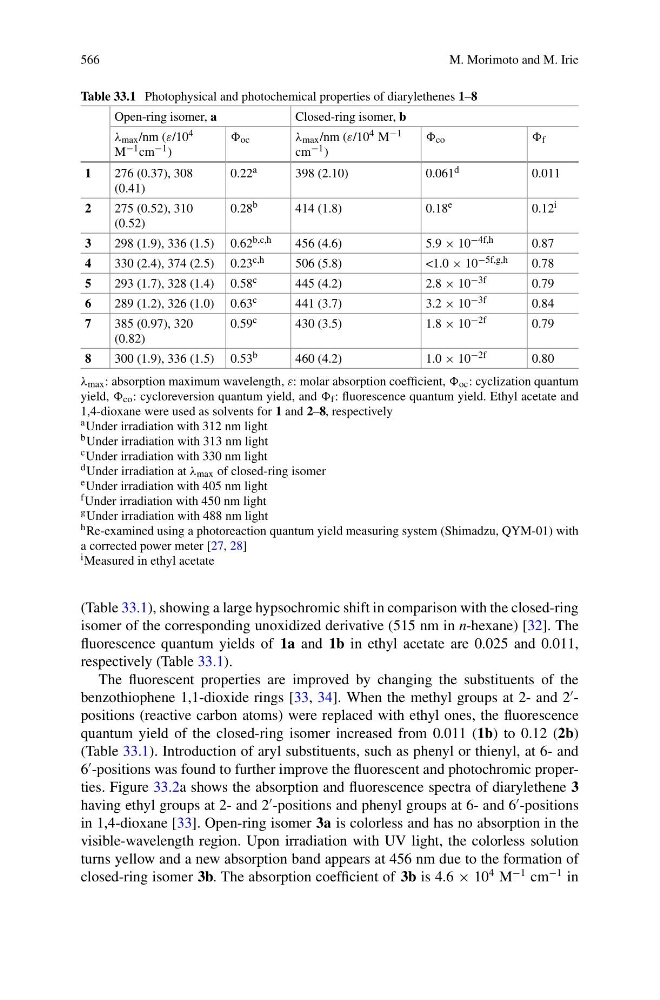
Table 33.1 Photophysical and photochemical properties of diarylethenes 1–8
Open-ring isomer, a
Closed-ring isomer, b
λ max /nm (ε/10 4
M −1 cm −1 )
oc
λ max /nm (ε/10 4 M −1
cm −1 )
co
f
1
276 (0.37), 308
(0.41)
0.22 a
398 (2.10)
0.061 d
0.011
2
275 (0.52), 310
(0.52)
0.28 b
414 (1.8)
0.18 e
0.12 i
3
298 (1.9), 336 (1.5) 0.62 b,c,h
456 (4.6)
5.9 × 10 −4f,h
0.87
4
330 (2.4), 374 (2.5) 0.23 c,h
506 (5.8)
<1.0 × 10 −5f,g,h
0.78
5
293 (1.7), 328 (1.4) 0.58 c
445 (4.2)
2.8 × 10 −3f
0.79
6
289 (1.2), 326 (1.0) 0.63 c
441 (3.7)
3.2 × 10 −3f
0.84
7
385 (0.97), 320
(0.82)
0.59 c
430 (3.5)
1.8 × 10 −2f
0.79
8
300 (1.9), 336 (1.5) 0.53 b
460 (4.2)
1.0 × 10 −2f
0.80
λ max : absorption maximum wavelength, ε: molar absorption coefficient, oc : cyclization quantum
yield, co : cycloreversion quantum yield, and f : fluorescence quantum yield. Ethyl acetate and
1,4-dioxane were used as solvents for 1 and 2–8, respectively
a Under irradiation with 312 nm light
b Under irradiation with 313 nm light
c Under irradiation with 330 nm light
d Under irradiation at λ max of closed-ring isomer
e Under irradiation with 405 nm light
f Under irradiation with 450 nm light
g Under irradiation with 488 nm light
h Re-examined using a photoreaction quantum yield measuring system (Shimadzu, QYM-01) with
a corrected power meter [27, 28]
i Measured in ethyl acetate
(Table 33.1), showing a large hypsochromic shift in comparison with the closed-ring
isomer of the corresponding unoxidized derivative (515 nm in n-hexane) [32]. The
fluorescence quantum yields of 1a and 1b in ethyl acetate are 0.025 and 0.011,
respectively (Table 33.1).
The fluorescent properties are improved by changing the substituents of the
benzothiophene 1,1-dioxide rings [33, 34]. When the methyl groups at 2- and 2
-
positions (reactive carbon atoms) were replaced with ethyl ones, the fluorescence
quantum yield of the closed-ring isomer increased from 0.011 (1b) to 0.12 (2b)
(Table 33.1). Introduction of aryl substituents, such as phenyl or thienyl, at 6- and
6
-positions was found to further improve the fluorescent and photochromic properties. Figure 33.2a shows the absorption and fluorescence spectra of diarylethene 3
having ethyl groups at 2- and 2
-positions and phenyl groups at 6- and 6
-positions
in 1,4-dioxane [33]. Open-ring isomer 3a is colorless and has no absorption in the
visible-wavelength region. Upon irradiation with UV light, the colorless solution
turns yellow and a new absorption band appears at 456 nm due to the formation of
closed-ring isomer 3b. The absorption coefficient of 3b is 4.6 × 10
4 M
−1 cm
−1 in
M. Morimoto and M. Irie
Table 33.1 Photophysical and photochemical properties of diarylethenes 1–8
Open-ring isomer, a
Closed-ring isomer, b
λ max /nm (ε/10 4
M −1 cm −1 )
oc
λ max /nm (ε/10 4 M −1
cm −1 )
co
f
1
276 (0.37), 308
(0.41)
0.22 a
398 (2.10)
0.061 d
0.011
2
275 (0.52), 310
(0.52)
0.28 b
414 (1.8)
0.18 e
0.12 i
3
298 (1.9), 336 (1.5) 0.62 b,c,h
456 (4.6)
5.9 × 10 −4f,h
0.87
4
330 (2.4), 374 (2.5) 0.23 c,h
506 (5.8)
<1.0 × 10 −5f,g,h
0.78
5
293 (1.7), 328 (1.4) 0.58 c
445 (4.2)
2.8 × 10 −3f
0.79
6
289 (1.2), 326 (1.0) 0.63 c
441 (3.7)
3.2 × 10 −3f
0.84
7
385 (0.97), 320
(0.82)
0.59 c
430 (3.5)
1.8 × 10 −2f
0.79
8
300 (1.9), 336 (1.5) 0.53 b
460 (4.2)
1.0 × 10 −2f
0.80
λ max : absorption maximum wavelength, ε: molar absorption coefficient, oc : cyclization quantum
yield, co : cycloreversion quantum yield, and f : fluorescence quantum yield. Ethyl acetate and
1,4-dioxane were used as solvents for 1 and 2–8, respectively
a Under irradiation with 312 nm light
b Under irradiation with 313 nm light
c Under irradiation with 330 nm light
d Under irradiation at λ max of closed-ring isomer
e Under irradiation with 405 nm light
f Under irradiation with 450 nm light
g Under irradiation with 488 nm light
h Re-examined using a photoreaction quantum yield measuring system (Shimadzu, QYM-01) with
a corrected power meter [27, 28]
i Measured in ethyl acetate
(Table 33.1), showing a large hypsochromic shift in comparison with the closed-ring
isomer of the corresponding unoxidized derivative (515 nm in n-hexane) [32]. The
fluorescence quantum yields of 1a and 1b in ethyl acetate are 0.025 and 0.011,
respectively (Table 33.1).
The fluorescent properties are improved by changing the substituents of the
benzothiophene 1,1-dioxide rings [33, 34]. When the methyl groups at 2- and 2
-
positions (reactive carbon atoms) were replaced with ethyl ones, the fluorescence
quantum yield of the closed-ring isomer increased from 0.011 (1b) to 0.12 (2b)
(Table 33.1). Introduction of aryl substituents, such as phenyl or thienyl, at 6- and
6
-positions was found to further improve the fluorescent and photochromic properties. Figure 33.2a shows the absorption and fluorescence spectra of diarylethene 3
having ethyl groups at 2- and 2
-positions and phenyl groups at 6- and 6
-positions
in 1,4-dioxane [33]. Open-ring isomer 3a is colorless and has no absorption in the
visible-wavelength region. Upon irradiation with UV light, the colorless solution
turns yellow and a new absorption band appears at 456 nm due to the formation of
closed-ring isomer 3b. The absorption coefficient of 3b is 4.6 × 10
4 M
−1 cm
−1 in