

568
M. Morimoto and M. Irie
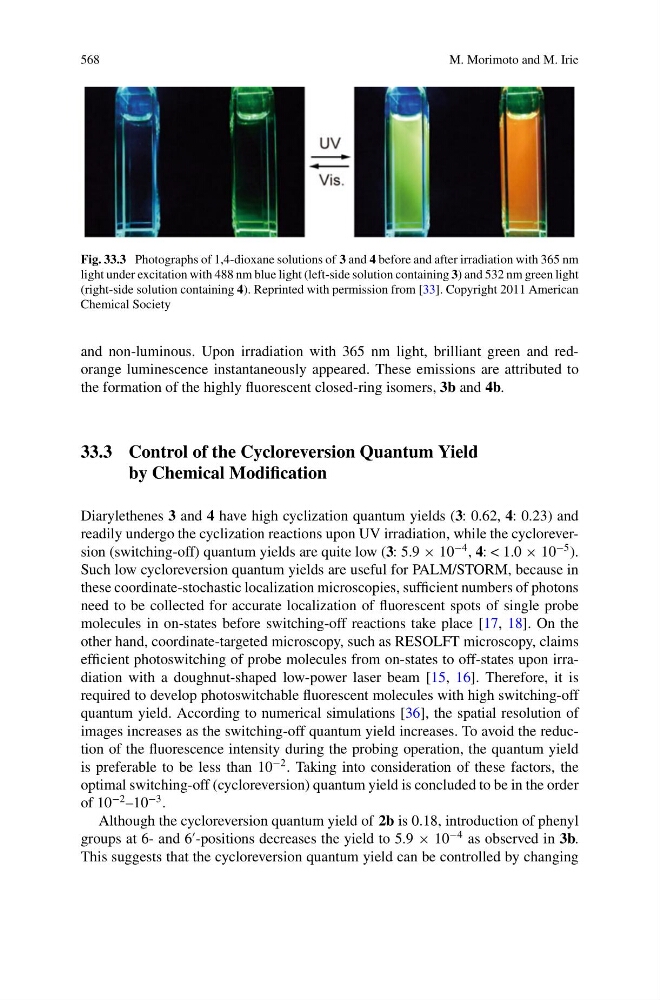
Fig. 33.3 Photographs of 1,4-dioxane solutions of 3 and 4 before and after irradiation with 365 nm
light under excitation with 488 nm blue light (left-side solution containing 3) and 532 nm green light
(right-side solution containing 4). Reprinted with permission from [33]. Copyright 2011 American
Chemical Society
and non-luminous. Upon irradiation with 365 nm light, brilliant green and redorange luminescence instantaneously appeared. These emissions are attributed to
the formation of the highly fluorescent closed-ring isomers, 3b and 4b.
33.3 Control of the Cycloreversion Quantum Yield
by Chemical Modification
Diarylethenes 3 and 4 have high cyclization quantum yields (3: 0.62, 4: 0.23) and
readily undergo the cyclization reactions upon UV irradiation, while the cycloreversion (switching-off) quantum yields are quite low (3: 5.9 × 10
−4 , 4: < 1.0 × 10
−5 ).
Such low cycloreversion quantum yields are useful for PALM/STORM, because in
these coordinate-stochastic localization microscopies, sufficient numbers of photons
need to be collected for accurate localization of fluorescent spots of single probe
molecules in on-states before switching-off reactions take place [17, 18]. On the
other hand, coordinate-targeted microscopy, such as RESOLFT microscopy, claims
efficient photoswitching of probe molecules from on-states to off-states upon irradiation with a doughnut-shaped low-power laser beam [15, 16]. Therefore, it is
required to develop photoswitchable fluorescent molecules with high switching-off
quantum yield. According to numerical simulations [36], the spatial resolution of
images increases as the switching-off quantum yield increases. To avoid the reduction of the fluorescence intensity during the probing operation, the quantum yield
is preferable to be less than 10
−2 . Taking into consideration of these factors, the
optimal switching-off (cycloreversion) quantum yield is concluded to be in the order
of 10
−2 –10
−3 .
Although the cycloreversion quantum yield of 2b is 0.18, introduction of phenyl
groups at 6- and 6
-positions decreases the yield to 5.9 × 10
−4 as observed in 3b.
This suggests that the cycloreversion quantum yield can be controlled by changing
M. Morimoto and M. Irie
Fig. 33.3 Photographs of 1,4-dioxane solutions of 3 and 4 before and after irradiation with 365 nm
light under excitation with 488 nm blue light (left-side solution containing 3) and 532 nm green light
(right-side solution containing 4). Reprinted with permission from [33]. Copyright 2011 American
Chemical Society
and non-luminous. Upon irradiation with 365 nm light, brilliant green and redorange luminescence instantaneously appeared. These emissions are attributed to
the formation of the highly fluorescent closed-ring isomers, 3b and 4b.
33.3 Control of the Cycloreversion Quantum Yield
by Chemical Modification
Diarylethenes 3 and 4 have high cyclization quantum yields (3: 0.62, 4: 0.23) and
readily undergo the cyclization reactions upon UV irradiation, while the cycloreversion (switching-off) quantum yields are quite low (3: 5.9 × 10
−4 , 4: < 1.0 × 10
−5 ).
Such low cycloreversion quantum yields are useful for PALM/STORM, because in
these coordinate-stochastic localization microscopies, sufficient numbers of photons
need to be collected for accurate localization of fluorescent spots of single probe
molecules in on-states before switching-off reactions take place [17, 18]. On the
other hand, coordinate-targeted microscopy, such as RESOLFT microscopy, claims
efficient photoswitching of probe molecules from on-states to off-states upon irradiation with a doughnut-shaped low-power laser beam [15, 16]. Therefore, it is
required to develop photoswitchable fluorescent molecules with high switching-off
quantum yield. According to numerical simulations [36], the spatial resolution of
images increases as the switching-off quantum yield increases. To avoid the reduction of the fluorescence intensity during the probing operation, the quantum yield
is preferable to be less than 10
−2 . Taking into consideration of these factors, the
optimal switching-off (cycloreversion) quantum yield is concluded to be in the order
of 10
−2 –10
−3 .
Although the cycloreversion quantum yield of 2b is 0.18, introduction of phenyl
groups at 6- and 6
-positions decreases the yield to 5.9 × 10
−4 as observed in 3b.
This suggests that the cycloreversion quantum yield can be controlled by changing