

32 Fabrication of Charge-Transfer Complex Nanocrystals …
559
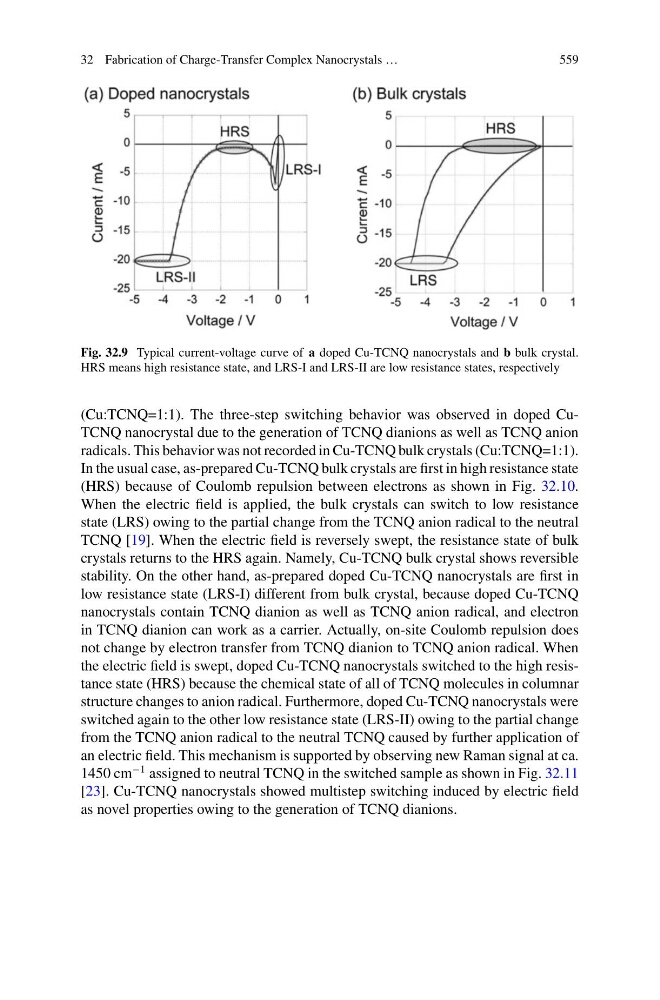
Fig. 32.9 Typical current-voltage curve of a doped Cu-TCNQ nanocrystals and b bulk crystal.
HRS means high resistance state, and LRS-I and LRS-II are low resistance states, respectively
(Cu:TCNQ=1:1). The three-step switching behavior was observed in doped CuTCNQ nanocrystal due to the generation of TCNQ dianions as well as TCNQ anion
radicals. This behavior was not recorded in Cu-TCNQ bulk crystals (Cu:TCNQ=1:1).
In the usual case, as-prepared Cu-TCNQ bulk crystals are first in high resistance state
(HRS) because of Coulomb repulsion between electrons as shown in Fig. 32.10.
When the electric field is applied, the bulk crystals can switch to low resistance
state (LRS) owing to the partial change from the TCNQ anion radical to the neutral
TCNQ [19]. When the electric field is reversely swept, the resistance state of bulk
crystals returns to the HRS again. Namely, Cu-TCNQ bulk crystal shows reversible
stability. On the other hand, as-prepared doped Cu-TCNQ nanocrystals are first in
low resistance state (LRS-I) different from bulk crystal, because doped Cu-TCNQ
nanocrystals contain TCNQ dianion as well as TCNQ anion radical, and electron
in TCNQ dianion can work as a carrier. Actually, on-site Coulomb repulsion does
not change by electron transfer from TCNQ dianion to TCNQ anion radical. When
the electric field is swept, doped Cu-TCNQ nanocrystals switched to the high resistance state (HRS) because the chemical state of all of TCNQ molecules in columnar
structure changes to anion radical. Furthermore, doped Cu-TCNQ nanocrystals were
switched again to the other low resistance state (LRS-II) owing to the partial change
from the TCNQ anion radical to the neutral TCNQ caused by further application of
an electric field. This mechanism is supported by observing new Raman signal at ca.
1450 cm
−1 assigned to neutral TCNQ in the switched sample as shown in Fig. 32.11
[23]. Cu-TCNQ nanocrystals showed multistep switching induced by electric field
as novel properties owing to the generation of TCNQ dianions.
559
Fig. 32.9 Typical current-voltage curve of a doped Cu-TCNQ nanocrystals and b bulk crystal.
HRS means high resistance state, and LRS-I and LRS-II are low resistance states, respectively
(Cu:TCNQ=1:1). The three-step switching behavior was observed in doped CuTCNQ nanocrystal due to the generation of TCNQ dianions as well as TCNQ anion
radicals. This behavior was not recorded in Cu-TCNQ bulk crystals (Cu:TCNQ=1:1).
In the usual case, as-prepared Cu-TCNQ bulk crystals are first in high resistance state
(HRS) because of Coulomb repulsion between electrons as shown in Fig. 32.10.
When the electric field is applied, the bulk crystals can switch to low resistance
state (LRS) owing to the partial change from the TCNQ anion radical to the neutral
TCNQ [19]. When the electric field is reversely swept, the resistance state of bulk
crystals returns to the HRS again. Namely, Cu-TCNQ bulk crystal shows reversible
stability. On the other hand, as-prepared doped Cu-TCNQ nanocrystals are first in
low resistance state (LRS-I) different from bulk crystal, because doped Cu-TCNQ
nanocrystals contain TCNQ dianion as well as TCNQ anion radical, and electron
in TCNQ dianion can work as a carrier. Actually, on-site Coulomb repulsion does
not change by electron transfer from TCNQ dianion to TCNQ anion radical. When
the electric field is swept, doped Cu-TCNQ nanocrystals switched to the high resistance state (HRS) because the chemical state of all of TCNQ molecules in columnar
structure changes to anion radical. Furthermore, doped Cu-TCNQ nanocrystals were
switched again to the other low resistance state (LRS-II) owing to the partial change
from the TCNQ anion radical to the neutral TCNQ caused by further application of
an electric field. This mechanism is supported by observing new Raman signal at ca.
1450 cm
−1 assigned to neutral TCNQ in the switched sample as shown in Fig. 32.11
[23]. Cu-TCNQ nanocrystals showed multistep switching induced by electric field
as novel properties owing to the generation of TCNQ dianions.