

32 Fabrication of Charge-Transfer Complex Nanocrystals …
557
Cu-TCNQ nanocrystals. In other words, an excess amount of Cu was included in
nanocrystals, so that excess amount of electron was injected in TCNQ column.
The doped Cu-TCNQ nanocrystals were characterized by UV-Vis-NIR absorption
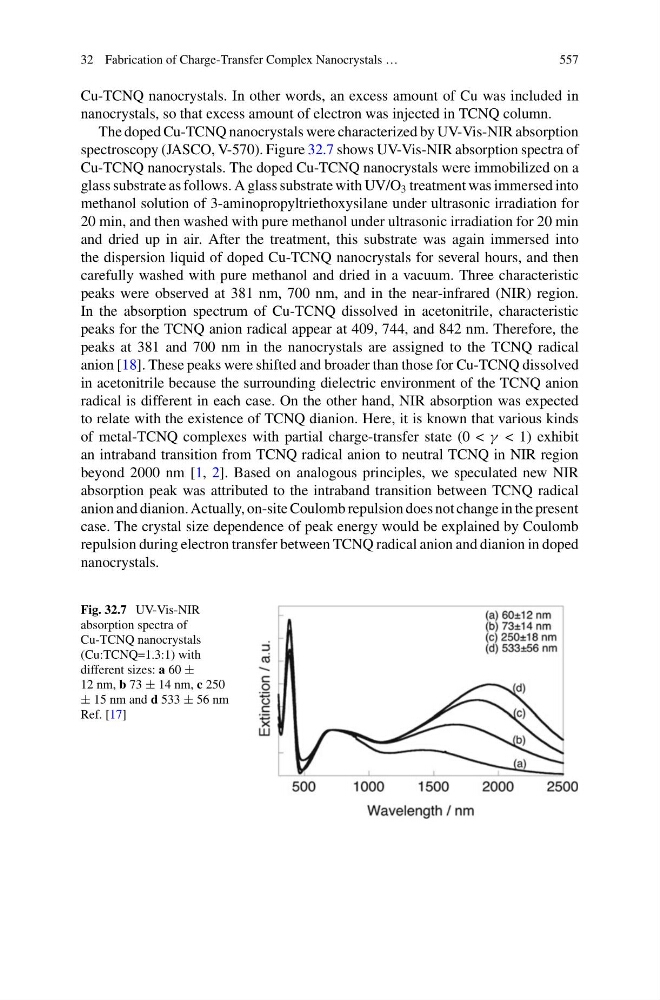
spectroscopy (JASCO, V-570). Figure 32.7 shows UV-Vis-NIR absorption spectra of
Cu-TCNQ nanocrystals. The doped Cu-TCNQ nanocrystals were immobilized on a
glass substrate as follows. A glass substrate with UV/O 3 treatment was immersed into
methanol solution of 3-aminopropyltriethoxysilane under ultrasonic irradiation for
20 min, and then washed with pure methanol under ultrasonic irradiation for 20 min
and dried up in air. After the treatment, this substrate was again immersed into
the dispersion liquid of doped Cu-TCNQ nanocrystals for several hours, and then
carefully washed with pure methanol and dried in a vacuum. Three characteristic
peaks were observed at 381 nm, 700 nm, and in the near-infrared (NIR) region.
In the absorption spectrum of Cu-TCNQ dissolved in acetonitrile, characteristic
peaks for the TCNQ anion radical appear at 409, 744, and 842 nm. Therefore, the
peaks at 381 and 700 nm in the nanocrystals are assigned to the TCNQ radical
anion [18]. These peaks were shifted and broader than those for Cu-TCNQ dissolved
in acetonitrile because the surrounding dielectric environment of the TCNQ anion
radical is different in each case. On the other hand, NIR absorption was expected
to relate with the existence of TCNQ dianion. Here, it is known that various kinds
of metal-TCNQ complexes with partial charge-transfer state (0 < γ < 1) exhibit
an intraband transition from TCNQ radical anion to neutral TCNQ in NIR region
beyond 2000 nm [1, 2]. Based on analogous principles, we speculated new NIR
absorption peak was attributed to the intraband transition between TCNQ radical
anion and dianion. Actually, on-site Coulomb repulsion does not change in the present
case. The crystal size dependence of peak energy would be explained by Coulomb
repulsion during electron transfer between TCNQ radical anion and dianion in doped
nanocrystals.
Fig. 32.7 UV-Vis-NIR
absorption spectra of
Cu-TCNQ nanocrystals
(Cu:TCNQ=1.3:1) with
different sizes: a 60 ±
12 nm, b 73 ± 14 nm, c 250
± 15 nm and d 533 ± 56 nm
Ref. [17]
557
Cu-TCNQ nanocrystals. In other words, an excess amount of Cu was included in
nanocrystals, so that excess amount of electron was injected in TCNQ column.
The doped Cu-TCNQ nanocrystals were characterized by UV-Vis-NIR absorption
spectroscopy (JASCO, V-570). Figure 32.7 shows UV-Vis-NIR absorption spectra of
Cu-TCNQ nanocrystals. The doped Cu-TCNQ nanocrystals were immobilized on a
glass substrate as follows. A glass substrate with UV/O 3 treatment was immersed into
methanol solution of 3-aminopropyltriethoxysilane under ultrasonic irradiation for
20 min, and then washed with pure methanol under ultrasonic irradiation for 20 min
and dried up in air. After the treatment, this substrate was again immersed into
the dispersion liquid of doped Cu-TCNQ nanocrystals for several hours, and then
carefully washed with pure methanol and dried in a vacuum. Three characteristic
peaks were observed at 381 nm, 700 nm, and in the near-infrared (NIR) region.
In the absorption spectrum of Cu-TCNQ dissolved in acetonitrile, characteristic
peaks for the TCNQ anion radical appear at 409, 744, and 842 nm. Therefore, the
peaks at 381 and 700 nm in the nanocrystals are assigned to the TCNQ radical
anion [18]. These peaks were shifted and broader than those for Cu-TCNQ dissolved
in acetonitrile because the surrounding dielectric environment of the TCNQ anion
radical is different in each case. On the other hand, NIR absorption was expected
to relate with the existence of TCNQ dianion. Here, it is known that various kinds
of metal-TCNQ complexes with partial charge-transfer state (0 < γ < 1) exhibit
an intraband transition from TCNQ radical anion to neutral TCNQ in NIR region
beyond 2000 nm [1, 2]. Based on analogous principles, we speculated new NIR
absorption peak was attributed to the intraband transition between TCNQ radical
anion and dianion. Actually, on-site Coulomb repulsion does not change in the present
case. The crystal size dependence of peak energy would be explained by Coulomb
repulsion during electron transfer between TCNQ radical anion and dianion in doped
nanocrystals.
Fig. 32.7 UV-Vis-NIR
absorption spectra of
Cu-TCNQ nanocrystals
(Cu:TCNQ=1.3:1) with
different sizes: a 60 ±
12 nm, b 73 ± 14 nm, c 250
± 15 nm and d 533 ± 56 nm
Ref. [17]