

3 Enhanced and Selective Two-Photon Excitation of Molecular …
45
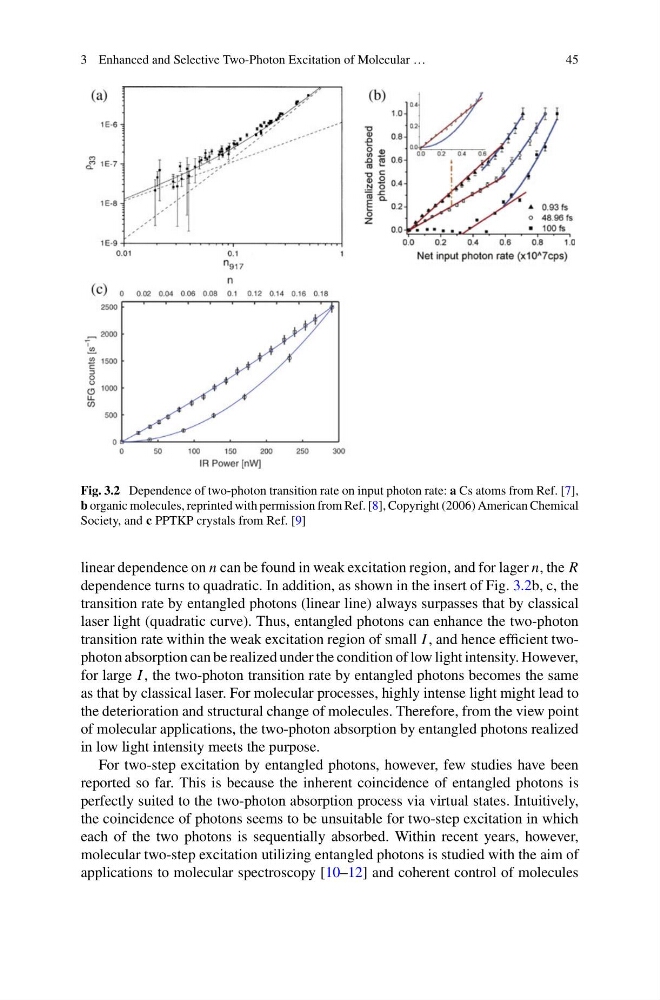
Fig. 3.2 Dependence of two-photon transition rate on input photon rate: a Cs atoms from Ref. [7],
b organic molecules, reprinted with permission from Ref. [8], Copyright (2006) American Chemical
Society, and c PPTKP crystals from Ref. [9]
linear dependence on n can be found in weak excitation region, and for lager n, the R
dependence turns to quadratic. In addition, as shown in the insert of Fig. 3.2b, c, the
transition rate by entangled photons (linear line) always surpasses that by classical
laser light (quadratic curve). Thus, entangled photons can enhance the two-photon
transition rate within the weak excitation region of small I , and hence efficient twophoton absorption can be realized under the condition of low light intensity. However,
for large I , the two-photon transition rate by entangled photons becomes the same
as that by classical laser. For molecular processes, highly intense light might lead to
the deterioration and structural change of molecules. Therefore, from the view point
of molecular applications, the two-photon absorption by entangled photons realized
in low light intensity meets the purpose.
For two-step excitation by entangled photons, however, few studies have been
reported so far. This is because the inherent coincidence of entangled photons is
perfectly suited to the two-photon absorption process via virtual states. Intuitively,
the coincidence of photons seems to be unsuitable for two-step excitation in which
each of the two photons is sequentially absorbed. Within recent years, however,
molecular two-step excitation utilizing entangled photons is studied with the aim of
applications to molecular spectroscopy [10–12] and coherent control of molecules
45
Fig. 3.2 Dependence of two-photon transition rate on input photon rate: a Cs atoms from Ref. [7],
b organic molecules, reprinted with permission from Ref. [8], Copyright (2006) American Chemical
Society, and c PPTKP crystals from Ref. [9]
linear dependence on n can be found in weak excitation region, and for lager n, the R
dependence turns to quadratic. In addition, as shown in the insert of Fig. 3.2b, c, the
transition rate by entangled photons (linear line) always surpasses that by classical
laser light (quadratic curve). Thus, entangled photons can enhance the two-photon
transition rate within the weak excitation region of small I , and hence efficient twophoton absorption can be realized under the condition of low light intensity. However,
for large I , the two-photon transition rate by entangled photons becomes the same
as that by classical laser. For molecular processes, highly intense light might lead to
the deterioration and structural change of molecules. Therefore, from the view point
of molecular applications, the two-photon absorption by entangled photons realized
in low light intensity meets the purpose.
For two-step excitation by entangled photons, however, few studies have been
reported so far. This is because the inherent coincidence of entangled photons is
perfectly suited to the two-photon absorption process via virtual states. Intuitively,
the coincidence of photons seems to be unsuitable for two-step excitation in which
each of the two photons is sequentially absorbed. Within recent years, however,
molecular two-step excitation utilizing entangled photons is studied with the aim of
applications to molecular spectroscopy [10–12] and coherent control of molecules