

46
H. Oka
[13–15]. In these applications, selective excitation of a molecular vibronic state rather
than enhancement plays an important role. Since the energy sum of entangled photons
is always constant even for ultrashort pulse owing to the quantum correlation with
energy anticorrelation, entangled photons can achieve efficiently selective excitation
of a molecular vibronic state. Thus, molecular two-step excitation utilizing entangled
photons is useful for selective excitation of a molecular vibronic state.
To maximize the potential of entangled photons in both the two-photon absorption
and two-step excitation processes, especially for molecular applications, ultrashortpulsed entangled photons, in other words, ultrabroadband entangled photons are
also indispensable to rapidly excite vibronic states and avoid molecular relaxation processes. In this study, we establish a theoretical framework for an efficient
molecular two-photon excitation by ultrabroadband frequency-entangled photons for
exactly two photons as a limiting case of low-intensity light. We show the two-photon
absorption and two-step excitation of molecular vibronic states can be selectively and
strongly enhanced by directly controlling the wavefunction of entangled photons.
3.2 Spatiotemporal Photon Pulse Theory for Entangled
Photons
In conventional studies of two-photon absorption for molecules, the time-dependent
perturbation theory is often used, in which the molecule–photon interaction is
assumed to be small and external photon fields are treated as a bath so that quantum
states of photons are not changed. In this study, however, we introduce the spatiotemporal photon pulse theory [16] extending input-output theory in the field of quantum
optics because we consider the molecule–photon interaction in the limiting case of
low-intensity light, in which exactly two photons interact with a single molecule and
the wavefunction of two photons is also changed by the molecule–photon interaction.
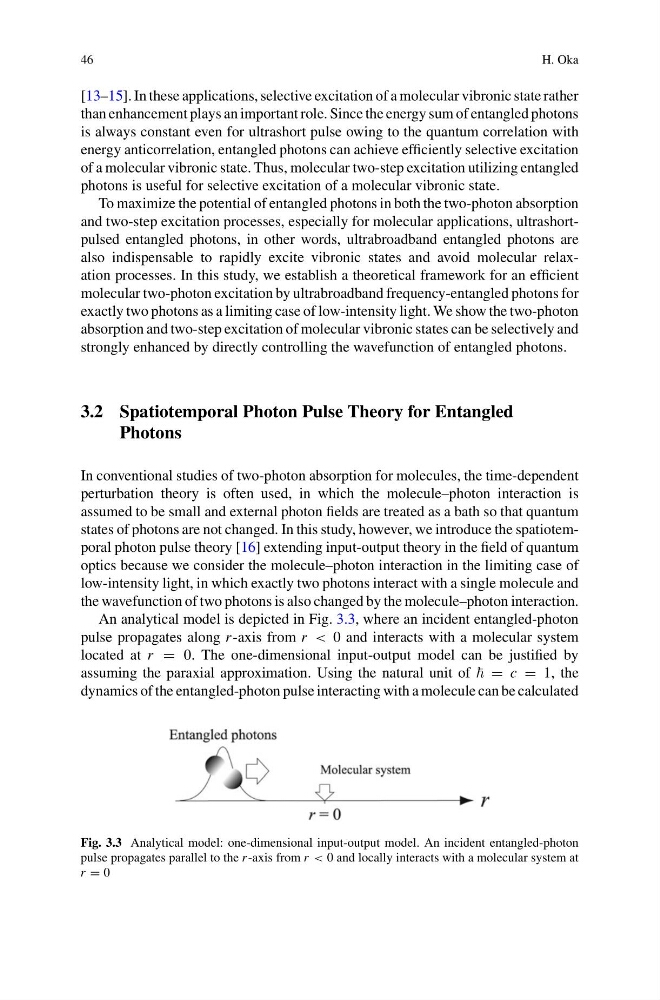
An analytical model is depicted in Fig. 3.3, where an incident entangled-photon
pulse propagates along r -axis from r < 0 and interacts with a molecular system
located at r = 0. The one-dimensional input-output model can be justified by
assuming the paraxial approximation. Using the natural unit of = c = 1, the
dynamics of the entangled-photon pulse interacting with a molecule can be calculated
Fig. 3.3 Analytical model: one-dimensional input-output model. An incident entangled-photon
pulse propagates parallel to the r -axis from r < 0 and locally interacts with a molecular system at
r = 0
H. Oka
[13–15]. In these applications, selective excitation of a molecular vibronic state rather
than enhancement plays an important role. Since the energy sum of entangled photons
is always constant even for ultrashort pulse owing to the quantum correlation with
energy anticorrelation, entangled photons can achieve efficiently selective excitation
of a molecular vibronic state. Thus, molecular two-step excitation utilizing entangled
photons is useful for selective excitation of a molecular vibronic state.
To maximize the potential of entangled photons in both the two-photon absorption
and two-step excitation processes, especially for molecular applications, ultrashortpulsed entangled photons, in other words, ultrabroadband entangled photons are
also indispensable to rapidly excite vibronic states and avoid molecular relaxation processes. In this study, we establish a theoretical framework for an efficient
molecular two-photon excitation by ultrabroadband frequency-entangled photons for
exactly two photons as a limiting case of low-intensity light. We show the two-photon
absorption and two-step excitation of molecular vibronic states can be selectively and
strongly enhanced by directly controlling the wavefunction of entangled photons.
3.2 Spatiotemporal Photon Pulse Theory for Entangled
Photons
In conventional studies of two-photon absorption for molecules, the time-dependent
perturbation theory is often used, in which the molecule–photon interaction is
assumed to be small and external photon fields are treated as a bath so that quantum
states of photons are not changed. In this study, however, we introduce the spatiotemporal photon pulse theory [16] extending input-output theory in the field of quantum
optics because we consider the molecule–photon interaction in the limiting case of
low-intensity light, in which exactly two photons interact with a single molecule and
the wavefunction of two photons is also changed by the molecule–photon interaction.
An analytical model is depicted in Fig. 3.3, where an incident entangled-photon
pulse propagates along r -axis from r < 0 and interacts with a molecular system
located at r = 0. The one-dimensional input-output model can be justified by
assuming the paraxial approximation. Using the natural unit of = c = 1, the
dynamics of the entangled-photon pulse interacting with a molecule can be calculated
Fig. 3.3 Analytical model: one-dimensional input-output model. An incident entangled-photon
pulse propagates parallel to the r -axis from r < 0 and locally interacts with a molecular system at
r = 0