

44
H. Oka
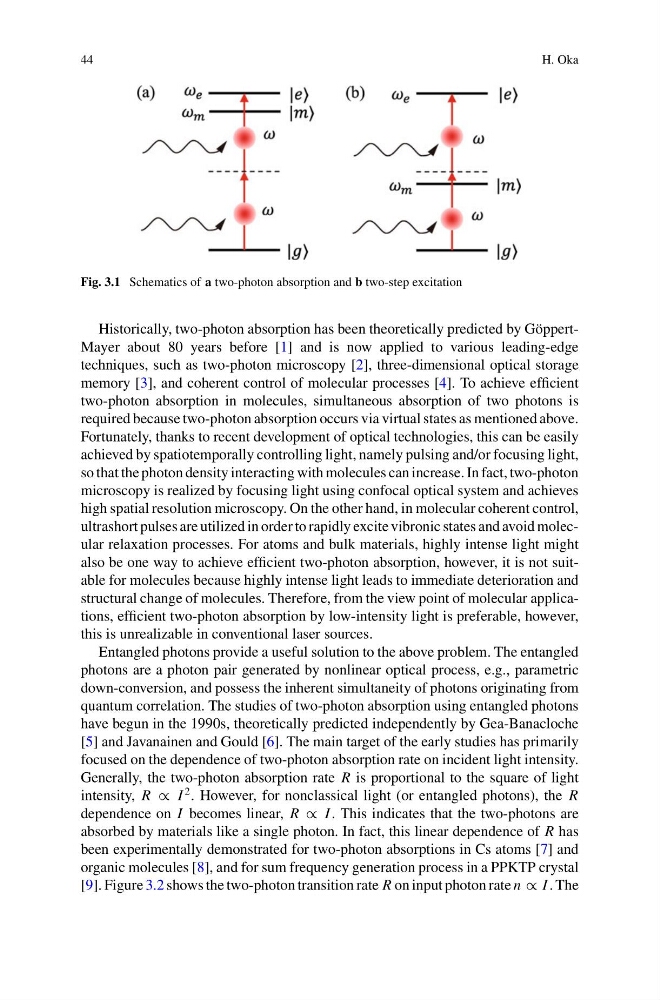
Fig. 3.1 Schematics of a two-photon absorption and b two-step excitation
Historically, two-photon absorption has been theoretically predicted by GöppertMayer about 80 years before [1] and is now applied to various leading-edge
techniques, such as two-photon microscopy [2], three-dimensional optical storage
memory [3], and coherent control of molecular processes [4]. To achieve efficient
two-photon absorption in molecules, simultaneous absorption of two photons is
required because two-photon absorption occurs via virtual states as mentioned above.
Fortunately, thanks to recent development of optical technologies, this can be easily
achieved by spatiotemporally controlling light, namely pulsing and/or focusing light,
so that the photon density interacting with molecules can increase. In fact, two-photon
microscopy is realized by focusing light using confocal optical system and achieves
high spatial resolution microscopy. On the other hand, in molecular coherent control,
ultrashort pulses are utilized in order to rapidly excite vibronic states and avoid molecular relaxation processes. For atoms and bulk materials, highly intense light might
also be one way to achieve efficient two-photon absorption, however, it is not suitable for molecules because highly intense light leads to immediate deterioration and
structural change of molecules. Therefore, from the view point of molecular applications, efficient two-photon absorption by low-intensity light is preferable, however,
this is unrealizable in conventional laser sources.
Entangled photons provide a useful solution to the above problem. The entangled
photons are a photon pair generated by nonlinear optical process, e.g., parametric
down-conversion, and possess the inherent simultaneity of photons originating from
quantum correlation. The studies of two-photon absorption using entangled photons
have begun in the 1990s, theoretically predicted independently by Gea-Banacloche
[5] and Javanainen and Gould [6]. The main target of the early studies has primarily
focused on the dependence of two-photon absorption rate on incident light intensity.
Generally, the two-photon absorption rate R is proportional to the square of light
intensity, R ∝ I
2 . However, for nonclassical light (or entangled photons), the R
dependence on I becomes linear, R ∝ I . This indicates that the two-photons are
absorbed by materials like a single photon. In fact, this linear dependence of R has
been experimentally demonstrated for two-photon absorptions in Cs atoms [7] and
organic molecules [8], and for sum frequency generation process in a PPKTP crystal
[9]. Figure 3.2 shows the two-photon transition rate R on input photon rate n ∝ I . The
H. Oka
Fig. 3.1 Schematics of a two-photon absorption and b two-step excitation
Historically, two-photon absorption has been theoretically predicted by GöppertMayer about 80 years before [1] and is now applied to various leading-edge
techniques, such as two-photon microscopy [2], three-dimensional optical storage
memory [3], and coherent control of molecular processes [4]. To achieve efficient
two-photon absorption in molecules, simultaneous absorption of two photons is
required because two-photon absorption occurs via virtual states as mentioned above.
Fortunately, thanks to recent development of optical technologies, this can be easily
achieved by spatiotemporally controlling light, namely pulsing and/or focusing light,
so that the photon density interacting with molecules can increase. In fact, two-photon
microscopy is realized by focusing light using confocal optical system and achieves
high spatial resolution microscopy. On the other hand, in molecular coherent control,
ultrashort pulses are utilized in order to rapidly excite vibronic states and avoid molecular relaxation processes. For atoms and bulk materials, highly intense light might
also be one way to achieve efficient two-photon absorption, however, it is not suitable for molecules because highly intense light leads to immediate deterioration and
structural change of molecules. Therefore, from the view point of molecular applications, efficient two-photon absorption by low-intensity light is preferable, however,
this is unrealizable in conventional laser sources.
Entangled photons provide a useful solution to the above problem. The entangled
photons are a photon pair generated by nonlinear optical process, e.g., parametric
down-conversion, and possess the inherent simultaneity of photons originating from
quantum correlation. The studies of two-photon absorption using entangled photons
have begun in the 1990s, theoretically predicted independently by Gea-Banacloche
[5] and Javanainen and Gould [6]. The main target of the early studies has primarily
focused on the dependence of two-photon absorption rate on incident light intensity.
Generally, the two-photon absorption rate R is proportional to the square of light
intensity, R ∝ I
2 . However, for nonclassical light (or entangled photons), the R
dependence on I becomes linear, R ∝ I . This indicates that the two-photons are
absorbed by materials like a single photon. In fact, this linear dependence of R has
been experimentally demonstrated for two-photon absorptions in Cs atoms [7] and
organic molecules [8], and for sum frequency generation process in a PPKTP crystal
[9]. Figure 3.2 shows the two-photon transition rate R on input photon rate n ∝ I . The