

29 Femtosecond Pump-Probe Microspectroscopy …
507
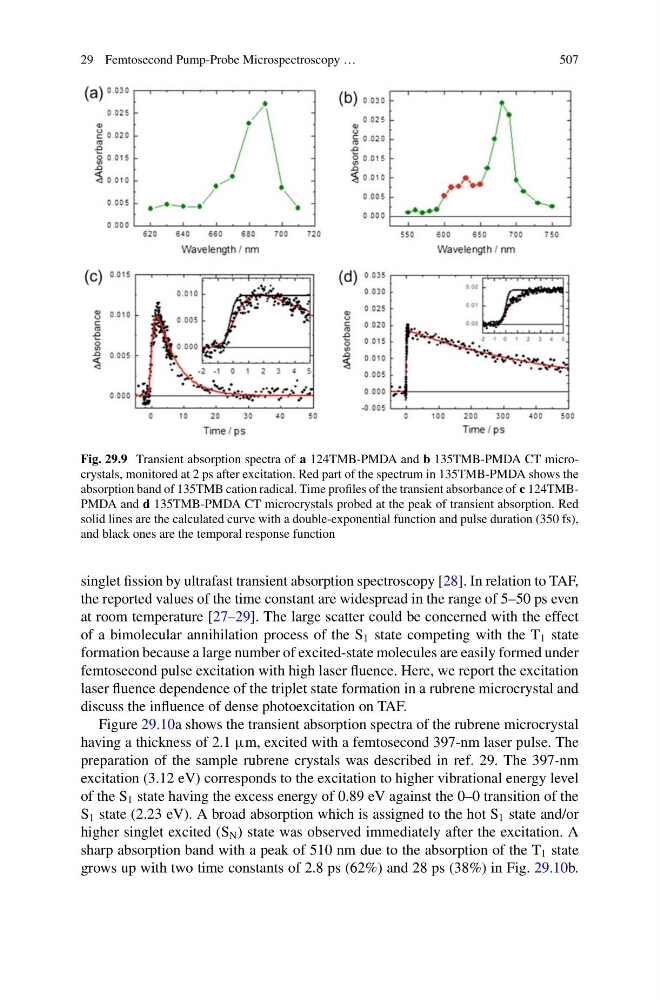
Fig. 29.9 Transient absorption spectra of a 124TMB-PMDA and b 135TMB-PMDA CT microcrystals, monitored at 2 ps after excitation. Red part of the spectrum in 135TMB-PMDA shows the
absorption band of 135TMB cation radical. Time profiles of the transient absorbance of c 124TMBPMDA and d 135TMB-PMDA CT microcrystals probed at the peak of transient absorption. Red
solid lines are the calculated curve with a double-exponential function and pulse duration (350 fs),
and black ones are the temporal response function
singlet fission by ultrafast transient absorption spectroscopy [28]. In relation to TAF,
the reported values of the time constant are widespread in the range of 5–50 ps even
at room temperature [27–29]. The large scatter could be concerned with the effect
of a bimolecular annihilation process of the S 1 state competing with the T 1 state
formation because a large number of excited-state molecules are easily formed under
femtosecond pulse excitation with high laser fluence. Here, we report the excitation
laser fluence dependence of the triplet state formation in a rubrene microcrystal and
discuss the influence of dense photoexcitation on TAF.
Figure 29.10a shows the transient absorption spectra of the rubrene microcrystal
having a thickness of 2.1 μm, excited with a femtosecond 397-nm laser pulse. The
preparation of the sample rubrene crystals was described in ref. 29. The 397-nm
excitation (3.12 eV) corresponds to the excitation to higher vibrational energy level
of the S 1 state having the excess energy of 0.89 eV against the 0–0 transition of the
S 1 state (2.23 eV). A broad absorption which is assigned to the hot S 1 state and/or
higher singlet excited (S N ) state was observed immediately after the excitation. A
sharp absorption band with a peak of 510 nm due to the absorption of the T 1 state
grows up with two time constants of 2.8 ps (62%) and 28 ps (38%) in Fig. 29.10b.
507
Fig. 29.9 Transient absorption spectra of a 124TMB-PMDA and b 135TMB-PMDA CT microcrystals, monitored at 2 ps after excitation. Red part of the spectrum in 135TMB-PMDA shows the
absorption band of 135TMB cation radical. Time profiles of the transient absorbance of c 124TMBPMDA and d 135TMB-PMDA CT microcrystals probed at the peak of transient absorption. Red
solid lines are the calculated curve with a double-exponential function and pulse duration (350 fs),
and black ones are the temporal response function
singlet fission by ultrafast transient absorption spectroscopy [28]. In relation to TAF,
the reported values of the time constant are widespread in the range of 5–50 ps even
at room temperature [27–29]. The large scatter could be concerned with the effect
of a bimolecular annihilation process of the S 1 state competing with the T 1 state
formation because a large number of excited-state molecules are easily formed under
femtosecond pulse excitation with high laser fluence. Here, we report the excitation
laser fluence dependence of the triplet state formation in a rubrene microcrystal and
discuss the influence of dense photoexcitation on TAF.
Figure 29.10a shows the transient absorption spectra of the rubrene microcrystal
having a thickness of 2.1 μm, excited with a femtosecond 397-nm laser pulse. The
preparation of the sample rubrene crystals was described in ref. 29. The 397-nm
excitation (3.12 eV) corresponds to the excitation to higher vibrational energy level
of the S 1 state having the excess energy of 0.89 eV against the 0–0 transition of the
S 1 state (2.23 eV). A broad absorption which is assigned to the hot S 1 state and/or
higher singlet excited (S N ) state was observed immediately after the excitation. A
sharp absorption band with a peak of 510 nm due to the absorption of the T 1 state
grows up with two time constants of 2.8 ps (62%) and 28 ps (38%) in Fig. 29.10b.