

506
Y. Ishibashi and T. Asahi
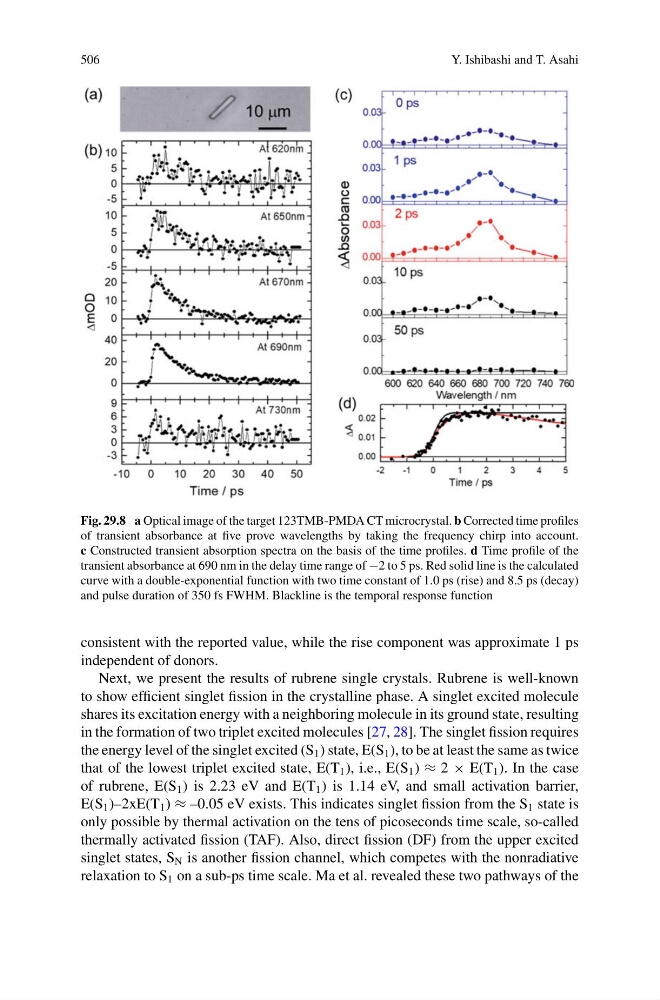
Fig. 29.8 a Optical image of the target 123TMB-PMDA CT microcrystal. b Corrected time profiles
of transient absorbance at five prove wavelengths by taking the frequency chirp into account.
c Constructed transient absorption spectra on the basis of the time profiles. d Time profile of the
transient absorbance at 690 nm in the delay time range of −2 to 5 ps. Red solid line is the calculated
curve with a double-exponential function with two time constant of 1.0 ps (rise) and 8.5 ps (decay)
and pulse duration of 350 fs FWHM. Blackline is the temporal response function
consistent with the reported value, while the rise component was approximate 1 ps
independent of donors.
Next, we present the results of rubrene single crystals. Rubrene is well-known
to show efficient singlet fission in the crystalline phase. A singlet excited molecule
shares its excitation energy with a neighboring molecule in its ground state, resulting
in the formation of two triplet excited molecules [27, 28]. The singlet fission requires
the energy level of the singlet excited (S 1 ) state, E(S 1 ), to be at least the same as twice
that of the lowest triplet excited state, E(T 1 ), i.e., E(S 1 ) ≈ 2 × E(T 1 ). In the case
of rubrene, E(S 1 ) is 2.23 eV and E(T 1 ) is 1.14 eV, and small activation barrier,
E(S 1 )–2xE(T 1 ) ≈ –0.05 eV exists. This indicates singlet fission from the S 1 state is
only possible by thermal activation on the tens of picoseconds time scale, so-called
thermally activated fission (TAF). Also, direct fission (DF) from the upper excited
singlet states, S N is another fission channel, which competes with the nonradiative
relaxation to S 1 on a sub-ps time scale. Ma et al. revealed these two pathways of the
Y. Ishibashi and T. Asahi
Fig. 29.8 a Optical image of the target 123TMB-PMDA CT microcrystal. b Corrected time profiles
of transient absorbance at five prove wavelengths by taking the frequency chirp into account.
c Constructed transient absorption spectra on the basis of the time profiles. d Time profile of the
transient absorbance at 690 nm in the delay time range of −2 to 5 ps. Red solid line is the calculated
curve with a double-exponential function with two time constant of 1.0 ps (rise) and 8.5 ps (decay)
and pulse duration of 350 fs FWHM. Blackline is the temporal response function
consistent with the reported value, while the rise component was approximate 1 ps
independent of donors.
Next, we present the results of rubrene single crystals. Rubrene is well-known
to show efficient singlet fission in the crystalline phase. A singlet excited molecule
shares its excitation energy with a neighboring molecule in its ground state, resulting
in the formation of two triplet excited molecules [27, 28]. The singlet fission requires
the energy level of the singlet excited (S 1 ) state, E(S 1 ), to be at least the same as twice
that of the lowest triplet excited state, E(T 1 ), i.e., E(S 1 ) ≈ 2 × E(T 1 ). In the case
of rubrene, E(S 1 ) is 2.23 eV and E(T 1 ) is 1.14 eV, and small activation barrier,
E(S 1 )–2xE(T 1 ) ≈ –0.05 eV exists. This indicates singlet fission from the S 1 state is
only possible by thermal activation on the tens of picoseconds time scale, so-called
thermally activated fission (TAF). Also, direct fission (DF) from the upper excited
singlet states, S N is another fission channel, which competes with the nonradiative
relaxation to S 1 on a sub-ps time scale. Ma et al. revealed these two pathways of the