

28 Photomechanical Effects in Crosslinked Liquid-Crystalline …
489
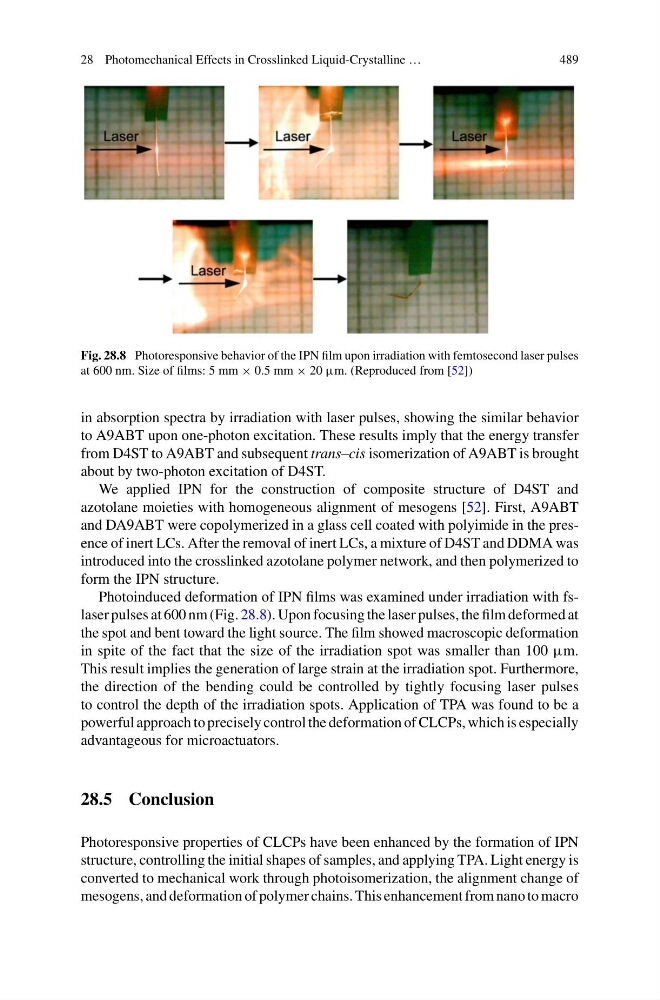
Fig. 28.8 Photoresponsive behavior of the IPN film upon irradiation with femtosecond laser pulses
at 600 nm. Size of films: 5 mm × 0.5 mm × 20 µm. (Reproduced from [52])
in absorption spectra by irradiation with laser pulses, showing the similar behavior
to A9ABT upon one-photon excitation. These results imply that the energy transfer
from D4ST to A9ABT and subsequent trans–cis isomerization of A9ABT is brought
about by two-photon excitation of D4ST.
We applied IPN for the construction of composite structure of D4ST and
azotolane moieties with homogeneous alignment of mesogens [52]. First, A9ABT
and DA9ABT were copolymerized in a glass cell coated with polyimide in the presence of inert LCs. After the removal of inert LCs, a mixture of D4ST and DDMA was
introduced into the crosslinked azotolane polymer network, and then polymerized to
form the IPN structure.
Photoinduced deformation of IPN films was examined under irradiation with fslaser pulses at 600 nm (Fig. 28.8). Upon focusing the laser pulses, the film deformed at
the spot and bent toward the light source. The film showed macroscopic deformation
in spite of the fact that the size of the irradiation spot was smaller than 100 µm.
This result implies the generation of large strain at the irradiation spot. Furthermore,
the direction of the bending could be controlled by tightly focusing laser pulses
to control the depth of the irradiation spots. Application of TPA was found to be a
powerful approach to precisely control the deformation of CLCPs, which is especially
advantageous for microactuators.
28.5 Conclusion
Photoresponsive properties of CLCPs have been enhanced by the formation of IPN
structure, controlling the initial shapes of samples, and applying TPA. Light energy is
converted to mechanical work through photoisomerization, the alignment change of
mesogens, and deformation of polymer chains. This enhancement from nano to macro
489
Fig. 28.8 Photoresponsive behavior of the IPN film upon irradiation with femtosecond laser pulses
at 600 nm. Size of films: 5 mm × 0.5 mm × 20 µm. (Reproduced from [52])
in absorption spectra by irradiation with laser pulses, showing the similar behavior
to A9ABT upon one-photon excitation. These results imply that the energy transfer
from D4ST to A9ABT and subsequent trans–cis isomerization of A9ABT is brought
about by two-photon excitation of D4ST.
We applied IPN for the construction of composite structure of D4ST and
azotolane moieties with homogeneous alignment of mesogens [52]. First, A9ABT
and DA9ABT were copolymerized in a glass cell coated with polyimide in the presence of inert LCs. After the removal of inert LCs, a mixture of D4ST and DDMA was
introduced into the crosslinked azotolane polymer network, and then polymerized to
form the IPN structure.
Photoinduced deformation of IPN films was examined under irradiation with fslaser pulses at 600 nm (Fig. 28.8). Upon focusing the laser pulses, the film deformed at
the spot and bent toward the light source. The film showed macroscopic deformation
in spite of the fact that the size of the irradiation spot was smaller than 100 µm.
This result implies the generation of large strain at the irradiation spot. Furthermore,
the direction of the bending could be controlled by tightly focusing laser pulses
to control the depth of the irradiation spots. Application of TPA was found to be a
powerful approach to precisely control the deformation of CLCPs, which is especially
advantageous for microactuators.
28.5 Conclusion
Photoresponsive properties of CLCPs have been enhanced by the formation of IPN
structure, controlling the initial shapes of samples, and applying TPA. Light energy is
converted to mechanical work through photoisomerization, the alignment change of
mesogens, and deformation of polymer chains. This enhancement from nano to macro