

488
T. Ube and T. Ikeda
to control 3D deformation is inducing localized strain by inhomogeneous irradiation
with the aid of spatial selectivity of light. For example, light-driven plastic motors
have been realized by irradiating adequate spots of a CLCP ring to generate torque
[27]. Controlling the intensity gradient of incident light has enabled manipulation of
fluid slugs in LCP microtubes [41] and wave-like motions of CLCPs [42]. Continuous
motions such as oscillation [43, 44] and wave propagation [45] have been demonstrated by self-shadowing effect under controlled incident direction. Therefore, the
precise control of irradiation spots is essential to induce sophisticated motions. In
conventional CLCP actuators based on one-photon absorption, the surface facing to
the light source absorbs actinic light in accordance with Beer-Lambert law, limiting
the 3D selection of irradiation spots.
We focused on two-photon absorption (TPA) to induce deformation of CLCPs
with high spatial selectivity. As the efficiency of TPA is proportional to the square of
the intensity of incident light, chromophores near the focal spot, even those located
deeply within a sample, can be selectively excited [46–48]. Application of TPA for
photoactuation of CLCPs allows 3D control of actuation spots, which enhances the
degree of freedom and preciseness of the photoinduced deformation.
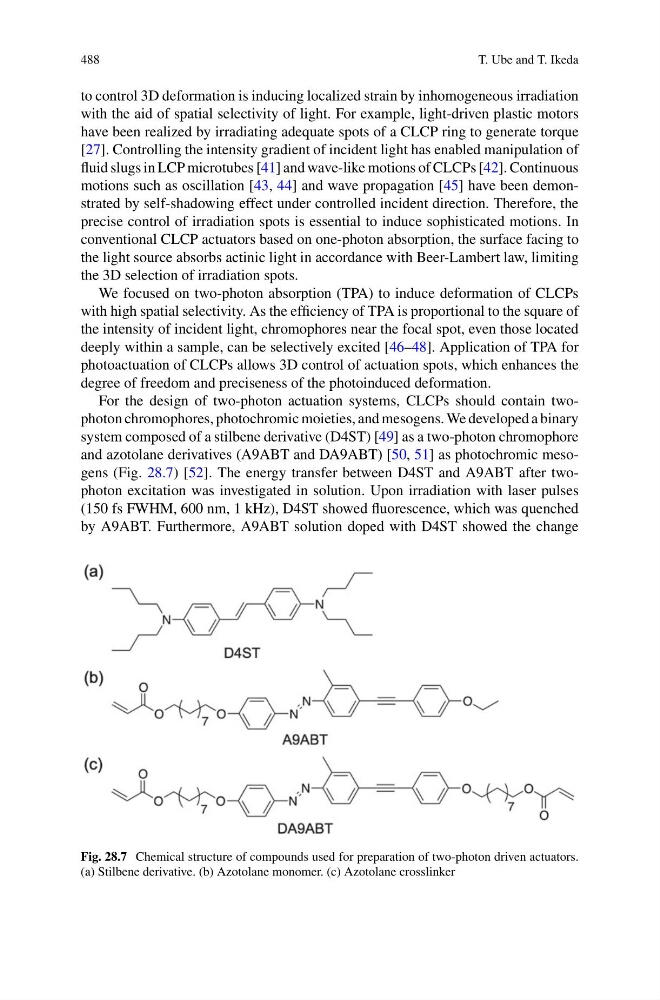
For the design of two-photon actuation systems, CLCPs should contain twophoton chromophores, photochromic moieties, and mesogens. We developed a binary
system composed of a stilbene derivative (D4ST) [49] as a two-photon chromophore
and azotolane derivatives (A9ABT and DA9ABT) [50, 51] as photochromic mesogens (Fig. 28.7) [52]. The energy transfer between D4ST and A9ABT after twophoton excitation was investigated in solution. Upon irradiation with laser pulses
(150 fs FWHM, 600 nm, 1 kHz), D4ST showed fluorescence, which was quenched
by A9ABT. Furthermore, A9ABT solution doped with D4ST showed the change
Fig. 28.7 Chemical structure of compounds used for preparation of two-photon driven actuators.
(a) Stilbene derivative. (b) Azotolane monomer. (c) Azotolane crosslinker
T. Ube and T. Ikeda
to control 3D deformation is inducing localized strain by inhomogeneous irradiation
with the aid of spatial selectivity of light. For example, light-driven plastic motors
have been realized by irradiating adequate spots of a CLCP ring to generate torque
[27]. Controlling the intensity gradient of incident light has enabled manipulation of
fluid slugs in LCP microtubes [41] and wave-like motions of CLCPs [42]. Continuous
motions such as oscillation [43, 44] and wave propagation [45] have been demonstrated by self-shadowing effect under controlled incident direction. Therefore, the
precise control of irradiation spots is essential to induce sophisticated motions. In
conventional CLCP actuators based on one-photon absorption, the surface facing to
the light source absorbs actinic light in accordance with Beer-Lambert law, limiting
the 3D selection of irradiation spots.
We focused on two-photon absorption (TPA) to induce deformation of CLCPs
with high spatial selectivity. As the efficiency of TPA is proportional to the square of
the intensity of incident light, chromophores near the focal spot, even those located
deeply within a sample, can be selectively excited [46–48]. Application of TPA for
photoactuation of CLCPs allows 3D control of actuation spots, which enhances the
degree of freedom and preciseness of the photoinduced deformation.
For the design of two-photon actuation systems, CLCPs should contain twophoton chromophores, photochromic moieties, and mesogens. We developed a binary
system composed of a stilbene derivative (D4ST) [49] as a two-photon chromophore
and azotolane derivatives (A9ABT and DA9ABT) [50, 51] as photochromic mesogens (Fig. 28.7) [52]. The energy transfer between D4ST and A9ABT after twophoton excitation was investigated in solution. Upon irradiation with laser pulses
(150 fs FWHM, 600 nm, 1 kHz), D4ST showed fluorescence, which was quenched
by A9ABT. Furthermore, A9ABT solution doped with D4ST showed the change
Fig. 28.7 Chemical structure of compounds used for preparation of two-photon driven actuators.
(a) Stilbene derivative. (b) Azotolane monomer. (c) Azotolane crosslinker