

28 Photomechanical Effects in Crosslinked Liquid-Crystalline …
487
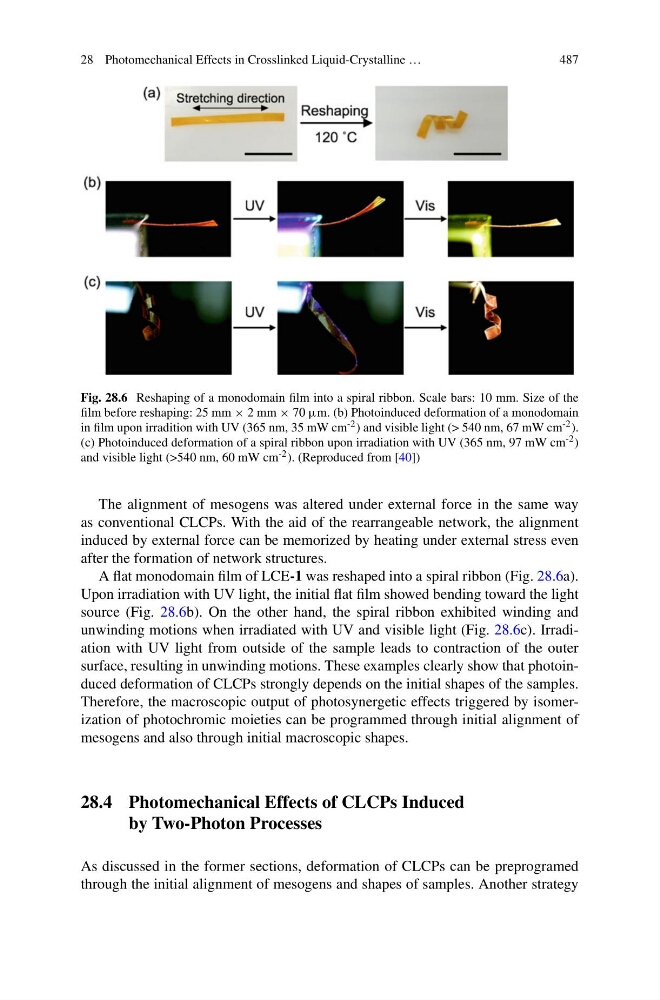
Fig. 28.6 Reshaping of a monodomain film into a spiral ribbon. Scale bars: 10 mm. Size of the
film before reshaping: 25 mm × 2 mm × 70 µm. (b) Photoinduced deformation of a monodomain
in film upon irradition with UV (365 nm, 35 mW cm -2 ) and visible light (> 540 nm, 67 mW cm -2 ).
(c) Photoinduced deformation of a spiral ribbon upon irradiation with UV (365 nm, 97 mW cm -2 )
and visible light (>540 nm, 60 mW cm -2 ). (Reproduced from [40])
The alignment of mesogens was altered under external force in the same way
as conventional CLCPs. With the aid of the rearrangeable network, the alignment
induced by external force can be memorized by heating under external stress even
after the formation of network structures.
A flat monodomain film of LCE-1 was reshaped into a spiral ribbon (Fig. 28.6a).
Upon irradiation with UV light, the initial flat film showed bending toward the light
source (Fig. 28.6b). On the other hand, the spiral ribbon exhibited winding and
unwinding motions when irradiated with UV and visible light (Fig. 28.6c). Irradiation with UV light from outside of the sample leads to contraction of the outer
surface, resulting in unwinding motions. These examples clearly show that photoinduced deformation of CLCPs strongly depends on the initial shapes of the samples.
Therefore, the macroscopic output of photosynergetic effects triggered by isomerization of photochromic moieties can be programmed through initial alignment of
mesogens and also through initial macroscopic shapes.
28.4 Photomechanical Effects of CLCPs Induced
by Two-Photon Processes
As discussed in the former sections, deformation of CLCPs can be preprogramed
through the initial alignment of mesogens and shapes of samples. Another strategy
487
Fig. 28.6 Reshaping of a monodomain film into a spiral ribbon. Scale bars: 10 mm. Size of the
film before reshaping: 25 mm × 2 mm × 70 µm. (b) Photoinduced deformation of a monodomain
in film upon irradition with UV (365 nm, 35 mW cm -2 ) and visible light (> 540 nm, 67 mW cm -2 ).
(c) Photoinduced deformation of a spiral ribbon upon irradiation with UV (365 nm, 97 mW cm -2 )
and visible light (>540 nm, 60 mW cm -2 ). (Reproduced from [40])
The alignment of mesogens was altered under external force in the same way
as conventional CLCPs. With the aid of the rearrangeable network, the alignment
induced by external force can be memorized by heating under external stress even
after the formation of network structures.
A flat monodomain film of LCE-1 was reshaped into a spiral ribbon (Fig. 28.6a).
Upon irradiation with UV light, the initial flat film showed bending toward the light
source (Fig. 28.6b). On the other hand, the spiral ribbon exhibited winding and
unwinding motions when irradiated with UV and visible light (Fig. 28.6c). Irradiation with UV light from outside of the sample leads to contraction of the outer
surface, resulting in unwinding motions. These examples clearly show that photoinduced deformation of CLCPs strongly depends on the initial shapes of the samples.
Therefore, the macroscopic output of photosynergetic effects triggered by isomerization of photochromic moieties can be programmed through initial alignment of
mesogens and also through initial macroscopic shapes.
28.4 Photomechanical Effects of CLCPs Induced
by Two-Photon Processes
As discussed in the former sections, deformation of CLCPs can be preprogramed
through the initial alignment of mesogens and shapes of samples. Another strategy