

27 Crawling and Bending Motions of Azobenzene Derivatives …
475
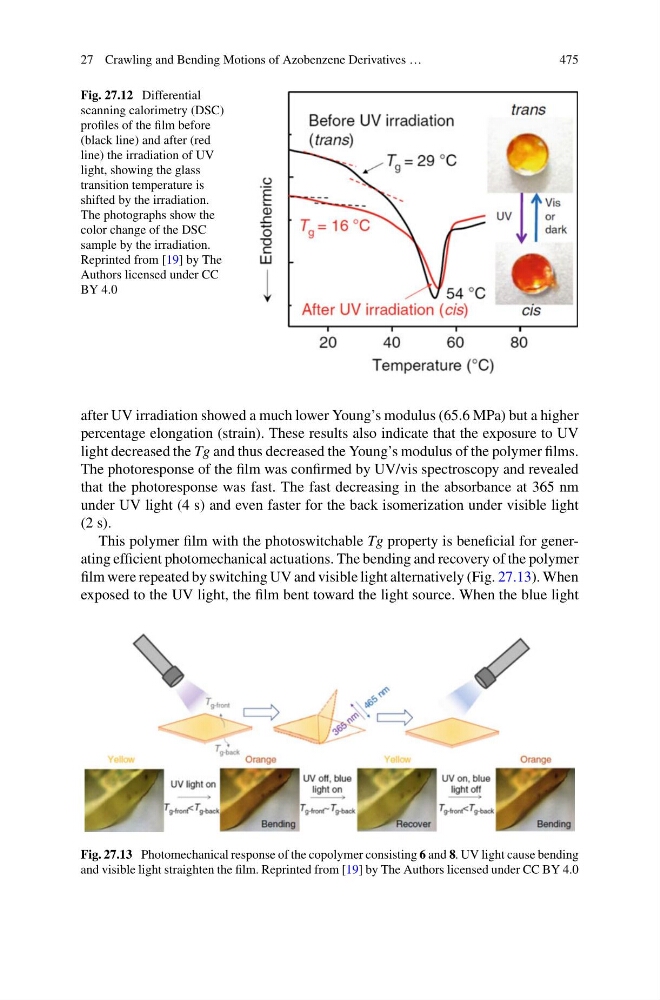
Fig. 27.12 Differential
scanning calorimetry (DSC)
profiles of the film before
(black line) and after (red
line) the irradiation of UV
light, showing the glass
transition temperature is
shifted by the irradiation.
The photographs show the
color change of the DSC
sample by the irradiation.
Reprinted from [19] by The
Authors licensed under CC
BY 4.0
after UV irradiation showed a much lower Young’s modulus (65.6 MPa) but a higher
percentage elongation (strain). These results also indicate that the exposure to UV
light decreased the Tg and thus decreased the Young’s modulus of the polymer films.
The photoresponse of the film was confirmed by UV/vis spectroscopy and revealed
that the photoresponse was fast. The fast decreasing in the absorbance at 365 nm
under UV light (4 s) and even faster for the back isomerization under visible light
(2 s).
This polymer film with the photoswitchable Tg property is beneficial for generating efficient photomechanical actuations. The bending and recovery of the polymer
film were repeated by switching UV and visible light alternatively (Fig. 27.13). When
exposed to the UV light, the film bent toward the light source. When the blue light
Fig. 27.13 Photomechanical response of the copolymer consisting 6 and 8. UV light cause bending
and visible light straighten the film. Reprinted from [19] by The Authors licensed under CC BY 4.0
475
Fig. 27.12 Differential
scanning calorimetry (DSC)
profiles of the film before
(black line) and after (red
line) the irradiation of UV
light, showing the glass
transition temperature is
shifted by the irradiation.
The photographs show the
color change of the DSC
sample by the irradiation.
Reprinted from [19] by The
Authors licensed under CC
BY 4.0
after UV irradiation showed a much lower Young’s modulus (65.6 MPa) but a higher
percentage elongation (strain). These results also indicate that the exposure to UV
light decreased the Tg and thus decreased the Young’s modulus of the polymer films.
The photoresponse of the film was confirmed by UV/vis spectroscopy and revealed
that the photoresponse was fast. The fast decreasing in the absorbance at 365 nm
under UV light (4 s) and even faster for the back isomerization under visible light
(2 s).
This polymer film with the photoswitchable Tg property is beneficial for generating efficient photomechanical actuations. The bending and recovery of the polymer
film were repeated by switching UV and visible light alternatively (Fig. 27.13). When
exposed to the UV light, the film bent toward the light source. When the blue light
Fig. 27.13 Photomechanical response of the copolymer consisting 6 and 8. UV light cause bending
and visible light straighten the film. Reprinted from [19] by The Authors licensed under CC BY 4.0