

474
Y. Norikane et al.
[19]. The azobenzene 6 exhibits a crystalline phase with its melting temperature of
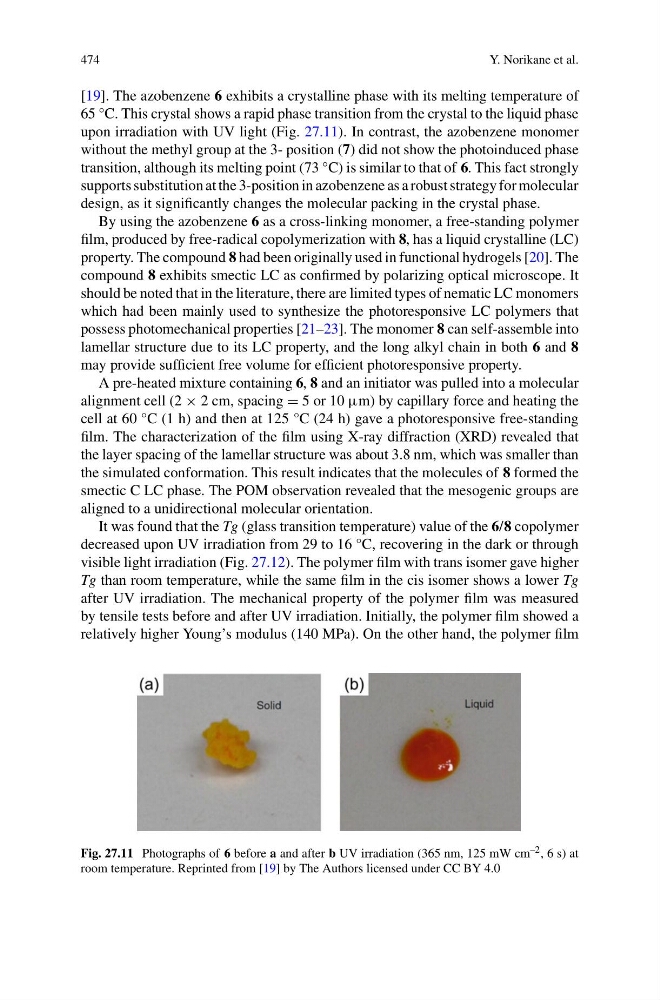
65 °C. This crystal shows a rapid phase transition from the crystal to the liquid phase
upon irradiation with UV light (Fig. 27.11). In contrast, the azobenzene monomer
without the methyl group at the 3- position (7) did not show the photoinduced phase
transition, although its melting point (73 °C) is similar to that of 6. This fact strongly
supports substitution at the 3-position in azobenzene as a robust strategy for molecular
design, as it significantly changes the molecular packing in the crystal phase.
By using the azobenzene 6 as a cross-linking monomer, a free-standing polymer
film, produced by free-radical copolymerization with 8, has a liquid crystalline (LC)
property. The compound 8 had been originally used in functional hydrogels [20]. The
compound 8 exhibits smectic LC as confirmed by polarizing optical microscope. It
should be noted that in the literature, there are limited types of nematic LC monomers
which had been mainly used to synthesize the photoresponsive LC polymers that
possess photomechanical properties [21–23]. The monomer 8 can self-assemble into
lamellar structure due to its LC property, and the long alkyl chain in both 6 and 8
may provide sufficient free volume for efficient photoresponsive property.
A pre-heated mixture containing 6, 8 and an initiator was pulled into a molecular
alignment cell (2 × 2 cm, spacing = 5 or 10 μm) by capillary force and heating the
cell at 60 °C (1 h) and then at 125 °C (24 h) gave a photoresponsive free-standing
film. The characterization of the film using X-ray diffraction (XRD) revealed that
the layer spacing of the lamellar structure was about 3.8 nm, which was smaller than
the simulated conformation. This result indicates that the molecules of 8 formed the
smectic C LC phase. The POM observation revealed that the mesogenic groups are
aligned to a unidirectional molecular orientation.
It was found that the Tg (glass transition temperature) value of the 6/8 copolymer
decreased upon UV irradiation from 29 to 16 °C, recovering in the dark or through
visible light irradiation (Fig. 27.12). The polymer film with trans isomer gave higher
Tg than room temperature, while the same film in the cis isomer shows a lower Tg
after UV irradiation. The mechanical property of the polymer film was measured
by tensile tests before and after UV irradiation. Initially, the polymer film showed a
relatively higher Young’s modulus (140 MPa). On the other hand, the polymer film
Fig. 27.11 Photographs of 6 before a and after b UV irradiation (365 nm, 125 mW cm –2 , 6 s) at
room temperature. Reprinted from [19] by The Authors licensed under CC BY 4.0
Y. Norikane et al.
[19]. The azobenzene 6 exhibits a crystalline phase with its melting temperature of
65 °C. This crystal shows a rapid phase transition from the crystal to the liquid phase
upon irradiation with UV light (Fig. 27.11). In contrast, the azobenzene monomer
without the methyl group at the 3- position (7) did not show the photoinduced phase
transition, although its melting point (73 °C) is similar to that of 6. This fact strongly
supports substitution at the 3-position in azobenzene as a robust strategy for molecular
design, as it significantly changes the molecular packing in the crystal phase.
By using the azobenzene 6 as a cross-linking monomer, a free-standing polymer
film, produced by free-radical copolymerization with 8, has a liquid crystalline (LC)
property. The compound 8 had been originally used in functional hydrogels [20]. The
compound 8 exhibits smectic LC as confirmed by polarizing optical microscope. It
should be noted that in the literature, there are limited types of nematic LC monomers
which had been mainly used to synthesize the photoresponsive LC polymers that
possess photomechanical properties [21–23]. The monomer 8 can self-assemble into
lamellar structure due to its LC property, and the long alkyl chain in both 6 and 8
may provide sufficient free volume for efficient photoresponsive property.
A pre-heated mixture containing 6, 8 and an initiator was pulled into a molecular
alignment cell (2 × 2 cm, spacing = 5 or 10 μm) by capillary force and heating the
cell at 60 °C (1 h) and then at 125 °C (24 h) gave a photoresponsive free-standing
film. The characterization of the film using X-ray diffraction (XRD) revealed that
the layer spacing of the lamellar structure was about 3.8 nm, which was smaller than
the simulated conformation. This result indicates that the molecules of 8 formed the
smectic C LC phase. The POM observation revealed that the mesogenic groups are
aligned to a unidirectional molecular orientation.
It was found that the Tg (glass transition temperature) value of the 6/8 copolymer
decreased upon UV irradiation from 29 to 16 °C, recovering in the dark or through
visible light irradiation (Fig. 27.12). The polymer film with trans isomer gave higher
Tg than room temperature, while the same film in the cis isomer shows a lower Tg
after UV irradiation. The mechanical property of the polymer film was measured
by tensile tests before and after UV irradiation. Initially, the polymer film showed a
relatively higher Young’s modulus (140 MPa). On the other hand, the polymer film
Fig. 27.11 Photographs of 6 before a and after b UV irradiation (365 nm, 125 mW cm –2 , 6 s) at
room temperature. Reprinted from [19] by The Authors licensed under CC BY 4.0