

476
Y. Norikane et al.
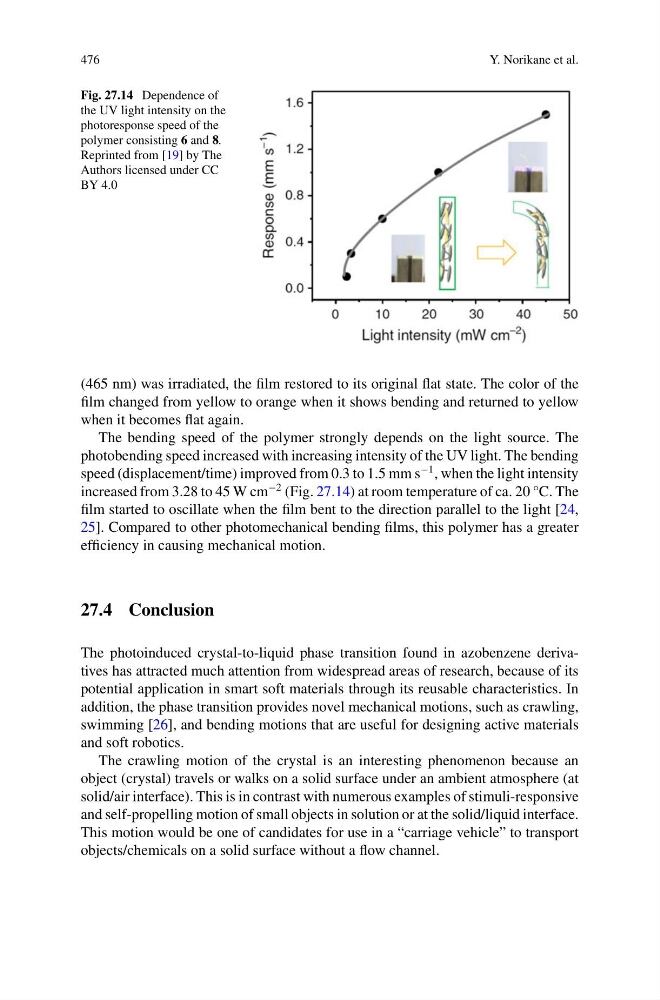
Fig. 27.14 Dependence of
the UV light intensity on the
photoresponse speed of the
polymer consisting 6 and 8.
Reprinted from [19] by The
Authors licensed under CC
BY 4.0
(465 nm) was irradiated, the film restored to its original flat state. The color of the
film changed from yellow to orange when it shows bending and returned to yellow
when it becomes flat again.
The bending speed of the polymer strongly depends on the light source. The
photobending speed increased with increasing intensity of the UV light. The bending
speed (displacement/time) improved from 0.3 to 1.5 mm s
−1 , when the light intensity
increased from 3.28 to 45 W cm
−2 (Fig. 27.14) at room temperature of ca. 20 °C. The
film started to oscillate when the film bent to the direction parallel to the light [24,
25]. Compared to other photomechanical bending films, this polymer has a greater
efficiency in causing mechanical motion.
27.4 Conclusion
The photoinduced crystal-to-liquid phase transition found in azobenzene derivatives has attracted much attention from widespread areas of research, because of its
potential application in smart soft materials through its reusable characteristics. In
addition, the phase transition provides novel mechanical motions, such as crawling,
swimming [26], and bending motions that are useful for designing active materials
and soft robotics.
The crawling motion of the crystal is an interesting phenomenon because an
object (crystal) travels or walks on a solid surface under an ambient atmosphere (at
solid/air interface). This is in contrast with numerous examples of stimuli-responsive
and self-propelling motion of small objects in solution or at the solid/liquid interface.
This motion would be one of candidates for use in a “carriage vehicle” to transport
objects/chemicals on a solid surface without a flow channel.
Y. Norikane et al.
Fig. 27.14 Dependence of
the UV light intensity on the
photoresponse speed of the
polymer consisting 6 and 8.
Reprinted from [19] by The
Authors licensed under CC
BY 4.0
(465 nm) was irradiated, the film restored to its original flat state. The color of the
film changed from yellow to orange when it shows bending and returned to yellow
when it becomes flat again.
The bending speed of the polymer strongly depends on the light source. The
photobending speed increased with increasing intensity of the UV light. The bending
speed (displacement/time) improved from 0.3 to 1.5 mm s
−1 , when the light intensity
increased from 3.28 to 45 W cm
−2 (Fig. 27.14) at room temperature of ca. 20 °C. The
film started to oscillate when the film bent to the direction parallel to the light [24,
25]. Compared to other photomechanical bending films, this polymer has a greater
efficiency in causing mechanical motion.
27.4 Conclusion
The photoinduced crystal-to-liquid phase transition found in azobenzene derivatives has attracted much attention from widespread areas of research, because of its
potential application in smart soft materials through its reusable characteristics. In
addition, the phase transition provides novel mechanical motions, such as crawling,
swimming [26], and bending motions that are useful for designing active materials
and soft robotics.
The crawling motion of the crystal is an interesting phenomenon because an
object (crystal) travels or walks on a solid surface under an ambient atmosphere (at
solid/air interface). This is in contrast with numerous examples of stimuli-responsive
and self-propelling motion of small objects in solution or at the solid/liquid interface.
This motion would be one of candidates for use in a “carriage vehicle” to transport
objects/chemicals on a solid surface without a flow channel.