

27 Crawling and Bending Motions of Azobenzene Derivatives …
471
corresponding cis isomer is known to be shorter. Especially, substituting an electrondonating amino group on the 4-position causes a decrease in the thermal isomerization
barrier by increasing the electron density in the π* orbital [3]. While trans-to-cis
isomerization occurs during irradiation, fast cis-to-trans thermal isomerization takes
place even during the irradiation. As light irradiation is not required to achieve
the cis-to-trans isomerization, only a single light source is needed to control the
photostationary state of this system. Thus, we attempted to use amino-substituted
azobenzenes to induce the crawling motion by using only one light source. We
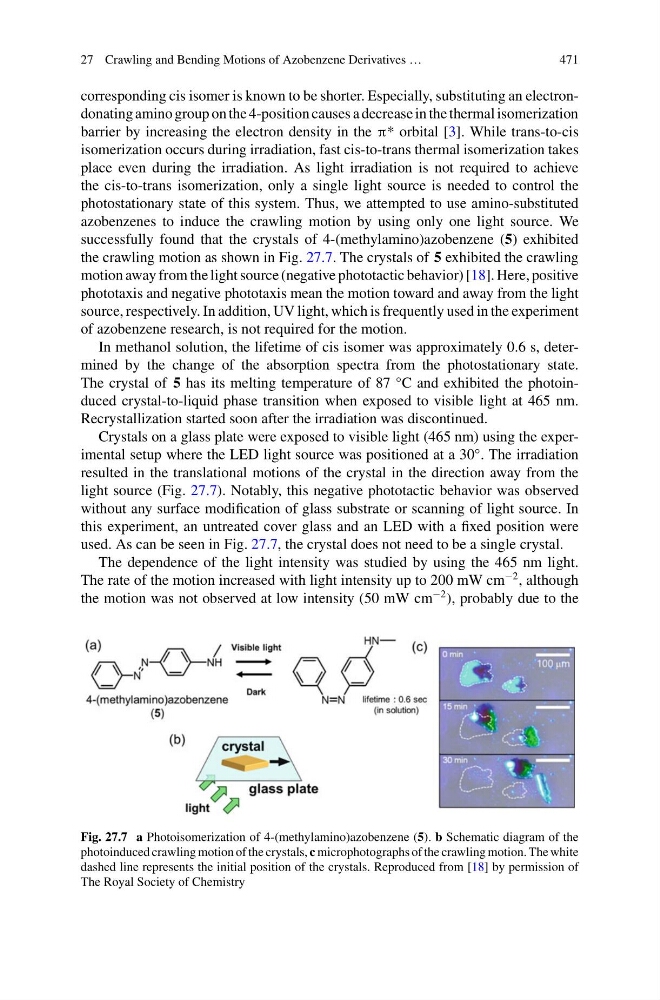
successfully found that the crystals of 4-(methylamino)azobenzene (5) exhibited
the crawling motion as shown in Fig. 27.7. The crystals of 5 exhibited the crawling
motion away from the light source (negative phototactic behavior) [18]. Here, positive
phototaxis and negative phototaxis mean the motion toward and away from the light
source, respectively. In addition, UV light, which is frequently used in the experiment
of azobenzene research, is not required for the motion.
In methanol solution, the lifetime of cis isomer was approximately 0.6 s, determined by the change of the absorption spectra from the photostationary state.
The crystal of 5 has its melting temperature of 87 °C and exhibited the photoinduced crystal-to-liquid phase transition when exposed to visible light at 465 nm.
Recrystallization started soon after the irradiation was discontinued.
Crystals on a glass plate were exposed to visible light (465 nm) using the experimental setup where the LED light source was positioned at a 30°. The irradiation
resulted in the translational motions of the crystal in the direction away from the
light source (Fig. 27.7). Notably, this negative phototactic behavior was observed
without any surface modification of glass substrate or scanning of light source. In
this experiment, an untreated cover glass and an LED with a fixed position were
used. As can be seen in Fig. 27.7, the crystal does not need to be a single crystal.
The dependence of the light intensity was studied by using the 465 nm light.
The rate of the motion increased with light intensity up to 200 mW cm
−2 , although
the motion was not observed at low intensity (50 mW cm
−2 ), probably due to the
Fig. 27.7 a Photoisomerization of 4-(methylamino)azobenzene (5). b Schematic diagram of the
photoinduced crawling motion of the crystals, c microphotographs of the crawling motion. The white
dashed line represents the initial position of the crystals. Reproduced from [18] by permission of
The Royal Society of Chemistry
471
corresponding cis isomer is known to be shorter. Especially, substituting an electrondonating amino group on the 4-position causes a decrease in the thermal isomerization
barrier by increasing the electron density in the π* orbital [3]. While trans-to-cis
isomerization occurs during irradiation, fast cis-to-trans thermal isomerization takes
place even during the irradiation. As light irradiation is not required to achieve
the cis-to-trans isomerization, only a single light source is needed to control the
photostationary state of this system. Thus, we attempted to use amino-substituted
azobenzenes to induce the crawling motion by using only one light source. We
successfully found that the crystals of 4-(methylamino)azobenzene (5) exhibited
the crawling motion as shown in Fig. 27.7. The crystals of 5 exhibited the crawling
motion away from the light source (negative phototactic behavior) [18]. Here, positive
phototaxis and negative phototaxis mean the motion toward and away from the light
source, respectively. In addition, UV light, which is frequently used in the experiment
of azobenzene research, is not required for the motion.
In methanol solution, the lifetime of cis isomer was approximately 0.6 s, determined by the change of the absorption spectra from the photostationary state.
The crystal of 5 has its melting temperature of 87 °C and exhibited the photoinduced crystal-to-liquid phase transition when exposed to visible light at 465 nm.
Recrystallization started soon after the irradiation was discontinued.
Crystals on a glass plate were exposed to visible light (465 nm) using the experimental setup where the LED light source was positioned at a 30°. The irradiation
resulted in the translational motions of the crystal in the direction away from the
light source (Fig. 27.7). Notably, this negative phototactic behavior was observed
without any surface modification of glass substrate or scanning of light source. In
this experiment, an untreated cover glass and an LED with a fixed position were
used. As can be seen in Fig. 27.7, the crystal does not need to be a single crystal.
The dependence of the light intensity was studied by using the 465 nm light.
The rate of the motion increased with light intensity up to 200 mW cm
−2 , although
the motion was not observed at low intensity (50 mW cm
−2 ), probably due to the
Fig. 27.7 a Photoisomerization of 4-(methylamino)azobenzene (5). b Schematic diagram of the
photoinduced crawling motion of the crystals, c microphotographs of the crawling motion. The white
dashed line represents the initial position of the crystals. Reproduced from [18] by permission of
The Royal Society of Chemistry