

472
Y. Norikane et al.
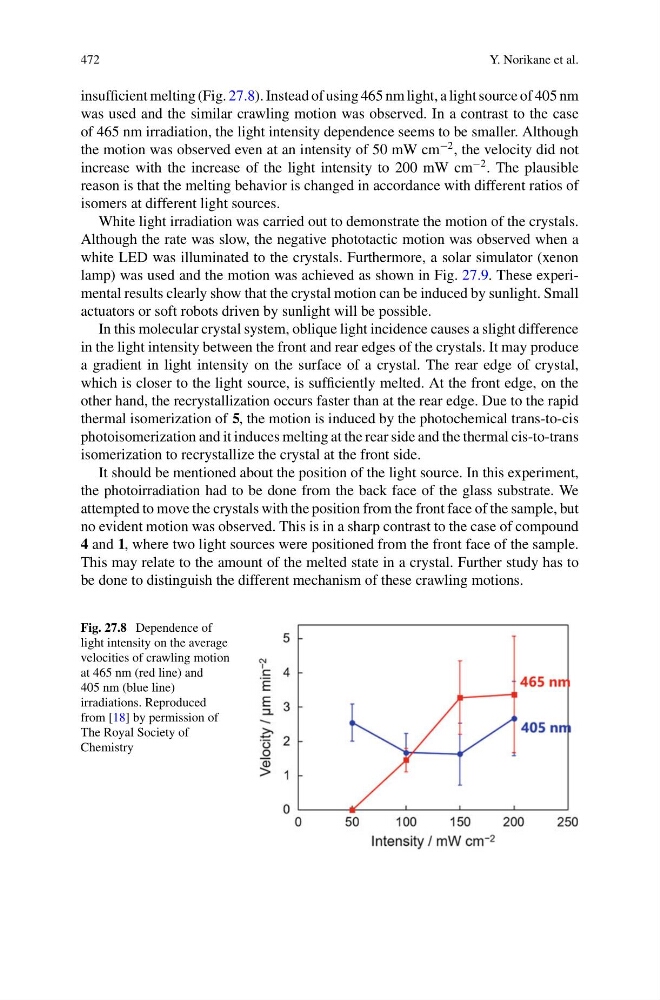
insufficient melting (Fig. 27.8). Instead of using 465 nm light, a light source of 405 nm
was used and the similar crawling motion was observed. In a contrast to the case
of 465 nm irradiation, the light intensity dependence seems to be smaller. Although
the motion was observed even at an intensity of 50 mW cm
−2 , the velocity did not
increase with the increase of the light intensity to 200 mW cm
−2 . The plausible
reason is that the melting behavior is changed in accordance with different ratios of
isomers at different light sources.
White light irradiation was carried out to demonstrate the motion of the crystals.
Although the rate was slow, the negative phototactic motion was observed when a
white LED was illuminated to the crystals. Furthermore, a solar simulator (xenon
lamp) was used and the motion was achieved as shown in Fig. 27.9. These experimental results clearly show that the crystal motion can be induced by sunlight. Small
actuators or soft robots driven by sunlight will be possible.
In this molecular crystal system, oblique light incidence causes a slight difference
in the light intensity between the front and rear edges of the crystals. It may produce
a gradient in light intensity on the surface of a crystal. The rear edge of crystal,
which is closer to the light source, is sufficiently melted. At the front edge, on the
other hand, the recrystallization occurs faster than at the rear edge. Due to the rapid
thermal isomerization of 5, the motion is induced by the photochemical trans-to-cis
photoisomerization and it induces melting at the rear side and the thermal cis-to-trans
isomerization to recrystallize the crystal at the front side.
It should be mentioned about the position of the light source. In this experiment,
the photoirradiation had to be done from the back face of the glass substrate. We
attempted to move the crystals with the position from the front face of the sample, but
no evident motion was observed. This is in a sharp contrast to the case of compound
4 and 1, where two light sources were positioned from the front face of the sample.
This may relate to the amount of the melted state in a crystal. Further study has to
be done to distinguish the different mechanism of these crawling motions.
Fig. 27.8 Dependence of
light intensity on the average
velocities of crawling motion
at 465 nm (red line) and
405 nm (blue line)
irradiations. Reproduced
from [18] by permission of
The Royal Society of
Chemistry
Y. Norikane et al.
insufficient melting (Fig. 27.8). Instead of using 465 nm light, a light source of 405 nm
was used and the similar crawling motion was observed. In a contrast to the case
of 465 nm irradiation, the light intensity dependence seems to be smaller. Although
the motion was observed even at an intensity of 50 mW cm
−2 , the velocity did not
increase with the increase of the light intensity to 200 mW cm
−2 . The plausible
reason is that the melting behavior is changed in accordance with different ratios of
isomers at different light sources.
White light irradiation was carried out to demonstrate the motion of the crystals.
Although the rate was slow, the negative phototactic motion was observed when a
white LED was illuminated to the crystals. Furthermore, a solar simulator (xenon
lamp) was used and the motion was achieved as shown in Fig. 27.9. These experimental results clearly show that the crystal motion can be induced by sunlight. Small
actuators or soft robots driven by sunlight will be possible.
In this molecular crystal system, oblique light incidence causes a slight difference
in the light intensity between the front and rear edges of the crystals. It may produce
a gradient in light intensity on the surface of a crystal. The rear edge of crystal,
which is closer to the light source, is sufficiently melted. At the front edge, on the
other hand, the recrystallization occurs faster than at the rear edge. Due to the rapid
thermal isomerization of 5, the motion is induced by the photochemical trans-to-cis
photoisomerization and it induces melting at the rear side and the thermal cis-to-trans
isomerization to recrystallize the crystal at the front side.
It should be mentioned about the position of the light source. In this experiment,
the photoirradiation had to be done from the back face of the glass substrate. We
attempted to move the crystals with the position from the front face of the sample, but
no evident motion was observed. This is in a sharp contrast to the case of compound
4 and 1, where two light sources were positioned from the front face of the sample.
This may relate to the amount of the melted state in a crystal. Further study has to
be done to distinguish the different mechanism of these crawling motions.
Fig. 27.8 Dependence of
light intensity on the average
velocities of crawling motion
at 465 nm (red line) and
405 nm (blue line)
irradiations. Reproduced
from [18] by permission of
The Royal Society of
Chemistry