

470
Y. Norikane et al.
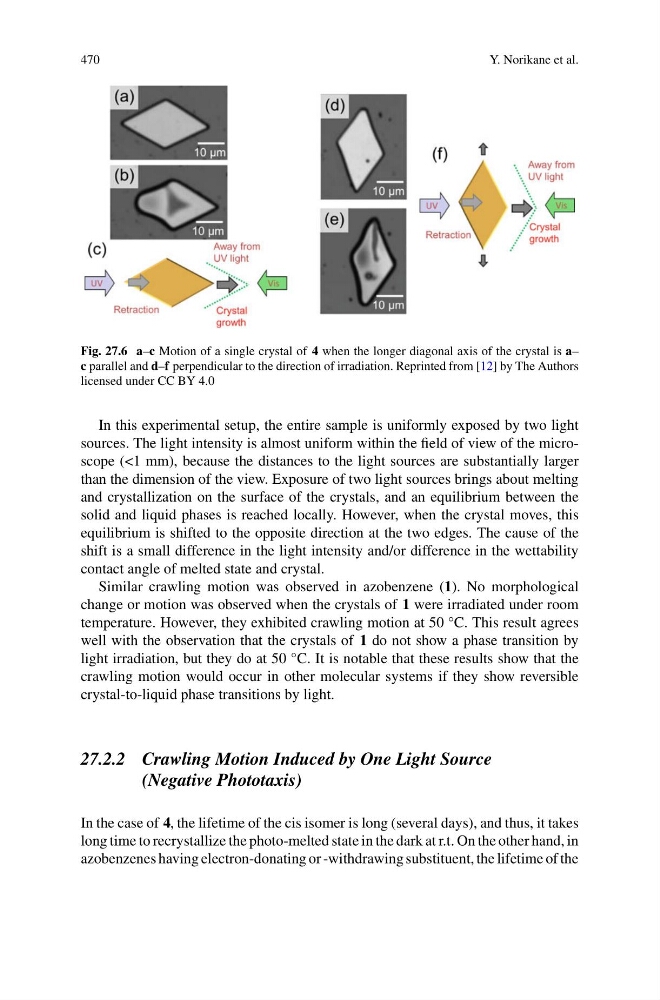
Fig. 27.6 a–c Motion of a single crystal of 4 when the longer diagonal axis of the crystal is a–
c parallel and d–f perpendicular to the direction of irradiation. Reprinted from [12] by The Authors
licensed under CC BY 4.0
In this experimental setup, the entire sample is uniformly exposed by two light
sources. The light intensity is almost uniform within the field of view of the microscope (<1 mm), because the distances to the light sources are substantially larger
than the dimension of the view. Exposure of two light sources brings about melting
and crystallization on the surface of the crystals, and an equilibrium between the
solid and liquid phases is reached locally. However, when the crystal moves, this
equilibrium is shifted to the opposite direction at the two edges. The cause of the
shift is a small difference in the light intensity and/or difference in the wettability
contact angle of melted state and crystal.
Similar crawling motion was observed in azobenzene (1). No morphological
change or motion was observed when the crystals of 1 were irradiated under room
temperature. However, they exhibited crawling motion at 50 °C. This result agrees
well with the observation that the crystals of 1 do not show a phase transition by
light irradiation, but they do at 50 °C. It is notable that these results show that the
crawling motion would occur in other molecular systems if they show reversible
crystal-to-liquid phase transitions by light.
27.2.2 Crawling Motion Induced by One Light Source
(Negative Phototaxis)
In the case of 4, the lifetime of the cis isomer is long (several days), and thus, it takes
long time to recrystallize the photo-melted state in the dark at r.t. On the other hand, in
azobenzenes having electron-donating or -withdrawing substituent, the lifetime of the
Y. Norikane et al.
Fig. 27.6 a–c Motion of a single crystal of 4 when the longer diagonal axis of the crystal is a–
c parallel and d–f perpendicular to the direction of irradiation. Reprinted from [12] by The Authors
licensed under CC BY 4.0
In this experimental setup, the entire sample is uniformly exposed by two light
sources. The light intensity is almost uniform within the field of view of the microscope (<1 mm), because the distances to the light sources are substantially larger
than the dimension of the view. Exposure of two light sources brings about melting
and crystallization on the surface of the crystals, and an equilibrium between the
solid and liquid phases is reached locally. However, when the crystal moves, this
equilibrium is shifted to the opposite direction at the two edges. The cause of the
shift is a small difference in the light intensity and/or difference in the wettability
contact angle of melted state and crystal.
Similar crawling motion was observed in azobenzene (1). No morphological
change or motion was observed when the crystals of 1 were irradiated under room
temperature. However, they exhibited crawling motion at 50 °C. This result agrees
well with the observation that the crystals of 1 do not show a phase transition by
light irradiation, but they do at 50 °C. It is notable that these results show that the
crawling motion would occur in other molecular systems if they show reversible
crystal-to-liquid phase transitions by light.
27.2.2 Crawling Motion Induced by One Light Source
(Negative Phototaxis)
In the case of 4, the lifetime of the cis isomer is long (several days), and thus, it takes
long time to recrystallize the photo-melted state in the dark at r.t. On the other hand, in
azobenzenes having electron-donating or -withdrawing substituent, the lifetime of the