

27 Crawling and Bending Motions of Azobenzene Derivatives …
469
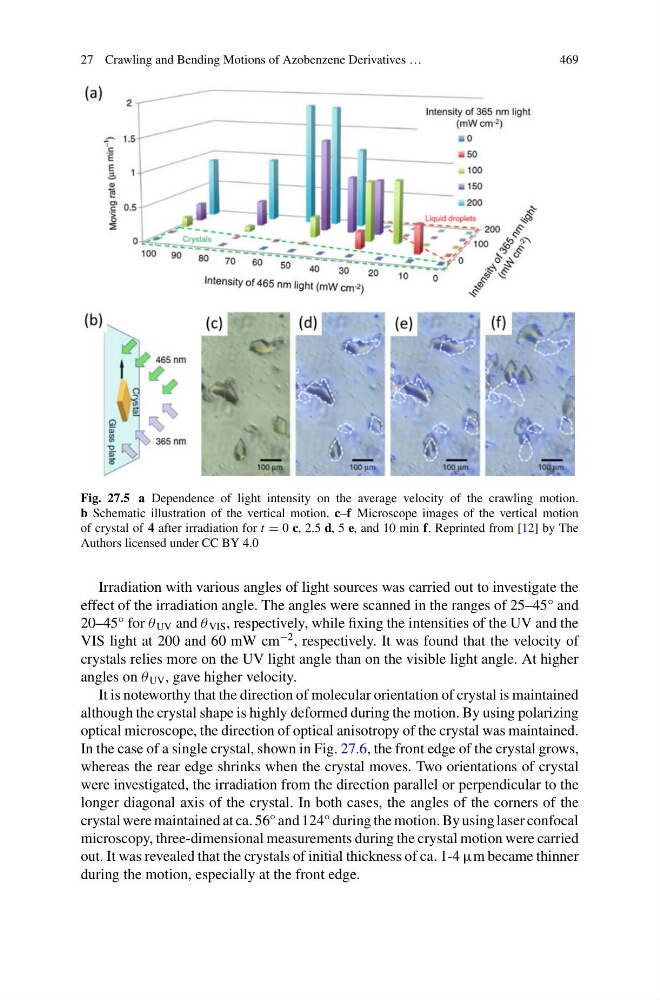
Fig. 27.5 a Dependence of light intensity on the average velocity of the crawling motion.
b Schematic illustration of the vertical motion. c–f Microscope images of the vertical motion
of crystal of 4 after irradiation for t = 0 c, 2.5 d, 5 e, and 10 min f. Reprinted from [12] by The
Authors licensed under CC BY 4.0
Irradiation with various angles of light sources was carried out to investigate the
effect of the irradiation angle. The angles were scanned in the ranges of 25–45° and
20–45° for θ UV and θ VIS , respectively, while fixing the intensities of the UV and the
VIS light at 200 and 60 mW cm
−2 , respectively. It was found that the velocity of
crystals relies more on the UV light angle than on the visible light angle. At higher
angles on θ UV , gave higher velocity.
It is noteworthy that the direction of molecular orientation of crystal is maintained
although the crystal shape is highly deformed during the motion. By using polarizing
optical microscope, the direction of optical anisotropy of the crystal was maintained.
In the case of a single crystal, shown in Fig. 27.6, the front edge of the crystal grows,
whereas the rear edge shrinks when the crystal moves. Two orientations of crystal
were investigated, the irradiation from the direction parallel or perpendicular to the
longer diagonal axis of the crystal. In both cases, the angles of the corners of the
crystal were maintained at ca. 56° and 124° during the motion. By using laser confocal
microscopy, three-dimensional measurements during the crystal motion were carried
out. It was revealed that the crystals of initial thickness of ca. 1-4 μm became thinner
during the motion, especially at the front edge.
469
Fig. 27.5 a Dependence of light intensity on the average velocity of the crawling motion.
b Schematic illustration of the vertical motion. c–f Microscope images of the vertical motion
of crystal of 4 after irradiation for t = 0 c, 2.5 d, 5 e, and 10 min f. Reprinted from [12] by The
Authors licensed under CC BY 4.0
Irradiation with various angles of light sources was carried out to investigate the
effect of the irradiation angle. The angles were scanned in the ranges of 25–45° and
20–45° for θ UV and θ VIS , respectively, while fixing the intensities of the UV and the
VIS light at 200 and 60 mW cm
−2 , respectively. It was found that the velocity of
crystals relies more on the UV light angle than on the visible light angle. At higher
angles on θ UV , gave higher velocity.
It is noteworthy that the direction of molecular orientation of crystal is maintained
although the crystal shape is highly deformed during the motion. By using polarizing
optical microscope, the direction of optical anisotropy of the crystal was maintained.
In the case of a single crystal, shown in Fig. 27.6, the front edge of the crystal grows,
whereas the rear edge shrinks when the crystal moves. Two orientations of crystal
were investigated, the irradiation from the direction parallel or perpendicular to the
longer diagonal axis of the crystal. In both cases, the angles of the corners of the
crystal were maintained at ca. 56° and 124° during the motion. By using laser confocal
microscopy, three-dimensional measurements during the crystal motion were carried
out. It was revealed that the crystals of initial thickness of ca. 1-4 μm became thinner
during the motion, especially at the front edge.