

468
Y. Norikane et al.
device is required. As another advantages, no special treatment on the surface, such
as chemical modification [13–15], spatial gradients [16], or application of ratchet
potential [17], is required.
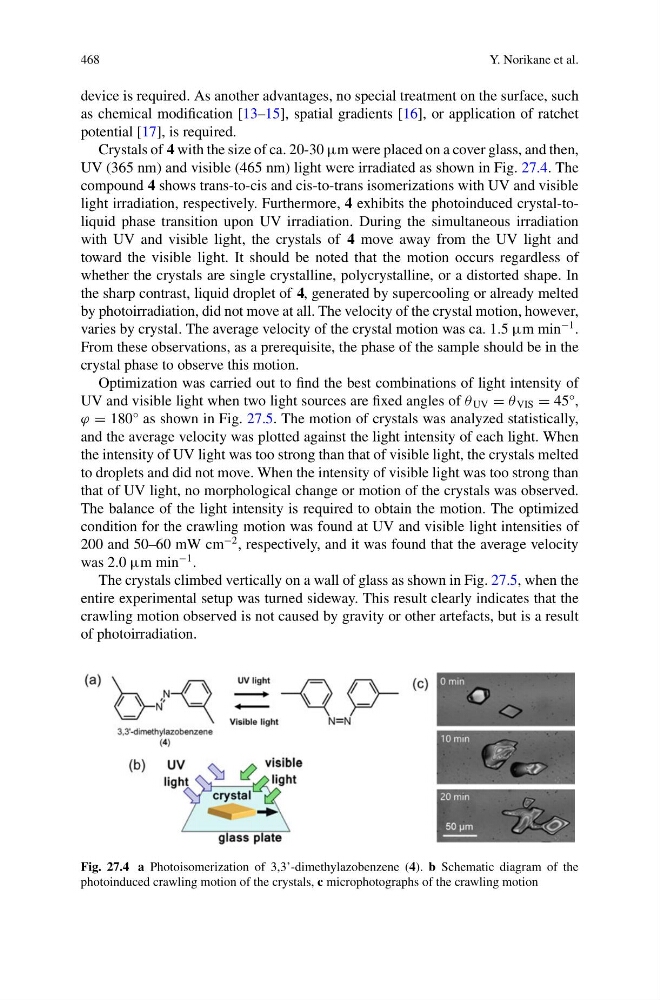
Crystals of 4 with the size of ca. 20-30 μm were placed on a cover glass, and then,
UV (365 nm) and visible (465 nm) light were irradiated as shown in Fig. 27.4. The
compound 4 shows trans-to-cis and cis-to-trans isomerizations with UV and visible
light irradiation, respectively. Furthermore, 4 exhibits the photoinduced crystal-toliquid phase transition upon UV irradiation. During the simultaneous irradiation
with UV and visible light, the crystals of 4 move away from the UV light and
toward the visible light. It should be noted that the motion occurs regardless of
whether the crystals are single crystalline, polycrystalline, or a distorted shape. In
the sharp contrast, liquid droplet of 4, generated by supercooling or already melted
by photoirradiation, did not move at all. The velocity of the crystal motion, however,
varies by crystal. The average velocity of the crystal motion was ca. 1.5 μm min
−1 .
From these observations, as a prerequisite, the phase of the sample should be in the
crystal phase to observe this motion.
Optimization was carried out to find the best combinations of light intensity of
UV and visible light when two light sources are fixed angles of θ UV = θ VIS = 45°,
ϕ = 180° as shown in Fig. 27.5. The motion of crystals was analyzed statistically,
and the average velocity was plotted against the light intensity of each light. When
the intensity of UV light was too strong than that of visible light, the crystals melted
to droplets and did not move. When the intensity of visible light was too strong than
that of UV light, no morphological change or motion of the crystals was observed.
The balance of the light intensity is required to obtain the motion. The optimized
condition for the crawling motion was found at UV and visible light intensities of
200 and 50–60 mW cm
−2 , respectively, and it was found that the average velocity
was 2.0 μm min
−1 .
The crystals climbed vertically on a wall of glass as shown in Fig. 27.5, when the
entire experimental setup was turned sideway. This result clearly indicates that the
crawling motion observed is not caused by gravity or other artefacts, but is a result
of photoirradiation.
Fig. 27.4 a Photoisomerization of 3,3’-dimethylazobenzene (4). b Schematic diagram of the
photoinduced crawling motion of the crystals, c microphotographs of the crawling motion
Y. Norikane et al.
device is required. As another advantages, no special treatment on the surface, such
as chemical modification [13–15], spatial gradients [16], or application of ratchet
potential [17], is required.
Crystals of 4 with the size of ca. 20-30 μm were placed on a cover glass, and then,
UV (365 nm) and visible (465 nm) light were irradiated as shown in Fig. 27.4. The
compound 4 shows trans-to-cis and cis-to-trans isomerizations with UV and visible
light irradiation, respectively. Furthermore, 4 exhibits the photoinduced crystal-toliquid phase transition upon UV irradiation. During the simultaneous irradiation
with UV and visible light, the crystals of 4 move away from the UV light and
toward the visible light. It should be noted that the motion occurs regardless of
whether the crystals are single crystalline, polycrystalline, or a distorted shape. In
the sharp contrast, liquid droplet of 4, generated by supercooling or already melted
by photoirradiation, did not move at all. The velocity of the crystal motion, however,
varies by crystal. The average velocity of the crystal motion was ca. 1.5 μm min
−1 .
From these observations, as a prerequisite, the phase of the sample should be in the
crystal phase to observe this motion.
Optimization was carried out to find the best combinations of light intensity of
UV and visible light when two light sources are fixed angles of θ UV = θ VIS = 45°,
ϕ = 180° as shown in Fig. 27.5. The motion of crystals was analyzed statistically,
and the average velocity was plotted against the light intensity of each light. When
the intensity of UV light was too strong than that of visible light, the crystals melted
to droplets and did not move. When the intensity of visible light was too strong than
that of UV light, no morphological change or motion of the crystals was observed.
The balance of the light intensity is required to obtain the motion. The optimized
condition for the crawling motion was found at UV and visible light intensities of
200 and 50–60 mW cm
−2 , respectively, and it was found that the average velocity
was 2.0 μm min
−1 .
The crystals climbed vertically on a wall of glass as shown in Fig. 27.5, when the
entire experimental setup was turned sideway. This result clearly indicates that the
crawling motion observed is not caused by gravity or other artefacts, but is a result
of photoirradiation.
Fig. 27.4 a Photoisomerization of 3,3’-dimethylazobenzene (4). b Schematic diagram of the
photoinduced crawling motion of the crystals, c microphotographs of the crawling motion