

2 Advanced Electronic Structure Theory for High-Accuracy …
37
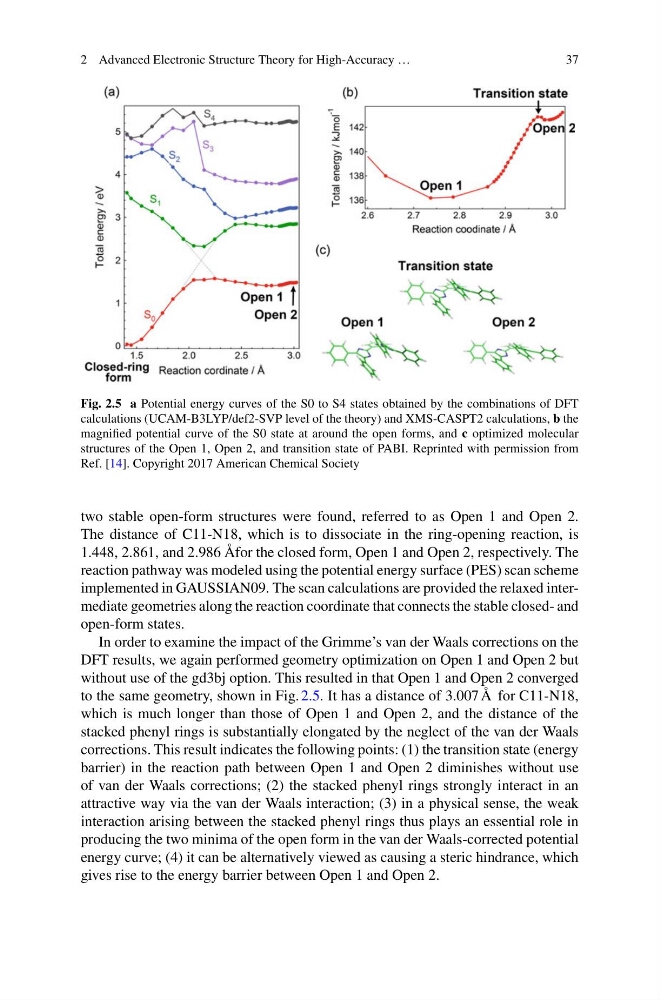
Fig. 2.5 a Potential energy curves of the S0 to S4 states obtained by the combinations of DFT
calculations (UCAM-B3LYP/def2-SVP level of the theory) and XMS-CASPT2 calculations, b the
magnified potential curve of the S0 state at around the open forms, and c optimized molecular
structures of the Open 1, Open 2, and transition state of PABI. Reprinted with permission from
Ref. [14]. Copyright 2017 American Chemical Society
two stable open-form structures were found, referred to as Open 1 and Open 2.
The distance of C11-N18, which is to dissociate in the ring-opening reaction, is
1.448, 2.861, and 2.986 Åfor the closed form, Open 1 and Open 2, respectively. The
reaction pathway was modeled using the potential energy surface (PES) scan scheme
implemented in GAUSSIAN09. The scan calculations are provided the relaxed intermediate geometries along the reaction coordinate that connects the stable closed- and
open-form states.
In order to examine the impact of the Grimme’s van der Waals corrections on the
DFT results, we again performed geometry optimization on Open 1 and Open 2 but
without use of the gd3bj option. This resulted in that Open 1 and Open 2 converged
to the same geometry, shown in Fig. 2.5. It has a distance of 3.007 Å for C11-N18,
which is much longer than those of Open 1 and Open 2, and the distance of the
stacked phenyl rings is substantially elongated by the neglect of the van der Waals
corrections. This result indicates the following points: (1) the transition state (energy
barrier) in the reaction path between Open 1 and Open 2 diminishes without use
of van der Waals corrections; (2) the stacked phenyl rings strongly interact in an
attractive way via the van der Waals interaction; (3) in a physical sense, the weak
interaction arising between the stacked phenyl rings thus plays an essential role in
producing the two minima of the open form in the van der Waals-corrected potential
energy curve; (4) it can be alternatively viewed as causing a steric hindrance, which
gives rise to the energy barrier between Open 1 and Open 2.
37
Fig. 2.5 a Potential energy curves of the S0 to S4 states obtained by the combinations of DFT
calculations (UCAM-B3LYP/def2-SVP level of the theory) and XMS-CASPT2 calculations, b the
magnified potential curve of the S0 state at around the open forms, and c optimized molecular
structures of the Open 1, Open 2, and transition state of PABI. Reprinted with permission from
Ref. [14]. Copyright 2017 American Chemical Society
two stable open-form structures were found, referred to as Open 1 and Open 2.
The distance of C11-N18, which is to dissociate in the ring-opening reaction, is
1.448, 2.861, and 2.986 Åfor the closed form, Open 1 and Open 2, respectively. The
reaction pathway was modeled using the potential energy surface (PES) scan scheme
implemented in GAUSSIAN09. The scan calculations are provided the relaxed intermediate geometries along the reaction coordinate that connects the stable closed- and
open-form states.
In order to examine the impact of the Grimme’s van der Waals corrections on the
DFT results, we again performed geometry optimization on Open 1 and Open 2 but
without use of the gd3bj option. This resulted in that Open 1 and Open 2 converged
to the same geometry, shown in Fig. 2.5. It has a distance of 3.007 Å for C11-N18,
which is much longer than those of Open 1 and Open 2, and the distance of the
stacked phenyl rings is substantially elongated by the neglect of the van der Waals
corrections. This result indicates the following points: (1) the transition state (energy
barrier) in the reaction path between Open 1 and Open 2 diminishes without use
of van der Waals corrections; (2) the stacked phenyl rings strongly interact in an
attractive way via the van der Waals interaction; (3) in a physical sense, the weak
interaction arising between the stacked phenyl rings thus plays an essential role in
producing the two minima of the open form in the van der Waals-corrected potential
energy curve; (4) it can be alternatively viewed as causing a steric hindrance, which
gives rise to the energy barrier between Open 1 and Open 2.