

36
T. Yanai
a
b
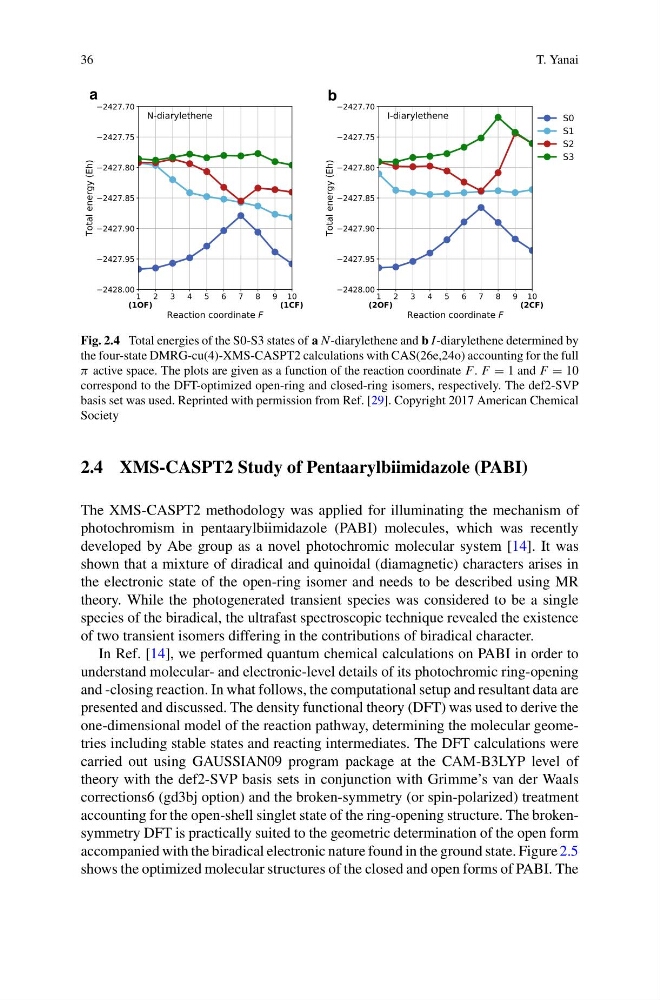
Fig. 2.4 Total energies of the S0-S3 states of a N-diarylethene and b I-diarylethene determined by
the four-state DMRG-cu(4)-XMS-CASPT2 calculations with CAS(26e,24o) accounting for the full
π active space. The plots are given as a function of the reaction coordinate F. F = 1 and F = 10
correspond to the DFT-optimized open-ring and closed-ring isomers, respectively. The def2-SVP
basis set was used. Reprinted with permission from Ref. [29]. Copyright 2017 American Chemical
Society
2.4 XMS-CASPT2 Study of Pentaarylbiimidazole (PABI)
The XMS-CASPT2 methodology was applied for illuminating the mechanism of
photochromism in pentaarylbiimidazole (PABI) molecules, which was recently
developed by Abe group as a novel photochromic molecular system [14]. It was
shown that a mixture of diradical and quinoidal (diamagnetic) characters arises in
the electronic state of the open-ring isomer and needs to be described using MR
theory. While the photogenerated transient species was considered to be a single
species of the biradical, the ultrafast spectroscopic technique revealed the existence
of two transient isomers differing in the contributions of biradical character.
In Ref. [14], we performed quantum chemical calculations on PABI in order to
understand molecular- and electronic-level details of its photochromic ring-opening
and -closing reaction. In what follows, the computational setup and resultant data are
presented and discussed. The density functional theory (DFT) was used to derive the
one-dimensional model of the reaction pathway, determining the molecular geometries including stable states and reacting intermediates. The DFT calculations were
carried out using GAUSSIAN09 program package at the CAM-B3LYP level of
theory with the def2-SVP basis sets in conjunction with Grimme’s van der Waals
corrections6 (gd3bj option) and the broken-symmetry (or spin-polarized) treatment
accounting for the open-shell singlet state of the ring-opening structure. The brokensymmetry DFT is practically suited to the geometric determination of the open form
accompanied with the biradical electronic nature found in the ground state. Figure 2.5
shows the optimized molecular structures of the closed and open forms of PABI. The
T. Yanai
a
b
Fig. 2.4 Total energies of the S0-S3 states of a N-diarylethene and b I-diarylethene determined by
the four-state DMRG-cu(4)-XMS-CASPT2 calculations with CAS(26e,24o) accounting for the full
π active space. The plots are given as a function of the reaction coordinate F. F = 1 and F = 10
correspond to the DFT-optimized open-ring and closed-ring isomers, respectively. The def2-SVP
basis set was used. Reprinted with permission from Ref. [29]. Copyright 2017 American Chemical
Society
2.4 XMS-CASPT2 Study of Pentaarylbiimidazole (PABI)
The XMS-CASPT2 methodology was applied for illuminating the mechanism of
photochromism in pentaarylbiimidazole (PABI) molecules, which was recently
developed by Abe group as a novel photochromic molecular system [14]. It was
shown that a mixture of diradical and quinoidal (diamagnetic) characters arises in
the electronic state of the open-ring isomer and needs to be described using MR
theory. While the photogenerated transient species was considered to be a single
species of the biradical, the ultrafast spectroscopic technique revealed the existence
of two transient isomers differing in the contributions of biradical character.
In Ref. [14], we performed quantum chemical calculations on PABI in order to
understand molecular- and electronic-level details of its photochromic ring-opening
and -closing reaction. In what follows, the computational setup and resultant data are
presented and discussed. The density functional theory (DFT) was used to derive the
one-dimensional model of the reaction pathway, determining the molecular geometries including stable states and reacting intermediates. The DFT calculations were
carried out using GAUSSIAN09 program package at the CAM-B3LYP level of
theory with the def2-SVP basis sets in conjunction with Grimme’s van der Waals
corrections6 (gd3bj option) and the broken-symmetry (or spin-polarized) treatment
accounting for the open-shell singlet state of the ring-opening structure. The brokensymmetry DFT is practically suited to the geometric determination of the open form
accompanied with the biradical electronic nature found in the ground state. Figure 2.5
shows the optimized molecular structures of the closed and open forms of PABI. The