

2 Advanced Electronic Structure Theory for High-Accuracy …
35
1
2
3
4
5
6
7
8
9
1 0
1 1
1 2
13
14
15
16
17
18
19
20
21
22
23
24
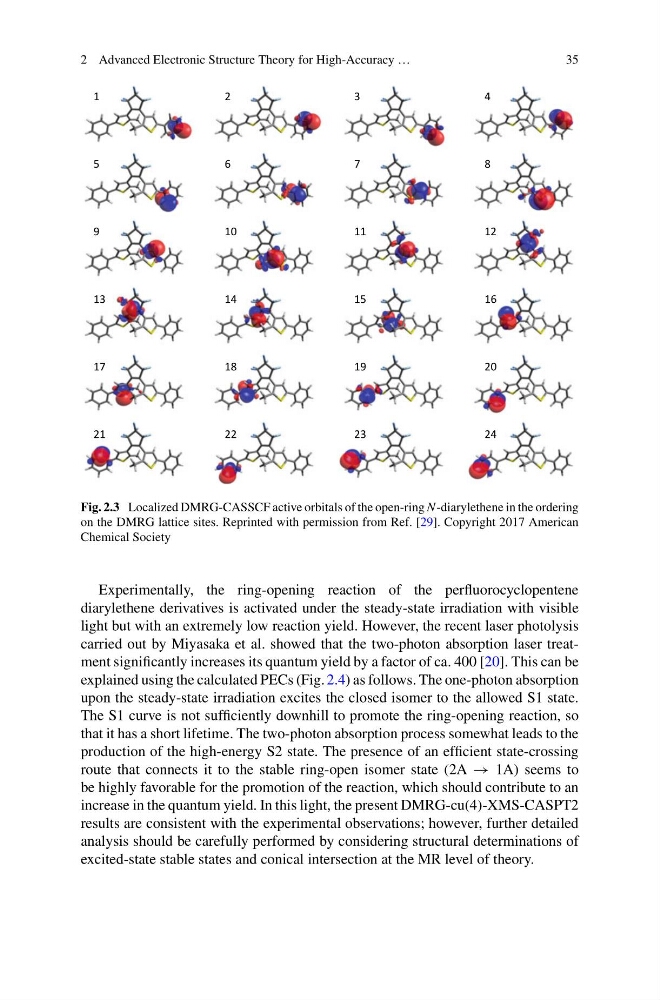
Fig. 2.3 Localized DMRG-CASSCF active orbitals of the open-ring N-diarylethene in the ordering
on the DMRG lattice sites. Reprinted with permission from Ref. [29]. Copyright 2017 American
Chemical Society
Experimentally, the ring-opening reaction of the perfluorocyclopentene
diarylethene derivatives is activated under the steady-state irradiation with visible
light but with an extremely low reaction yield. However, the recent laser photolysis
carried out by Miyasaka et al. showed that the two-photon absorption laser treatment significantly increases its quantum yield by a factor of ca. 400 [20]. This can be
explained using the calculated PECs (Fig. 2.4) as follows. The one-photon absorption
upon the steady-state irradiation excites the closed isomer to the allowed S1 state.
The S1 curve is not sufficiently downhill to promote the ring-opening reaction, so
that it has a short lifetime. The two-photon absorption process somewhat leads to the
production of the high-energy S2 state. The presence of an efficient state-crossing
route that connects it to the stable ring-open isomer state (2A → 1A) seems to
be highly favorable for the promotion of the reaction, which should contribute to an
increase in the quantum yield. In this light, the present DMRG-cu(4)-XMS-CASPT2
results are consistent with the experimental observations; however, further detailed
analysis should be carefully performed by considering structural determinations of
excited-state stable states and conical intersection at the MR level of theory.
35
1
2
3
4
5
6
7
8
9
1 0
1 1
1 2
13
14
15
16
17
18
19
20
21
22
23
24
Fig. 2.3 Localized DMRG-CASSCF active orbitals of the open-ring N-diarylethene in the ordering
on the DMRG lattice sites. Reprinted with permission from Ref. [29]. Copyright 2017 American
Chemical Society
Experimentally, the ring-opening reaction of the perfluorocyclopentene
diarylethene derivatives is activated under the steady-state irradiation with visible
light but with an extremely low reaction yield. However, the recent laser photolysis
carried out by Miyasaka et al. showed that the two-photon absorption laser treatment significantly increases its quantum yield by a factor of ca. 400 [20]. This can be
explained using the calculated PECs (Fig. 2.4) as follows. The one-photon absorption
upon the steady-state irradiation excites the closed isomer to the allowed S1 state.
The S1 curve is not sufficiently downhill to promote the ring-opening reaction, so
that it has a short lifetime. The two-photon absorption process somewhat leads to the
production of the high-energy S2 state. The presence of an efficient state-crossing
route that connects it to the stable ring-open isomer state (2A → 1A) seems to
be highly favorable for the promotion of the reaction, which should contribute to an
increase in the quantum yield. In this light, the present DMRG-cu(4)-XMS-CASPT2
results are consistent with the experimental observations; however, further detailed
analysis should be carefully performed by considering structural determinations of
excited-state stable states and conical intersection at the MR level of theory.