

34
T. Yanai
(1) N-diarylethene
(2) I-diarylethene
UV
Vis.
open-ring isomer
(1OF)
closed-ring isomer
(1CF)
UV
Vis.
open-ring isomer
(2OF)
closed-ring isomer
(2CF)
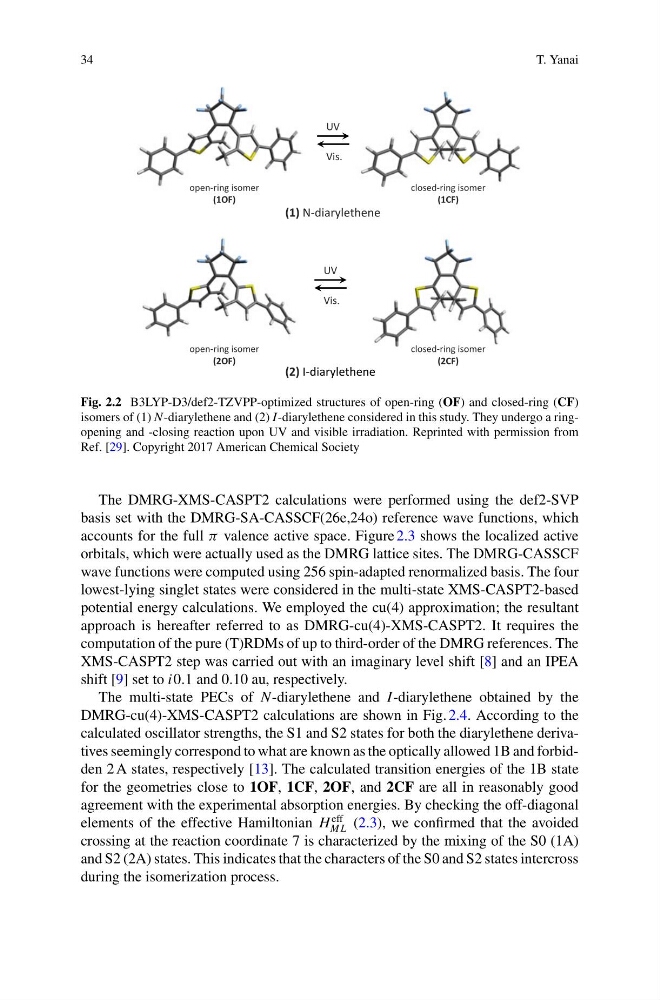
Fig. 2.2 B3LYP-D3/def2-TZVPP-optimized structures of open-ring (OF) and closed-ring (CF)
isomers of (1) N-diarylethene and (2) I-diarylethene considered in this study. They undergo a ringopening and -closing reaction upon UV and visible irradiation. Reprinted with permission from
Ref. [29]. Copyright 2017 American Chemical Society
The DMRG-XMS-CASPT2 calculations were performed using the def2-SVP
basis set with the DMRG-SA-CASSCF(26e,24o) reference wave functions, which
accounts for the full π valence active space. Figure 2.3 shows the localized active
orbitals, which were actually used as the DMRG lattice sites. The DMRG-CASSCF
wave functions were computed using 256 spin-adapted renormalized basis. The four
lowest-lying singlet states were considered in the multi-state XMS-CASPT2-based
potential energy calculations. We employed the cu(4) approximation; the resultant
approach is hereafter referred to as DMRG-cu(4)-XMS-CASPT2. It requires the
computation of the pure (T)RDMs of up to third-order of the DMRG references. The
XMS-CASPT2 step was carried out with an imaginary level shift [8] and an IPEA
shift [9] set to i0.1 and 0.10 au, respectively.
The multi-state PECs of N-diarylethene and I-diarylethene obtained by the
DMRG-cu(4)-XMS-CASPT2 calculations are shown in Fig. 2.4. According to the
calculated oscillator strengths, the S1 and S2 states for both the diarylethene derivatives seemingly correspond to what are known as the optically allowed 1B and forbidden 2 A states, respectively [13]. The calculated transition energies of the 1B state
for the geometries close to 1OF, 1CF, 2OF, and 2CF are all in reasonably good
agreement with the experimental absorption energies. By checking the off-diagonal
elements of the effective Hamiltonian H
eff
M L (2.3), we confirmed that the avoided
crossing at the reaction coordinate 7 is characterized by the mixing of the S0 (1A)
and S2 (2A) states. This indicates that the characters of the S0 and S2 states intercross
during the isomerization process.
T. Yanai
(1) N-diarylethene
(2) I-diarylethene
UV
Vis.
open-ring isomer
(1OF)
closed-ring isomer
(1CF)
UV
Vis.
open-ring isomer
(2OF)
closed-ring isomer
(2CF)
Fig. 2.2 B3LYP-D3/def2-TZVPP-optimized structures of open-ring (OF) and closed-ring (CF)
isomers of (1) N-diarylethene and (2) I-diarylethene considered in this study. They undergo a ringopening and -closing reaction upon UV and visible irradiation. Reprinted with permission from
Ref. [29]. Copyright 2017 American Chemical Society
The DMRG-XMS-CASPT2 calculations were performed using the def2-SVP
basis set with the DMRG-SA-CASSCF(26e,24o) reference wave functions, which
accounts for the full π valence active space. Figure 2.3 shows the localized active
orbitals, which were actually used as the DMRG lattice sites. The DMRG-CASSCF
wave functions were computed using 256 spin-adapted renormalized basis. The four
lowest-lying singlet states were considered in the multi-state XMS-CASPT2-based
potential energy calculations. We employed the cu(4) approximation; the resultant
approach is hereafter referred to as DMRG-cu(4)-XMS-CASPT2. It requires the
computation of the pure (T)RDMs of up to third-order of the DMRG references. The
XMS-CASPT2 step was carried out with an imaginary level shift [8] and an IPEA
shift [9] set to i0.1 and 0.10 au, respectively.
The multi-state PECs of N-diarylethene and I-diarylethene obtained by the
DMRG-cu(4)-XMS-CASPT2 calculations are shown in Fig. 2.4. According to the
calculated oscillator strengths, the S1 and S2 states for both the diarylethene derivatives seemingly correspond to what are known as the optically allowed 1B and forbidden 2 A states, respectively [13]. The calculated transition energies of the 1B state
for the geometries close to 1OF, 1CF, 2OF, and 2CF are all in reasonably good
agreement with the experimental absorption energies. By checking the off-diagonal
elements of the effective Hamiltonian H
eff
M L (2.3), we confirmed that the avoided
crossing at the reaction coordinate 7 is characterized by the mixing of the S0 (1A)
and S2 (2A) states. This indicates that the characters of the S0 and S2 states intercross
during the isomerization process.