

38
T. Yanai
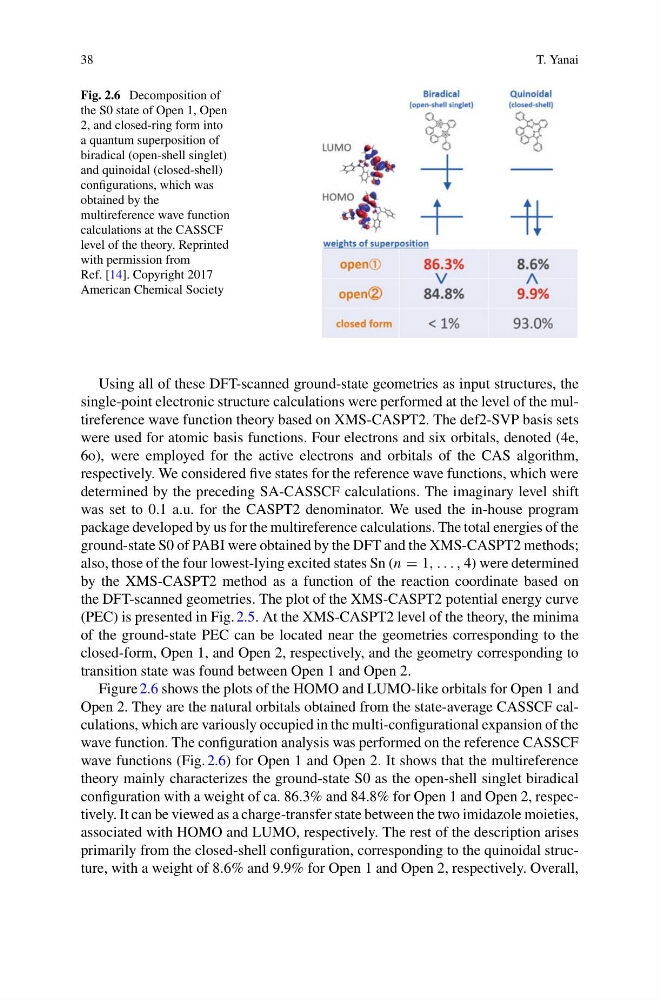
Fig. 2.6 Decomposition of
the S0 state of Open 1, Open
2, and closed-ring form into
a quantum superposition of
biradical (open-shell singlet)
and quinoidal (closed-shell)
configurations, which was
obtained by the
multireference wave function
calculations at the CASSCF
level of the theory. Reprinted
with permission from
Ref. [14]. Copyright 2017
American Chemical Society
Using all of these DFT-scanned ground-state geometries as input structures, the
single-point electronic structure calculations were performed at the level of the multireference wave function theory based on XMS-CASPT2. The def2-SVP basis sets
were used for atomic basis functions. Four electrons and six orbitals, denoted (4e,
6o), were employed for the active electrons and orbitals of the CAS algorithm,
respectively. We considered five states for the reference wave functions, which were
determined by the preceding SA-CASSCF calculations. The imaginary level shift
was set to 0.1 a.u. for the CASPT2 denominator. We used the in-house program
package developed by us for the multireference calculations. The total energies of the
ground-state S0 of PABI were obtained by the DFT and the XMS-CASPT2 methods;
also, those of the four lowest-lying excited states Sn (n = 1, . . . , 4) were determined
by the XMS-CASPT2 method as a function of the reaction coordinate based on
the DFT-scanned geometries. The plot of the XMS-CASPT2 potential energy curve
(PEC) is presented in Fig. 2.5. At the XMS-CASPT2 level of the theory, the minima
of the ground-state PEC can be located near the geometries corresponding to the
closed-form, Open 1, and Open 2, respectively, and the geometry corresponding to
transition state was found between Open 1 and Open 2.
Figure 2.6 shows the plots of the HOMO and LUMO-like orbitals for Open 1 and
Open 2. They are the natural orbitals obtained from the state-average CASSCF calculations, which are variously occupied in the multi-configurational expansion of the
wave function. The configuration analysis was performed on the reference CASSCF
wave functions (Fig. 2.6) for Open 1 and Open 2. It shows that the multireference
theory mainly characterizes the ground-state S0 as the open-shell singlet biradical
configuration with a weight of ca. 86.3% and 84.8% for Open 1 and Open 2, respectively. It can be viewed as a charge-transfer state between the two imidazole moieties,
associated with HOMO and LUMO, respectively. The rest of the description arises
primarily from the closed-shell configuration, corresponding to the quinoidal structure, with a weight of 8.6% and 9.9% for Open 1 and Open 2, respectively. Overall,
T. Yanai
Fig. 2.6 Decomposition of
the S0 state of Open 1, Open
2, and closed-ring form into
a quantum superposition of
biradical (open-shell singlet)
and quinoidal (closed-shell)
configurations, which was
obtained by the
multireference wave function
calculations at the CASSCF
level of the theory. Reprinted
with permission from
Ref. [14]. Copyright 2017
American Chemical Society
Using all of these DFT-scanned ground-state geometries as input structures, the
single-point electronic structure calculations were performed at the level of the multireference wave function theory based on XMS-CASPT2. The def2-SVP basis sets
were used for atomic basis functions. Four electrons and six orbitals, denoted (4e,
6o), were employed for the active electrons and orbitals of the CAS algorithm,
respectively. We considered five states for the reference wave functions, which were
determined by the preceding SA-CASSCF calculations. The imaginary level shift
was set to 0.1 a.u. for the CASPT2 denominator. We used the in-house program
package developed by us for the multireference calculations. The total energies of the
ground-state S0 of PABI were obtained by the DFT and the XMS-CASPT2 methods;
also, those of the four lowest-lying excited states Sn (n = 1, . . . , 4) were determined
by the XMS-CASPT2 method as a function of the reaction coordinate based on
the DFT-scanned geometries. The plot of the XMS-CASPT2 potential energy curve
(PEC) is presented in Fig. 2.5. At the XMS-CASPT2 level of the theory, the minima
of the ground-state PEC can be located near the geometries corresponding to the
closed-form, Open 1, and Open 2, respectively, and the geometry corresponding to
transition state was found between Open 1 and Open 2.
Figure 2.6 shows the plots of the HOMO and LUMO-like orbitals for Open 1 and
Open 2. They are the natural orbitals obtained from the state-average CASSCF calculations, which are variously occupied in the multi-configurational expansion of the
wave function. The configuration analysis was performed on the reference CASSCF
wave functions (Fig. 2.6) for Open 1 and Open 2. It shows that the multireference
theory mainly characterizes the ground-state S0 as the open-shell singlet biradical
configuration with a weight of ca. 86.3% and 84.8% for Open 1 and Open 2, respectively. It can be viewed as a charge-transfer state between the two imidazole moieties,
associated with HOMO and LUMO, respectively. The rest of the description arises
primarily from the closed-shell configuration, corresponding to the quinoidal structure, with a weight of 8.6% and 9.9% for Open 1 and Open 2, respectively. Overall,