

26 Interplay of Photoisomerization and Phase Transition Events …
453
structural change
structural change
structural change
structural change
light spot
light spot
light spot
light spot
fixed
fixed
fixed
fixed
light
light
light
light
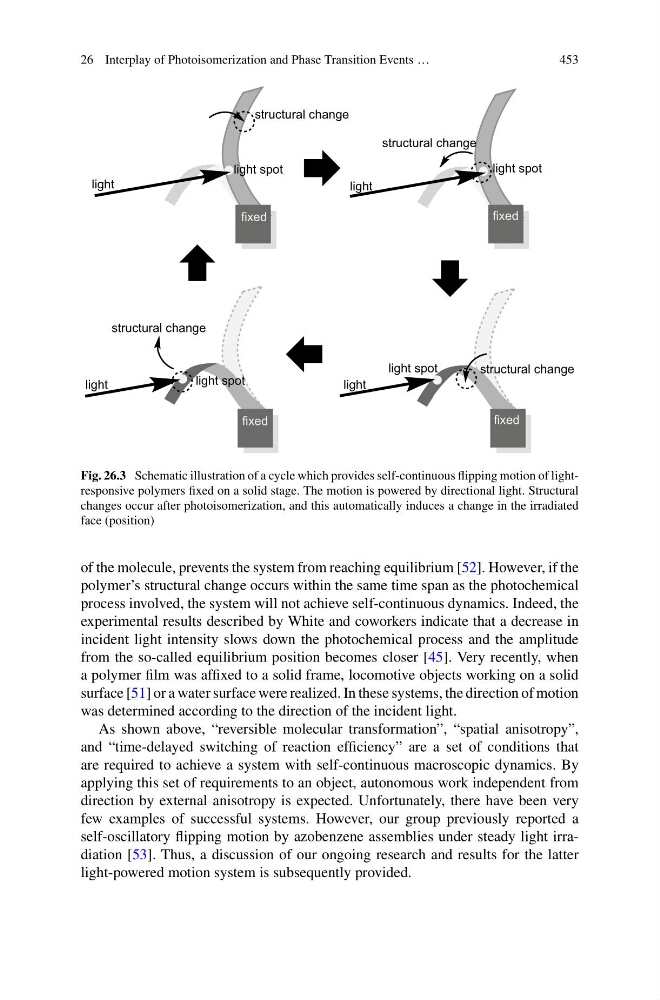
Fig. 26.3 Schematic illustration of a cycle which provides self-continuous flipping motion of lightresponsive polymers fixed on a solid stage. The motion is powered by directional light. Structural
changes occur after photoisomerization, and this automatically induces a change in the irradiated
face (position)
of the molecule, prevents the system from reaching equilibrium [52]. However, if the
polymer’s structural change occurs within the same time span as the photochemical
process involved, the system will not achieve self-continuous dynamics. Indeed, the
experimental results described by White and coworkers indicate that a decrease in
incident light intensity slows down the photochemical process and the amplitude
from the so-called equilibrium position becomes closer [45]. Very recently, when
a polymer film was affixed to a solid frame, locomotive objects working on a solid
surface [51] or a water surface were realized. In these systems, the direction of motion
was determined according to the direction of the incident light.
As shown above, “reversible molecular transformation”, “spatial anisotropy”,
and “time-delayed switching of reaction efficiency” are a set of conditions that
are required to achieve a system with self-continuous macroscopic dynamics. By
applying this set of requirements to an object, autonomous work independent from
direction by external anisotropy is expected. Unfortunately, there have been very
few examples of successful systems. However, our group previously reported a
self-oscillatory flipping motion by azobenzene assemblies under steady light irradiation [53]. Thus, a discussion of our ongoing research and results for the latter
light-powered motion system is subsequently provided.
453
structural change
structural change
structural change
structural change
light spot
light spot
light spot
light spot
fixed
fixed
fixed
fixed
light
light
light
light
Fig. 26.3 Schematic illustration of a cycle which provides self-continuous flipping motion of lightresponsive polymers fixed on a solid stage. The motion is powered by directional light. Structural
changes occur after photoisomerization, and this automatically induces a change in the irradiated
face (position)
of the molecule, prevents the system from reaching equilibrium [52]. However, if the
polymer’s structural change occurs within the same time span as the photochemical
process involved, the system will not achieve self-continuous dynamics. Indeed, the
experimental results described by White and coworkers indicate that a decrease in
incident light intensity slows down the photochemical process and the amplitude
from the so-called equilibrium position becomes closer [45]. Very recently, when
a polymer film was affixed to a solid frame, locomotive objects working on a solid
surface [51] or a water surface were realized. In these systems, the direction of motion
was determined according to the direction of the incident light.
As shown above, “reversible molecular transformation”, “spatial anisotropy”,
and “time-delayed switching of reaction efficiency” are a set of conditions that
are required to achieve a system with self-continuous macroscopic dynamics. By
applying this set of requirements to an object, autonomous work independent from
direction by external anisotropy is expected. Unfortunately, there have been very
few examples of successful systems. However, our group previously reported a
self-oscillatory flipping motion by azobenzene assemblies under steady light irradiation [53]. Thus, a discussion of our ongoing research and results for the latter
light-powered motion system is subsequently provided.