

454
Y. Kageyama
26.2 Realization of Self-Oscillatory Flipping Motion
of Azobenzene Assemblies
The theory of self-organization in continuous dynamics was established based on a
series of studies of dissipative structures [54]. This type of structure is dynamic, yet
it maintains an ordered configuration, in the presence of an energy source. In regard
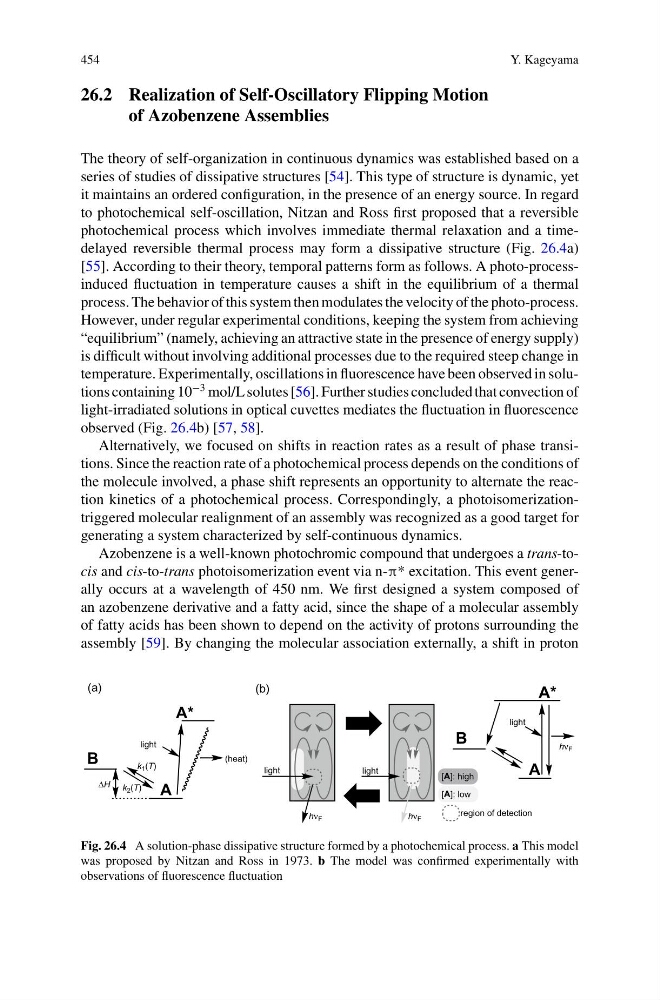
to photochemical self-oscillation, Nitzan and Ross first proposed that a reversible
photochemical process which involves immediate thermal relaxation and a timedelayed reversible thermal process may form a dissipative structure (Fig. 26.4a)
[55]. According to their theory, temporal patterns form as follows. A photo-processinduced fluctuation in temperature causes a shift in the equilibrium of a thermal
process. The behavior of this system then modulates the velocity of the photo-process.
However, under regular experimental conditions, keeping the system from achieving
“equilibrium” (namely, achieving an attractive state in the presence of energy supply)
is difficult without involving additional processes due to the required steep change in
temperature. Experimentally, oscillations in fluorescence have been observed in solutions containing 10
−3 mol/L solutes [56]. Further studies concluded that convection of
light-irradiated solutions in optical cuvettes mediates the fluctuation in fluorescence
observed (Fig. 26.4b) [57, 58].
Alternatively, we focused on shifts in reaction rates as a result of phase transitions. Since the reaction rate of a photochemical process depends on the conditions of
the molecule involved, a phase shift represents an opportunity to alternate the reaction kinetics of a photochemical process. Correspondingly, a photoisomerizationtriggered molecular realignment of an assembly was recognized as a good target for
generating a system characterized by self-continuous dynamics.
Azobenzene is a well-known photochromic compound that undergoes a trans-tocis and cis-to-trans photoisomerization event via n-π* excitation. This event generally occurs at a wavelength of 450 nm. We first designed a system composed of
an azobenzene derivative and a fatty acid, since the shape of a molecular assembly
of fatty acids has been shown to depend on the activity of protons surrounding the
assembly [59]. By changing the molecular association externally, a shift in proton
light
(heat)
A
A*
B
k 1 (T)
k 2 (T)
hν F
hν F
region of detection
(a)
(b)
ΔH
light
A
A*
B
hν F
[A]: low
[A]: high
light
light
Fig. 26.4 A solution-phase dissipative structure formed by a photochemical process. a This model
was proposed by Nitzan and Ross in 1973. b The model was confirmed experimentally with
observations of fluorescence fluctuation
Y. Kageyama
26.2 Realization of Self-Oscillatory Flipping Motion
of Azobenzene Assemblies
The theory of self-organization in continuous dynamics was established based on a
series of studies of dissipative structures [54]. This type of structure is dynamic, yet
it maintains an ordered configuration, in the presence of an energy source. In regard
to photochemical self-oscillation, Nitzan and Ross first proposed that a reversible
photochemical process which involves immediate thermal relaxation and a timedelayed reversible thermal process may form a dissipative structure (Fig. 26.4a)
[55]. According to their theory, temporal patterns form as follows. A photo-processinduced fluctuation in temperature causes a shift in the equilibrium of a thermal
process. The behavior of this system then modulates the velocity of the photo-process.
However, under regular experimental conditions, keeping the system from achieving
“equilibrium” (namely, achieving an attractive state in the presence of energy supply)
is difficult without involving additional processes due to the required steep change in
temperature. Experimentally, oscillations in fluorescence have been observed in solutions containing 10
−3 mol/L solutes [56]. Further studies concluded that convection of
light-irradiated solutions in optical cuvettes mediates the fluctuation in fluorescence
observed (Fig. 26.4b) [57, 58].
Alternatively, we focused on shifts in reaction rates as a result of phase transitions. Since the reaction rate of a photochemical process depends on the conditions of
the molecule involved, a phase shift represents an opportunity to alternate the reaction kinetics of a photochemical process. Correspondingly, a photoisomerizationtriggered molecular realignment of an assembly was recognized as a good target for
generating a system characterized by self-continuous dynamics.
Azobenzene is a well-known photochromic compound that undergoes a trans-tocis and cis-to-trans photoisomerization event via n-π* excitation. This event generally occurs at a wavelength of 450 nm. We first designed a system composed of
an azobenzene derivative and a fatty acid, since the shape of a molecular assembly
of fatty acids has been shown to depend on the activity of protons surrounding the
assembly [59]. By changing the molecular association externally, a shift in proton
light
(heat)
A
A*
B
k 1 (T)
k 2 (T)
hν F
hν F
region of detection
(a)
(b)
ΔH
light
A
A*
B
hν F
[A]: low
[A]: high
light
light
Fig. 26.4 A solution-phase dissipative structure formed by a photochemical process. a This model
was proposed by Nitzan and Ross in 1973. b The model was confirmed experimentally with
observations of fluorescence fluctuation