

440
S. Kobatake and D. Kitagawa
(a)
(b)
(b)
(c)
(d)
(e)
(f)
(g)
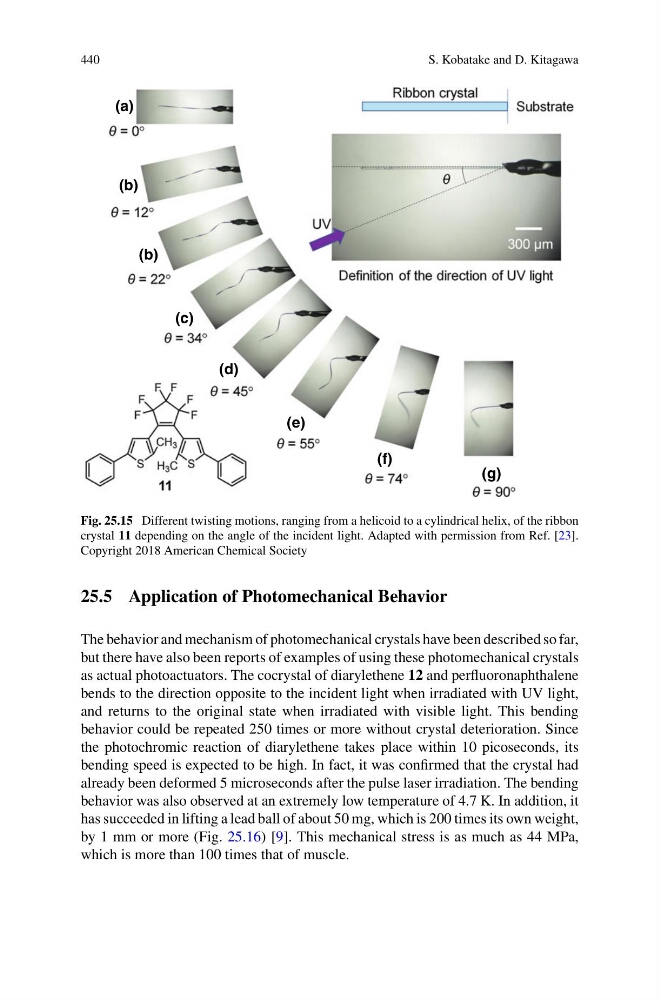
Fig. 25.15 Different twisting motions, ranging from a helicoid to a cylindrical helix, of the ribbon
crystal 11 depending on the angle of the incident light. Adapted with permission from Ref. [23].
Copyright 2018 American Chemical Society
25.5 Application of Photomechanical Behavior
The behavior and mechanism of photomechanical crystals have been described so far,
but there have also been reports of examples of using these photomechanical crystals
as actual photoactuators. The cocrystal of diarylethene 12 and perfluoronaphthalene
bends to the direction opposite to the incident light when irradiated with UV light,
and returns to the original state when irradiated with visible light. This bending
behavior could be repeated 250 times or more without crystal deterioration. Since
the photochromic reaction of diarylethene takes place within 10 picoseconds, its
bending speed is expected to be high. In fact, it was confirmed that the crystal had
already been deformed 5 microseconds after the pulse laser irradiation. The bending
behavior was also observed at an extremely low temperature of 4.7 K. In addition, it
has succeeded in lifting a lead ball of about 50 mg, which is 200 times its own weight,
by 1 mm or more (Fig. 25.16) [9]. This mechanical stress is as much as 44 MPa,
which is more than 100 times that of muscle.
S. Kobatake and D. Kitagawa
(a)
(b)
(b)
(c)
(d)
(e)
(f)
(g)
Fig. 25.15 Different twisting motions, ranging from a helicoid to a cylindrical helix, of the ribbon
crystal 11 depending on the angle of the incident light. Adapted with permission from Ref. [23].
Copyright 2018 American Chemical Society
25.5 Application of Photomechanical Behavior
The behavior and mechanism of photomechanical crystals have been described so far,
but there have also been reports of examples of using these photomechanical crystals
as actual photoactuators. The cocrystal of diarylethene 12 and perfluoronaphthalene
bends to the direction opposite to the incident light when irradiated with UV light,
and returns to the original state when irradiated with visible light. This bending
behavior could be repeated 250 times or more without crystal deterioration. Since
the photochromic reaction of diarylethene takes place within 10 picoseconds, its
bending speed is expected to be high. In fact, it was confirmed that the crystal had
already been deformed 5 microseconds after the pulse laser irradiation. The bending
behavior was also observed at an extremely low temperature of 4.7 K. In addition, it
has succeeded in lifting a lead ball of about 50 mg, which is 200 times its own weight,
by 1 mm or more (Fig. 25.16) [9]. This mechanical stress is as much as 44 MPa,
which is more than 100 times that of muscle.