

25 Photoresponsive Molecular Crystals …
439
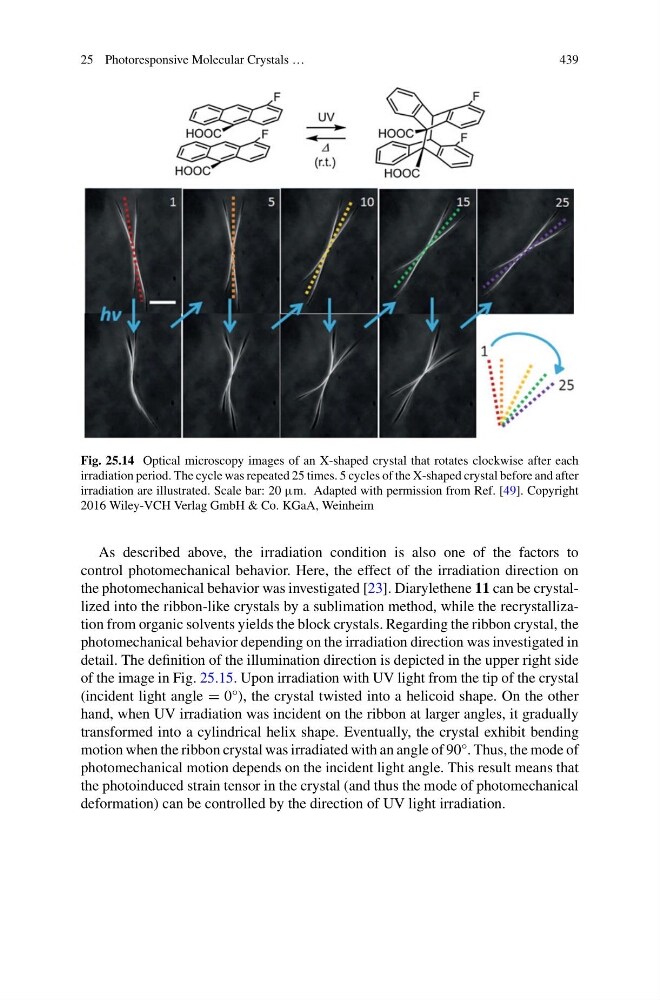
Fig. 25.14 Optical microscopy images of an X-shaped crystal that rotates clockwise after each
irradiation period. The cycle was repeated 25 times. 5 cycles of the X-shaped crystal before and after
irradiation are illustrated. Scale bar: 20 µm. Adapted with permission from Ref. [49]. Copyright
2016 Wiley-VCH Verlag GmbH & Co. KGaA, Weinheim
As described above, the irradiation condition is also one of the factors to
control photomechanical behavior. Here, the effect of the irradiation direction on
the photomechanical behavior was investigated [23]. Diarylethene 11 can be crystallized into the ribbon-like crystals by a sublimation method, while the recrystallization from organic solvents yields the block crystals. Regarding the ribbon crystal, the
photomechanical behavior depending on the irradiation direction was investigated in
detail. The definition of the illumination direction is depicted in the upper right side
of the image in Fig. 25.15. Upon irradiation with UV light from the tip of the crystal
(incident light angle = 0°), the crystal twisted into a helicoid shape. On the other
hand, when UV irradiation was incident on the ribbon at larger angles, it gradually
transformed into a cylindrical helix shape. Eventually, the crystal exhibit bending
motion when the ribbon crystal was irradiated with an angle of 90°. Thus, the mode of
photomechanical motion depends on the incident light angle. This result means that
the photoinduced strain tensor in the crystal (and thus the mode of photomechanical
deformation) can be controlled by the direction of UV light irradiation.
439
Fig. 25.14 Optical microscopy images of an X-shaped crystal that rotates clockwise after each
irradiation period. The cycle was repeated 25 times. 5 cycles of the X-shaped crystal before and after
irradiation are illustrated. Scale bar: 20 µm. Adapted with permission from Ref. [49]. Copyright
2016 Wiley-VCH Verlag GmbH & Co. KGaA, Weinheim
As described above, the irradiation condition is also one of the factors to
control photomechanical behavior. Here, the effect of the irradiation direction on
the photomechanical behavior was investigated [23]. Diarylethene 11 can be crystallized into the ribbon-like crystals by a sublimation method, while the recrystallization from organic solvents yields the block crystals. Regarding the ribbon crystal, the
photomechanical behavior depending on the irradiation direction was investigated in
detail. The definition of the illumination direction is depicted in the upper right side
of the image in Fig. 25.15. Upon irradiation with UV light from the tip of the crystal
(incident light angle = 0°), the crystal twisted into a helicoid shape. On the other
hand, when UV irradiation was incident on the ribbon at larger angles, it gradually
transformed into a cylindrical helix shape. Eventually, the crystal exhibit bending
motion when the ribbon crystal was irradiated with an angle of 90°. Thus, the mode of
photomechanical motion depends on the incident light angle. This result means that
the photoinduced strain tensor in the crystal (and thus the mode of photomechanical
deformation) can be controlled by the direction of UV light irradiation.