

438
S. Kobatake and D. Kitagawa
(a)
(b)
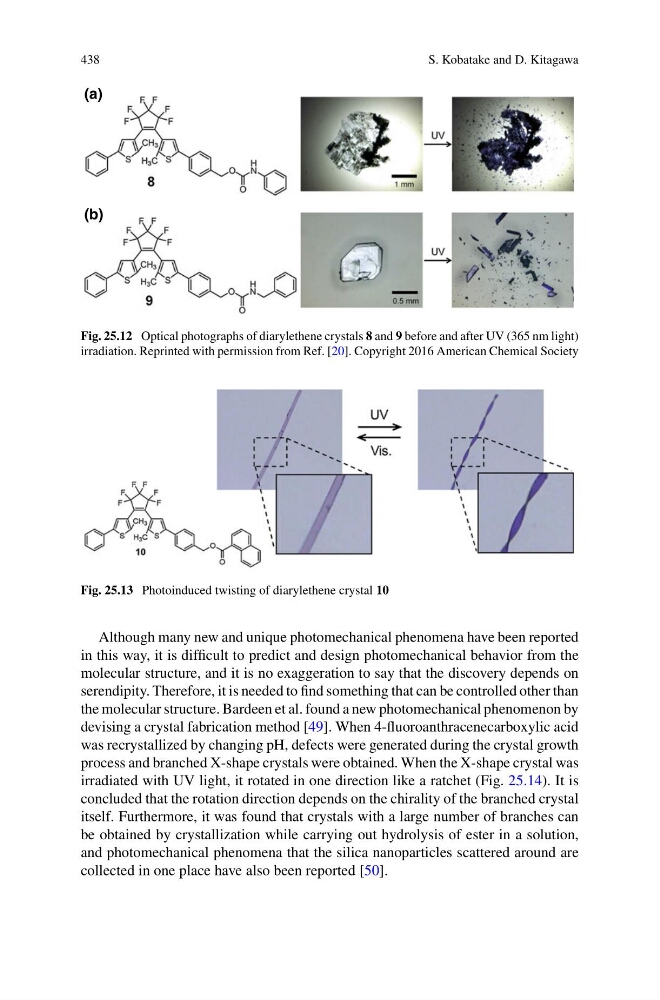
Fig. 25.12 Optical photographs of diarylethene crystals 8 and 9 before and after UV (365 nm light)
irradiation. Reprinted with permission from Ref. [20]. Copyright 2016 American Chemical Society
Fig. 25.13 Photoinduced twisting of diarylethene crystal 10
Although many new and unique photomechanical phenomena have been reported
in this way, it is difficult to predict and design photomechanical behavior from the
molecular structure, and it is no exaggeration to say that the discovery depends on
serendipity. Therefore, it is needed to find something that can be controlled other than
the molecular structure. Bardeen et al. found a new photomechanical phenomenon by
devising a crystal fabrication method [49]. When 4-fluoroanthracenecarboxylic acid
was recrystallized by changing pH, defects were generated during the crystal growth
process and branched X-shape crystals were obtained. When the X-shape crystal was
irradiated with UV light, it rotated in one direction like a ratchet (Fig. 25.14). It is
concluded that the rotation direction depends on the chirality of the branched crystal
itself. Furthermore, it was found that crystals with a large number of branches can
be obtained by crystallization while carrying out hydrolysis of ester in a solution,
and photomechanical phenomena that the silica nanoparticles scattered around are
collected in one place have also been reported [50].
S. Kobatake and D. Kitagawa
(a)
(b)
Fig. 25.12 Optical photographs of diarylethene crystals 8 and 9 before and after UV (365 nm light)
irradiation. Reprinted with permission from Ref. [20]. Copyright 2016 American Chemical Society
Fig. 25.13 Photoinduced twisting of diarylethene crystal 10
Although many new and unique photomechanical phenomena have been reported
in this way, it is difficult to predict and design photomechanical behavior from the
molecular structure, and it is no exaggeration to say that the discovery depends on
serendipity. Therefore, it is needed to find something that can be controlled other than
the molecular structure. Bardeen et al. found a new photomechanical phenomenon by
devising a crystal fabrication method [49]. When 4-fluoroanthracenecarboxylic acid
was recrystallized by changing pH, defects were generated during the crystal growth
process and branched X-shape crystals were obtained. When the X-shape crystal was
irradiated with UV light, it rotated in one direction like a ratchet (Fig. 25.14). It is
concluded that the rotation direction depends on the chirality of the branched crystal
itself. Furthermore, it was found that crystals with a large number of branches can
be obtained by crystallization while carrying out hydrolysis of ester in a solution,
and photomechanical phenomena that the silica nanoparticles scattered around are
collected in one place have also been reported [50].