

25 Photoresponsive Molecular Crystals …
441
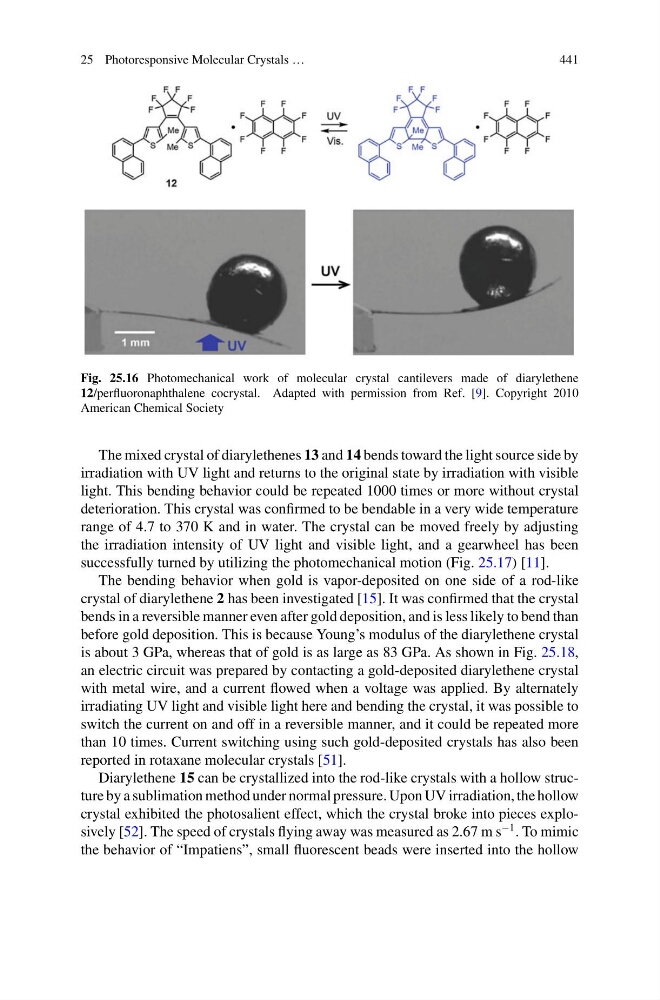
Fig. 25.16 Photomechanical work of molecular crystal cantilevers made of diarylethene
12/perfluoronaphthalene cocrystal. Adapted with permission from Ref. [9]. Copyright 2010
American Chemical Society
The mixed crystal of diarylethenes 13 and 14 bends toward the light source side by
irradiation with UV light and returns to the original state by irradiation with visible
light. This bending behavior could be repeated 1000 times or more without crystal
deterioration. This crystal was confirmed to be bendable in a very wide temperature
range of 4.7 to 370 K and in water. The crystal can be moved freely by adjusting
the irradiation intensity of UV light and visible light, and a gearwheel has been
successfully turned by utilizing the photomechanical motion (Fig. 25.17) [11].
The bending behavior when gold is vapor-deposited on one side of a rod-like
crystal of diarylethene 2 has been investigated [15]. It was confirmed that the crystal
bends in a reversible manner even after gold deposition, and is less likely to bend than
before gold deposition. This is because Young’s modulus of the diarylethene crystal
is about 3 GPa, whereas that of gold is as large as 83 GPa. As shown in Fig. 25.18,
an electric circuit was prepared by contacting a gold-deposited diarylethene crystal
with metal wire, and a current flowed when a voltage was applied. By alternately
irradiating UV light and visible light here and bending the crystal, it was possible to
switch the current on and off in a reversible manner, and it could be repeated more
than 10 times. Current switching using such gold-deposited crystals has also been
reported in rotaxane molecular crystals [51].
Diarylethene 15 can be crystallized into the rod-like crystals with a hollow structure by a sublimation method under normal pressure. Upon UV irradiation, the hollow
crystal exhibited the photosalient effect, which the crystal broke into pieces explosively [52]. The speed of crystals flying away was measured as 2.67 m s
−1 . To mimic
the behavior of “Impatiens”, small fluorescent beads were inserted into the hollow
441
Fig. 25.16 Photomechanical work of molecular crystal cantilevers made of diarylethene
12/perfluoronaphthalene cocrystal. Adapted with permission from Ref. [9]. Copyright 2010
American Chemical Society
The mixed crystal of diarylethenes 13 and 14 bends toward the light source side by
irradiation with UV light and returns to the original state by irradiation with visible
light. This bending behavior could be repeated 1000 times or more without crystal
deterioration. This crystal was confirmed to be bendable in a very wide temperature
range of 4.7 to 370 K and in water. The crystal can be moved freely by adjusting
the irradiation intensity of UV light and visible light, and a gearwheel has been
successfully turned by utilizing the photomechanical motion (Fig. 25.17) [11].
The bending behavior when gold is vapor-deposited on one side of a rod-like
crystal of diarylethene 2 has been investigated [15]. It was confirmed that the crystal
bends in a reversible manner even after gold deposition, and is less likely to bend than
before gold deposition. This is because Young’s modulus of the diarylethene crystal
is about 3 GPa, whereas that of gold is as large as 83 GPa. As shown in Fig. 25.18,
an electric circuit was prepared by contacting a gold-deposited diarylethene crystal
with metal wire, and a current flowed when a voltage was applied. By alternately
irradiating UV light and visible light here and bending the crystal, it was possible to
switch the current on and off in a reversible manner, and it could be repeated more
than 10 times. Current switching using such gold-deposited crystals has also been
reported in rotaxane molecular crystals [51].
Diarylethene 15 can be crystallized into the rod-like crystals with a hollow structure by a sublimation method under normal pressure. Upon UV irradiation, the hollow
crystal exhibited the photosalient effect, which the crystal broke into pieces explosively [52]. The speed of crystals flying away was measured as 2.67 m s
−1 . To mimic
the behavior of “Impatiens”, small fluorescent beads were inserted into the hollow