

25 Photoresponsive Molecular Crystals …
435
in crystal length, which was clarified by differential scanning calorimetry measurement, X-ray crystallographic analysis, and direct microscopic observation of the
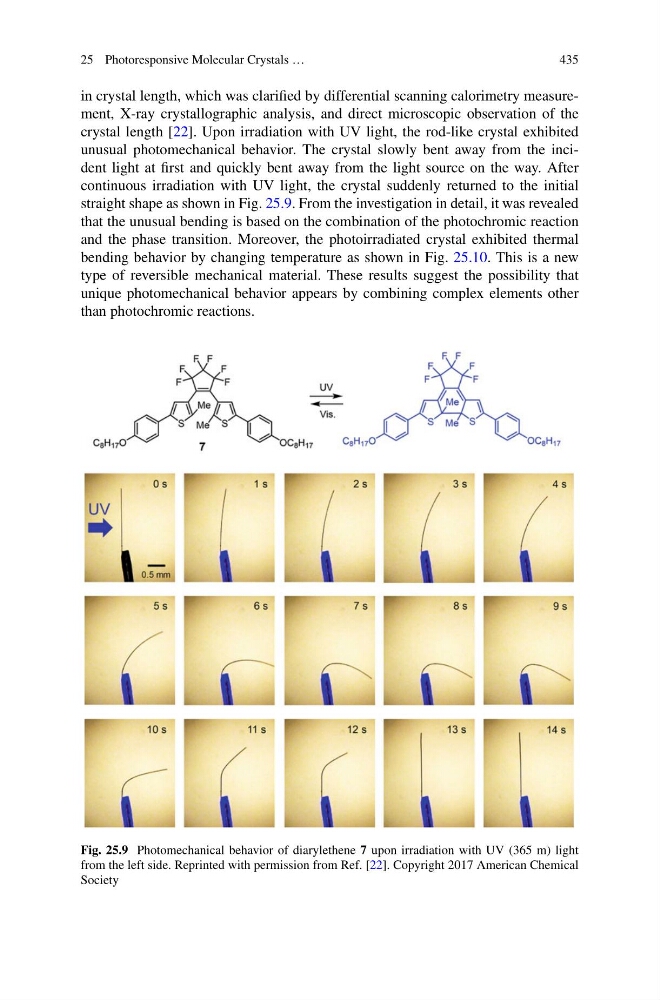
crystal length [22]. Upon irradiation with UV light, the rod-like crystal exhibited
unusual photomechanical behavior. The crystal slowly bent away from the incident light at first and quickly bent away from the light source on the way. After
continuous irradiation with UV light, the crystal suddenly returned to the initial
straight shape as shown in Fig. 25.9. From the investigation in detail, it was revealed
that the unusual bending is based on the combination of the photochromic reaction
and the phase transition. Moreover, the photoirradiated crystal exhibited thermal
bending behavior by changing temperature as shown in Fig. 25.10. This is a new
type of reversible mechanical material. These results suggest the possibility that
unique photomechanical behavior appears by combining complex elements other
than photochromic reactions.
Fig. 25.9 Photomechanical behavior of diarylethene 7 upon irradiation with UV (365 m) light
from the left side. Reprinted with permission from Ref. [22]. Copyright 2017 American Chemical
Society
435
in crystal length, which was clarified by differential scanning calorimetry measurement, X-ray crystallographic analysis, and direct microscopic observation of the
crystal length [22]. Upon irradiation with UV light, the rod-like crystal exhibited
unusual photomechanical behavior. The crystal slowly bent away from the incident light at first and quickly bent away from the light source on the way. After
continuous irradiation with UV light, the crystal suddenly returned to the initial
straight shape as shown in Fig. 25.9. From the investigation in detail, it was revealed
that the unusual bending is based on the combination of the photochromic reaction
and the phase transition. Moreover, the photoirradiated crystal exhibited thermal
bending behavior by changing temperature as shown in Fig. 25.10. This is a new
type of reversible mechanical material. These results suggest the possibility that
unique photomechanical behavior appears by combining complex elements other
than photochromic reactions.
Fig. 25.9 Photomechanical behavior of diarylethene 7 upon irradiation with UV (365 m) light
from the left side. Reprinted with permission from Ref. [22]. Copyright 2017 American Chemical
Society