

434
S. Kobatake and D. Kitagawa
(a)
(b)
(c)
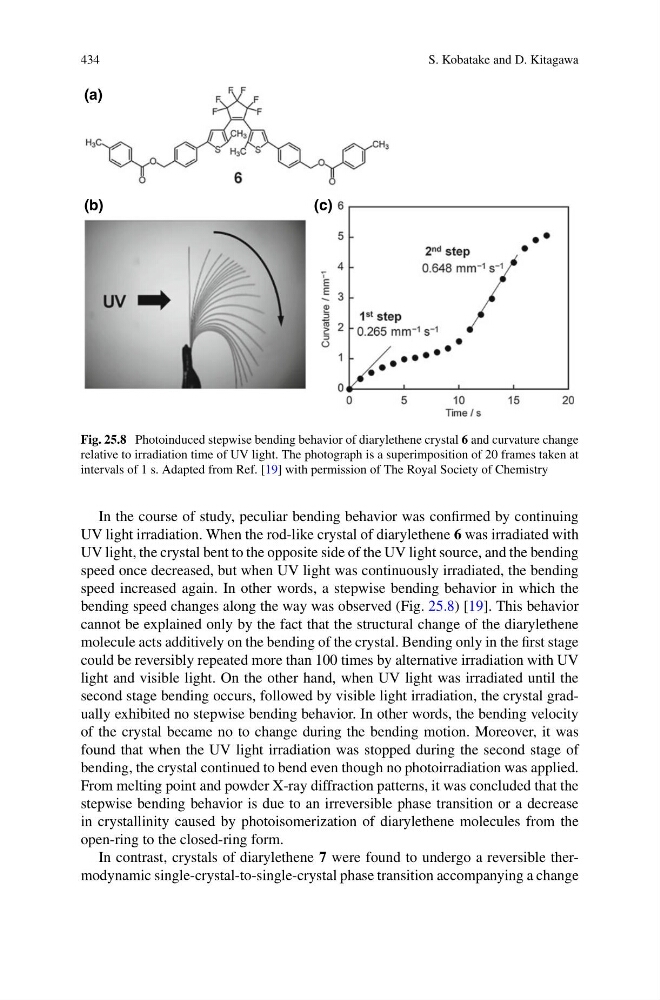
Fig. 25.8 Photoinduced stepwise bending behavior of diarylethene crystal 6 and curvature change
relative to irradiation time of UV light. The photograph is a superimposition of 20 frames taken at
intervals of 1 s. Adapted from Ref. [19] with permission of The Royal Society of Chemistry
In the course of study, peculiar bending behavior was confirmed by continuing
UV light irradiation. When the rod-like crystal of diarylethene 6 was irradiated with
UV light, the crystal bent to the opposite side of the UV light source, and the bending
speed once decreased, but when UV light was continuously irradiated, the bending
speed increased again. In other words, a stepwise bending behavior in which the
bending speed changes along the way was observed (Fig. 25.8) [19]. This behavior
cannot be explained only by the fact that the structural change of the diarylethene
molecule acts additively on the bending of the crystal. Bending only in the first stage
could be reversibly repeated more than 100 times by alternative irradiation with UV
light and visible light. On the other hand, when UV light was irradiated until the
second stage bending occurs, followed by visible light irradiation, the crystal gradually exhibited no stepwise bending behavior. In other words, the bending velocity
of the crystal became no to change during the bending motion. Moreover, it was
found that when the UV light irradiation was stopped during the second stage of
bending, the crystal continued to bend even though no photoirradiation was applied.
From melting point and powder X-ray diffraction patterns, it was concluded that the
stepwise bending behavior is due to an irreversible phase transition or a decrease
in crystallinity caused by photoisomerization of diarylethene molecules from the
open-ring to the closed-ring form.
In contrast, crystals of diarylethene 7 were found to undergo a reversible thermodynamic single-crystal-to-single-crystal phase transition accompanying a change
S. Kobatake and D. Kitagawa
(a)
(b)
(c)
Fig. 25.8 Photoinduced stepwise bending behavior of diarylethene crystal 6 and curvature change
relative to irradiation time of UV light. The photograph is a superimposition of 20 frames taken at
intervals of 1 s. Adapted from Ref. [19] with permission of The Royal Society of Chemistry
In the course of study, peculiar bending behavior was confirmed by continuing
UV light irradiation. When the rod-like crystal of diarylethene 6 was irradiated with
UV light, the crystal bent to the opposite side of the UV light source, and the bending
speed once decreased, but when UV light was continuously irradiated, the bending
speed increased again. In other words, a stepwise bending behavior in which the
bending speed changes along the way was observed (Fig. 25.8) [19]. This behavior
cannot be explained only by the fact that the structural change of the diarylethene
molecule acts additively on the bending of the crystal. Bending only in the first stage
could be reversibly repeated more than 100 times by alternative irradiation with UV
light and visible light. On the other hand, when UV light was irradiated until the
second stage bending occurs, followed by visible light irradiation, the crystal gradually exhibited no stepwise bending behavior. In other words, the bending velocity
of the crystal became no to change during the bending motion. Moreover, it was
found that when the UV light irradiation was stopped during the second stage of
bending, the crystal continued to bend even though no photoirradiation was applied.
From melting point and powder X-ray diffraction patterns, it was concluded that the
stepwise bending behavior is due to an irreversible phase transition or a decrease
in crystallinity caused by photoisomerization of diarylethene molecules from the
open-ring to the closed-ring form.
In contrast, crystals of diarylethene 7 were found to undergo a reversible thermodynamic single-crystal-to-single-crystal phase transition accompanying a change