

436
S. Kobatake and D. Kitagawa
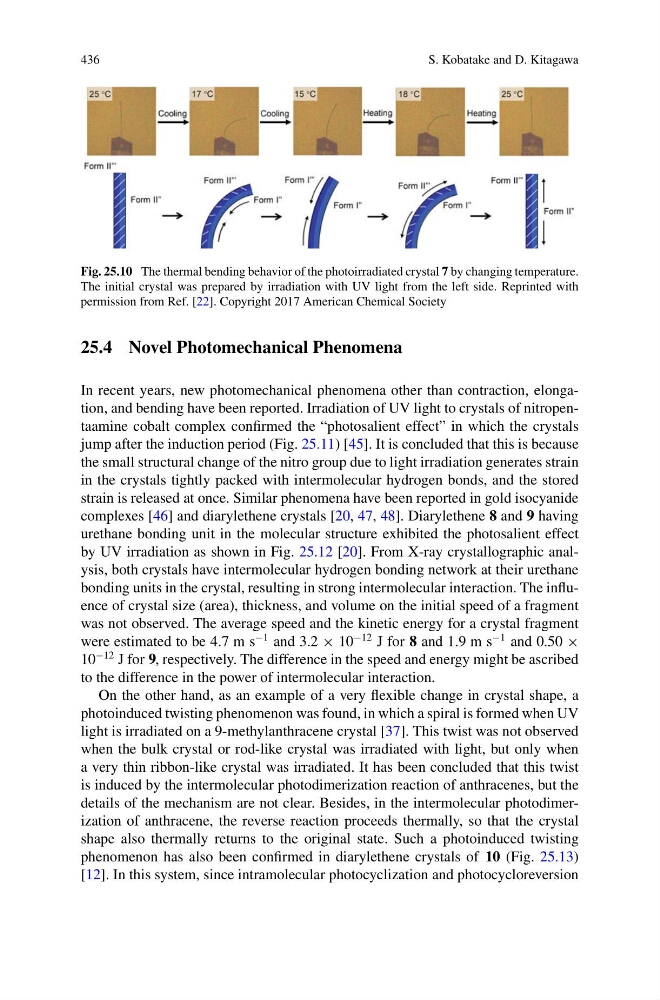
Fig. 25.10 The thermal bending behavior of the photoirradiated crystal 7 by changing temperature.
The initial crystal was prepared by irradiation with UV light from the left side. Reprinted with
permission from Ref. [22]. Copyright 2017 American Chemical Society
25.4 Novel Photomechanical Phenomena
In recent years, new photomechanical phenomena other than contraction, elongation, and bending have been reported. Irradiation of UV light to crystals of nitropentaamine cobalt complex confirmed the “photosalient effect” in which the crystals
jump after the induction period (Fig. 25.11) [45]. It is concluded that this is because
the small structural change of the nitro group due to light irradiation generates strain
in the crystals tightly packed with intermolecular hydrogen bonds, and the stored
strain is released at once. Similar phenomena have been reported in gold isocyanide
complexes [46] and diarylethene crystals [20, 47, 48]. Diarylethene 8 and 9 having
urethane bonding unit in the molecular structure exhibited the photosalient effect
by UV irradiation as shown in Fig. 25.12 [20]. From X-ray crystallographic analysis, both crystals have intermolecular hydrogen bonding network at their urethane
bonding units in the crystal, resulting in strong intermolecular interaction. The influence of crystal size (area), thickness, and volume on the initial speed of a fragment
was not observed. The average speed and the kinetic energy for a crystal fragment
were estimated to be 4.7 m s
−1 and 3.2 × 10
−12 J for 8 and 1.9 m s
−1 and 0.50 ×
10
−12 J for 9, respectively. The difference in the speed and energy might be ascribed
to the difference in the power of intermolecular interaction.
On the other hand, as an example of a very flexible change in crystal shape, a
photoinduced twisting phenomenon was found, in which a spiral is formed when UV
light is irradiated on a 9-methylanthracene crystal [37]. This twist was not observed
when the bulk crystal or rod-like crystal was irradiated with light, but only when
a very thin ribbon-like crystal was irradiated. It has been concluded that this twist
is induced by the intermolecular photodimerization reaction of anthracenes, but the
details of the mechanism are not clear. Besides, in the intermolecular photodimerization of anthracene, the reverse reaction proceeds thermally, so that the crystal
shape also thermally returns to the original state. Such a photoinduced twisting
phenomenon has also been confirmed in diarylethene crystals of 10 (Fig. 25.13)
[12]. In this system, since intramolecular photocyclization and photocycloreversion
S. Kobatake and D. Kitagawa
Fig. 25.10 The thermal bending behavior of the photoirradiated crystal 7 by changing temperature.
The initial crystal was prepared by irradiation with UV light from the left side. Reprinted with
permission from Ref. [22]. Copyright 2017 American Chemical Society
25.4 Novel Photomechanical Phenomena
In recent years, new photomechanical phenomena other than contraction, elongation, and bending have been reported. Irradiation of UV light to crystals of nitropentaamine cobalt complex confirmed the “photosalient effect” in which the crystals
jump after the induction period (Fig. 25.11) [45]. It is concluded that this is because
the small structural change of the nitro group due to light irradiation generates strain
in the crystals tightly packed with intermolecular hydrogen bonds, and the stored
strain is released at once. Similar phenomena have been reported in gold isocyanide
complexes [46] and diarylethene crystals [20, 47, 48]. Diarylethene 8 and 9 having
urethane bonding unit in the molecular structure exhibited the photosalient effect
by UV irradiation as shown in Fig. 25.12 [20]. From X-ray crystallographic analysis, both crystals have intermolecular hydrogen bonding network at their urethane
bonding units in the crystal, resulting in strong intermolecular interaction. The influence of crystal size (area), thickness, and volume on the initial speed of a fragment
was not observed. The average speed and the kinetic energy for a crystal fragment
were estimated to be 4.7 m s
−1 and 3.2 × 10
−12 J for 8 and 1.9 m s
−1 and 0.50 ×
10
−12 J for 9, respectively. The difference in the speed and energy might be ascribed
to the difference in the power of intermolecular interaction.
On the other hand, as an example of a very flexible change in crystal shape, a
photoinduced twisting phenomenon was found, in which a spiral is formed when UV
light is irradiated on a 9-methylanthracene crystal [37]. This twist was not observed
when the bulk crystal or rod-like crystal was irradiated with light, but only when
a very thin ribbon-like crystal was irradiated. It has been concluded that this twist
is induced by the intermolecular photodimerization reaction of anthracenes, but the
details of the mechanism are not clear. Besides, in the intermolecular photodimerization of anthracene, the reverse reaction proceeds thermally, so that the crystal
shape also thermally returns to the original state. Such a photoinduced twisting
phenomenon has also been confirmed in diarylethene crystals of 10 (Fig. 25.13)
[12]. In this system, since intramolecular photocyclization and photocycloreversion