

432
S. Kobatake and D. Kitagawa
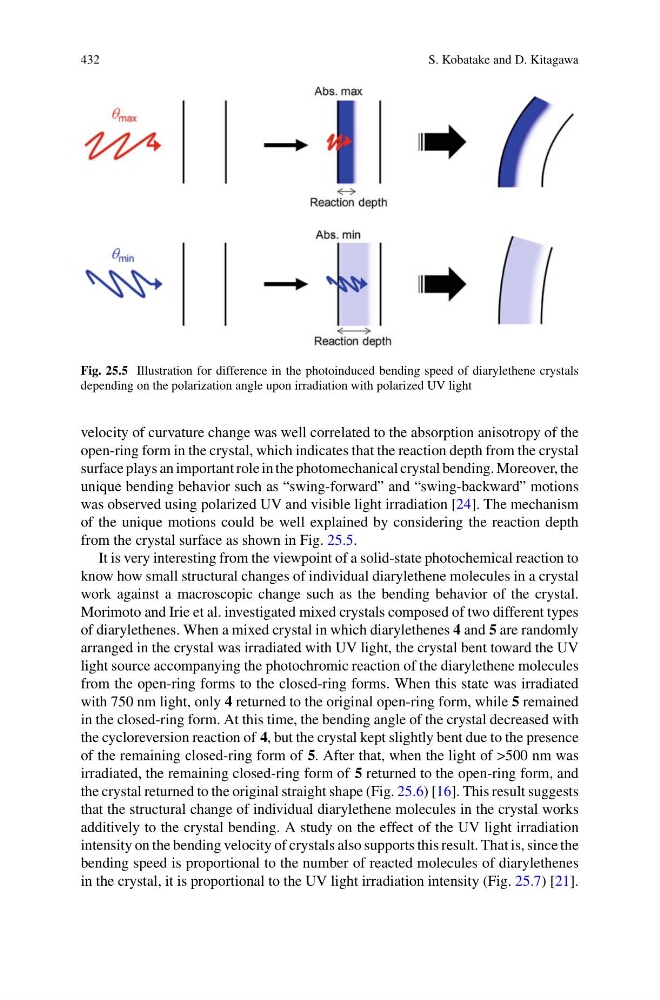
Fig. 25.5 Illustration for difference in the photoinduced bending speed of diarylethene crystals
depending on the polarization angle upon irradiation with polarized UV light
velocity of curvature change was well correlated to the absorption anisotropy of the
open-ring form in the crystal, which indicates that the reaction depth from the crystal
surface plays an important role in the photomechanical crystal bending. Moreover, the
unique bending behavior such as “swing-forward” and “swing-backward” motions
was observed using polarized UV and visible light irradiation [24]. The mechanism
of the unique motions could be well explained by considering the reaction depth
from the crystal surface as shown in Fig. 25.5.
It is very interesting from the viewpoint of a solid-state photochemical reaction to
know how small structural changes of individual diarylethene molecules in a crystal
work against a macroscopic change such as the bending behavior of the crystal.
Morimoto and Irie et al. investigated mixed crystals composed of two different types
of diarylethenes. When a mixed crystal in which diarylethenes 4 and 5 are randomly
arranged in the crystal was irradiated with UV light, the crystal bent toward the UV
light source accompanying the photochromic reaction of the diarylethene molecules
from the open-ring forms to the closed-ring forms. When this state was irradiated
with 750 nm light, only 4 returned to the original open-ring form, while 5 remained
in the closed-ring form. At this time, the bending angle of the crystal decreased with
the cycloreversion reaction of 4, but the crystal kept slightly bent due to the presence
of the remaining closed-ring form of 5. After that, when the light of >500 nm was
irradiated, the remaining closed-ring form of 5 returned to the open-ring form, and
the crystal returned to the original straight shape (Fig. 25.6) [16]. This result suggests
that the structural change of individual diarylethene molecules in the crystal works
additively to the crystal bending. A study on the effect of the UV light irradiation
intensity on the bending velocity of crystals also supports this result. That is, since the
bending speed is proportional to the number of reacted molecules of diarylethenes
in the crystal, it is proportional to the UV light irradiation intensity (Fig. 25.7) [21].
S. Kobatake and D. Kitagawa
Fig. 25.5 Illustration for difference in the photoinduced bending speed of diarylethene crystals
depending on the polarization angle upon irradiation with polarized UV light
velocity of curvature change was well correlated to the absorption anisotropy of the
open-ring form in the crystal, which indicates that the reaction depth from the crystal
surface plays an important role in the photomechanical crystal bending. Moreover, the
unique bending behavior such as “swing-forward” and “swing-backward” motions
was observed using polarized UV and visible light irradiation [24]. The mechanism
of the unique motions could be well explained by considering the reaction depth
from the crystal surface as shown in Fig. 25.5.
It is very interesting from the viewpoint of a solid-state photochemical reaction to
know how small structural changes of individual diarylethene molecules in a crystal
work against a macroscopic change such as the bending behavior of the crystal.
Morimoto and Irie et al. investigated mixed crystals composed of two different types
of diarylethenes. When a mixed crystal in which diarylethenes 4 and 5 are randomly
arranged in the crystal was irradiated with UV light, the crystal bent toward the UV
light source accompanying the photochromic reaction of the diarylethene molecules
from the open-ring forms to the closed-ring forms. When this state was irradiated
with 750 nm light, only 4 returned to the original open-ring form, while 5 remained
in the closed-ring form. At this time, the bending angle of the crystal decreased with
the cycloreversion reaction of 4, but the crystal kept slightly bent due to the presence
of the remaining closed-ring form of 5. After that, when the light of >500 nm was
irradiated, the remaining closed-ring form of 5 returned to the open-ring form, and
the crystal returned to the original straight shape (Fig. 25.6) [16]. This result suggests
that the structural change of individual diarylethene molecules in the crystal works
additively to the crystal bending. A study on the effect of the UV light irradiation
intensity on the bending velocity of crystals also supports this result. That is, since the
bending speed is proportional to the number of reacted molecules of diarylethenes
in the crystal, it is proportional to the UV light irradiation intensity (Fig. 25.7) [21].