

25 Photoresponsive Molecular Crystals …
431
with visible light (Fig. 25.1b). On the other hand, crystals that bend away from
the incident UV light have been reported. This means that the molecular packing of
diarylethene molecules in the crystal plays an important role in the bending direction.
Furthermore, such a bending behavior is observed when the thickness of the crystal
is about several µm, but the crystal does not bend when the thickness of the crystal is
increased. The dependence of the bending velocity on the crystal thickness has been
clarified by analysis using a bimetal model. Furthermore, by using Timoshenko’s
bimetal model analysis, it became possible to compare the bending speed between
crystals of different compounds.
Further detailed studies on the bending behavior using diarylethene crystals have
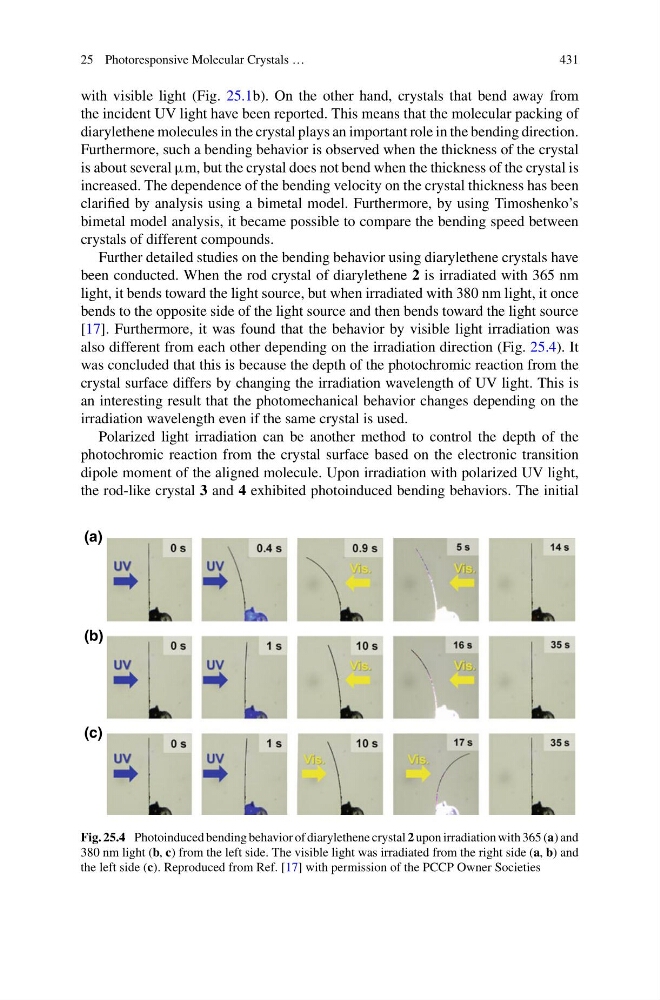
been conducted. When the rod crystal of diarylethene 2 is irradiated with 365 nm
light, it bends toward the light source, but when irradiated with 380 nm light, it once
bends to the opposite side of the light source and then bends toward the light source
[17]. Furthermore, it was found that the behavior by visible light irradiation was
also different from each other depending on the irradiation direction (Fig. 25.4). It
was concluded that this is because the depth of the photochromic reaction from the
crystal surface differs by changing the irradiation wavelength of UV light. This is
an interesting result that the photomechanical behavior changes depending on the
irradiation wavelength even if the same crystal is used.
Polarized light irradiation can be another method to control the depth of the
photochromic reaction from the crystal surface based on the electronic transition
dipole moment of the aligned molecule. Upon irradiation with polarized UV light,
the rod-like crystal 3 and 4 exhibited photoinduced bending behaviors. The initial
(a)
(b)
(c)
Fig. 25.4 Photoinduced bending behavior of diarylethene crystal 2 upon irradiation with 365 (a) and
380 nm light (b, c) from the left side. The visible light was irradiated from the right side (a, b) and
the left side (c). Reproduced from Ref. [17] with permission of the PCCP Owner Societies
431
with visible light (Fig. 25.1b). On the other hand, crystals that bend away from
the incident UV light have been reported. This means that the molecular packing of
diarylethene molecules in the crystal plays an important role in the bending direction.
Furthermore, such a bending behavior is observed when the thickness of the crystal
is about several µm, but the crystal does not bend when the thickness of the crystal is
increased. The dependence of the bending velocity on the crystal thickness has been
clarified by analysis using a bimetal model. Furthermore, by using Timoshenko’s
bimetal model analysis, it became possible to compare the bending speed between
crystals of different compounds.
Further detailed studies on the bending behavior using diarylethene crystals have
been conducted. When the rod crystal of diarylethene 2 is irradiated with 365 nm
light, it bends toward the light source, but when irradiated with 380 nm light, it once
bends to the opposite side of the light source and then bends toward the light source
[17]. Furthermore, it was found that the behavior by visible light irradiation was
also different from each other depending on the irradiation direction (Fig. 25.4). It
was concluded that this is because the depth of the photochromic reaction from the
crystal surface differs by changing the irradiation wavelength of UV light. This is
an interesting result that the photomechanical behavior changes depending on the
irradiation wavelength even if the same crystal is used.
Polarized light irradiation can be another method to control the depth of the
photochromic reaction from the crystal surface based on the electronic transition
dipole moment of the aligned molecule. Upon irradiation with polarized UV light,
the rod-like crystal 3 and 4 exhibited photoinduced bending behaviors. The initial
(a)
(b)
(c)
Fig. 25.4 Photoinduced bending behavior of diarylethene crystal 2 upon irradiation with 365 (a) and
380 nm light (b, c) from the left side. The visible light was irradiated from the right side (a, b) and
the left side (c). Reproduced from Ref. [17] with permission of the PCCP Owner Societies