

370
T. Fukaminato et al.
(a)
(b)
UV
Vis.
UV
Vis.
(c)
500
600
700
0
2500
5000
7500
10000
12500
Intensity / a.u.
Wavelength / nm
0 1 2 3 4 5 6 7 8 9 1 0
0.0
0.2
0.4
0.6
0.8
1.0
Normalized Intensity
Switching cycles
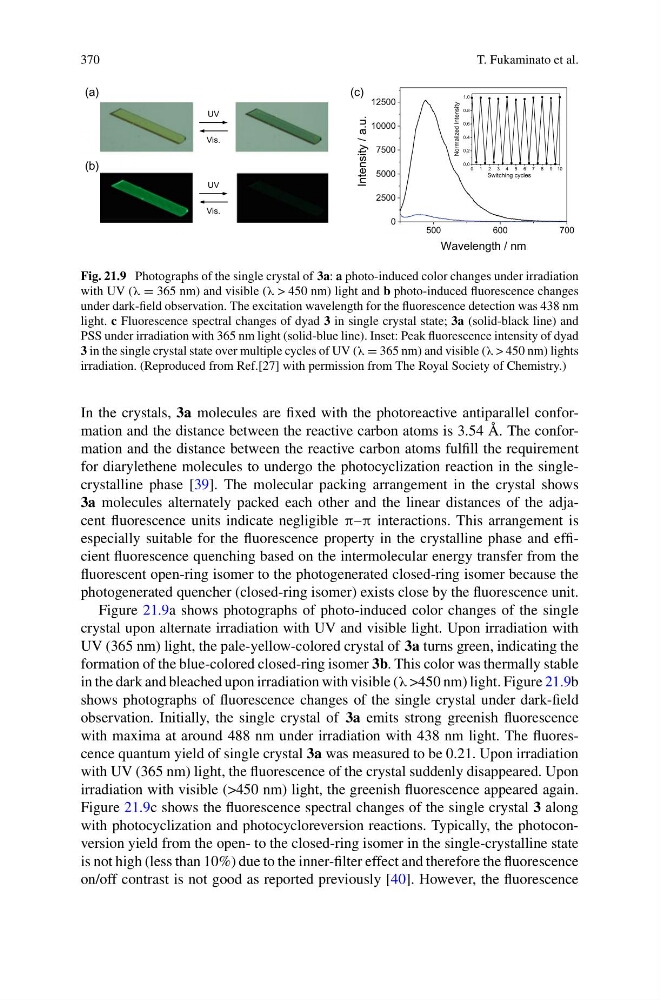
Fig. 21.9 Photographs of the single crystal of 3a: a photo-induced color changes under irradiation
with UV (λ = 365 nm) and visible (λ > 450 nm) light and b photo-induced fluorescence changes
under dark-field observation. The excitation wavelength for the fluorescence detection was 438 nm
light. c Fluorescence spectral changes of dyad 3 in single crystal state; 3a (solid-black line) and
PSS under irradiation with 365 nm light (solid-blue line). Inset: Peak fluorescence intensity of dyad
3 in the single crystal state over multiple cycles of UV (λ = 365 nm) and visible (λ > 450 nm) lights
irradiation. (Reproduced from Ref.[27] with permission from The Royal Society of Chemistry.)
In the crystals, 3a molecules are fixed with the photoreactive antiparallel conformation and the distance between the reactive carbon atoms is 3.54 Å. The conformation and the distance between the reactive carbon atoms fulfill the requirement
for diarylethene molecules to undergo the photocyclization reaction in the singlecrystalline phase [39]. The molecular packing arrangement in the crystal shows
3a molecules alternately packed each other and the linear distances of the adjacent fluorescence units indicate negligible π–π interactions. This arrangement is
especially suitable for the fluorescence property in the crystalline phase and efficient fluorescence quenching based on the intermolecular energy transfer from the
fluorescent open-ring isomer to the photogenerated closed-ring isomer because the
photogenerated quencher (closed-ring isomer) exists close by the fluorescence unit.
Figure 21.9a shows photographs of photo-induced color changes of the single
crystal upon alternate irradiation with UV and visible light. Upon irradiation with
UV (365 nm) light, the pale-yellow-colored crystal of 3a turns green, indicating the
formation of the blue-colored closed-ring isomer 3b. This color was thermally stable
in the dark and bleached upon irradiation with visible (λ >450 nm) light. Figure 21.9b
shows photographs of fluorescence changes of the single crystal under dark-field
observation. Initially, the single crystal of 3a emits strong greenish fluorescence
with maxima at around 488 nm under irradiation with 438 nm light. The fluorescence quantum yield of single crystal 3a was measured to be 0.21. Upon irradiation
with UV (365 nm) light, the fluorescence of the crystal suddenly disappeared. Upon
irradiation with visible (>450 nm) light, the greenish fluorescence appeared again.
Figure 21.9c shows the fluorescence spectral changes of the single crystal 3 along
with photocyclization and photocycloreversion reactions. Typically, the photoconversion yield from the open- to the closed-ring isomer in the single-crystalline state
is not high (less than 10%) due to the inner-filter effect and therefore the fluorescence
on/off contrast is not good as reported previously [40]. However, the fluorescence
T. Fukaminato et al.
(a)
(b)
UV
Vis.
UV
Vis.
(c)
500
600
700
0
2500
5000
7500
10000
12500
Intensity / a.u.
Wavelength / nm
0 1 2 3 4 5 6 7 8 9 1 0
0.0
0.2
0.4
0.6
0.8
1.0
Normalized Intensity
Switching cycles
Fig. 21.9 Photographs of the single crystal of 3a: a photo-induced color changes under irradiation
with UV (λ = 365 nm) and visible (λ > 450 nm) light and b photo-induced fluorescence changes
under dark-field observation. The excitation wavelength for the fluorescence detection was 438 nm
light. c Fluorescence spectral changes of dyad 3 in single crystal state; 3a (solid-black line) and
PSS under irradiation with 365 nm light (solid-blue line). Inset: Peak fluorescence intensity of dyad
3 in the single crystal state over multiple cycles of UV (λ = 365 nm) and visible (λ > 450 nm) lights
irradiation. (Reproduced from Ref.[27] with permission from The Royal Society of Chemistry.)
In the crystals, 3a molecules are fixed with the photoreactive antiparallel conformation and the distance between the reactive carbon atoms is 3.54 Å. The conformation and the distance between the reactive carbon atoms fulfill the requirement
for diarylethene molecules to undergo the photocyclization reaction in the singlecrystalline phase [39]. The molecular packing arrangement in the crystal shows
3a molecules alternately packed each other and the linear distances of the adjacent fluorescence units indicate negligible π–π interactions. This arrangement is
especially suitable for the fluorescence property in the crystalline phase and efficient fluorescence quenching based on the intermolecular energy transfer from the
fluorescent open-ring isomer to the photogenerated closed-ring isomer because the
photogenerated quencher (closed-ring isomer) exists close by the fluorescence unit.
Figure 21.9a shows photographs of photo-induced color changes of the single
crystal upon alternate irradiation with UV and visible light. Upon irradiation with
UV (365 nm) light, the pale-yellow-colored crystal of 3a turns green, indicating the
formation of the blue-colored closed-ring isomer 3b. This color was thermally stable
in the dark and bleached upon irradiation with visible (λ >450 nm) light. Figure 21.9b
shows photographs of fluorescence changes of the single crystal under dark-field
observation. Initially, the single crystal of 3a emits strong greenish fluorescence
with maxima at around 488 nm under irradiation with 438 nm light. The fluorescence quantum yield of single crystal 3a was measured to be 0.21. Upon irradiation
with UV (365 nm) light, the fluorescence of the crystal suddenly disappeared. Upon
irradiation with visible (>450 nm) light, the greenish fluorescence appeared again.
Figure 21.9c shows the fluorescence spectral changes of the single crystal 3 along
with photocyclization and photocycloreversion reactions. Typically, the photoconversion yield from the open- to the closed-ring isomer in the single-crystalline state
is not high (less than 10%) due to the inner-filter effect and therefore the fluorescence
on/off contrast is not good as reported previously [40]. However, the fluorescence