

21 Giant Amplification of Fluorescence Quenching in Photochromic …
369
21.5 Efficient Fluorescence Photoswitching in Single
Crystal
The amplification of fluorescence quenching is not limited to only in the nanoparticle system. Especially, the organic crystals in well-defined relative orientations and
distances may provide an ideal scaffold for efficient intermolecular energy transfer
compared to the randomly oriented amorphous nanoparticle systems. [36–38] In
order to realize further efficient fluorescence photoswitching systems, we tried to
make a crystal of dyad 1 under several recrystallization conditions. However, only
amorphous solids was obtained for dyad 1. It is well known that the triphenylamine
group is bulky-substituent and it can prevent strong π-π interaction between chromophores. Therefore, the derivatives having this substituent show highly fluorescence property even in the condensed solid state. However, such bulkiness of this
substituent is not suitable to prepare the regular packed molecular rearrangement in
the crystalline state.
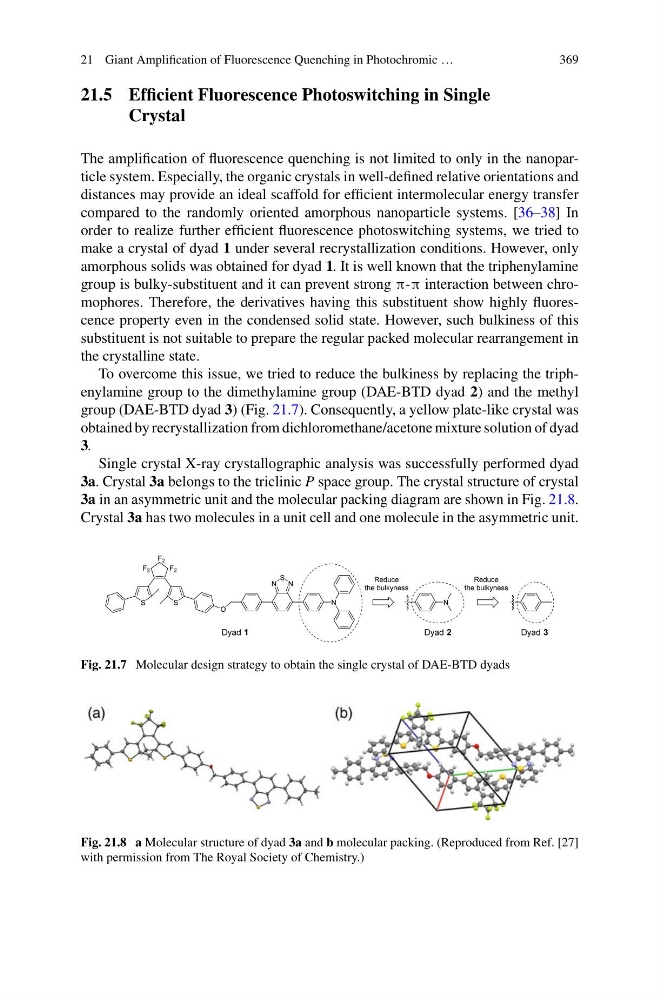
To overcome this issue, we tried to reduce the bulkiness by replacing the triphenylamine group to the dimethylamine group (DAE-BTD dyad 2) and the methyl
group (DAE-BTD dyad 3) (Fig. 21.7). Consequently, a yellow plate-like crystal was
obtained by recrystallization from dichloromethane/acetone mixture solution of dyad
3.
Single crystal X-ray crystallographic analysis was successfully performed dyad
3a. Crystal 3a belongs to the triclinic P space group. The crystal structure of crystal
3a in an asymmetric unit and the molecular packing diagram are shown in Fig. 21.8.
Crystal 3a has two molecules in a unit cell and one molecule in the asymmetric unit.
Fig. 21.7 Molecular design strategy to obtain the single crystal of DAE-BTD dyads
Fig. 21.8 a Molecular structure of dyad 3a and b molecular packing. (Reproduced from Ref. [27]
with permission from The Royal Society of Chemistry.)
369
21.5 Efficient Fluorescence Photoswitching in Single
Crystal
The amplification of fluorescence quenching is not limited to only in the nanoparticle system. Especially, the organic crystals in well-defined relative orientations and
distances may provide an ideal scaffold for efficient intermolecular energy transfer
compared to the randomly oriented amorphous nanoparticle systems. [36–38] In
order to realize further efficient fluorescence photoswitching systems, we tried to
make a crystal of dyad 1 under several recrystallization conditions. However, only
amorphous solids was obtained for dyad 1. It is well known that the triphenylamine
group is bulky-substituent and it can prevent strong π-π interaction between chromophores. Therefore, the derivatives having this substituent show highly fluorescence property even in the condensed solid state. However, such bulkiness of this
substituent is not suitable to prepare the regular packed molecular rearrangement in
the crystalline state.
To overcome this issue, we tried to reduce the bulkiness by replacing the triphenylamine group to the dimethylamine group (DAE-BTD dyad 2) and the methyl
group (DAE-BTD dyad 3) (Fig. 21.7). Consequently, a yellow plate-like crystal was
obtained by recrystallization from dichloromethane/acetone mixture solution of dyad
3.
Single crystal X-ray crystallographic analysis was successfully performed dyad
3a. Crystal 3a belongs to the triclinic P space group. The crystal structure of crystal
3a in an asymmetric unit and the molecular packing diagram are shown in Fig. 21.8.
Crystal 3a has two molecules in a unit cell and one molecule in the asymmetric unit.
Fig. 21.7 Molecular design strategy to obtain the single crystal of DAE-BTD dyads
Fig. 21.8 a Molecular structure of dyad 3a and b molecular packing. (Reproduced from Ref. [27]
with permission from The Royal Society of Chemistry.)